Simultaneous Equations – One Linear, One Quadratic (Leaving Cert Mathematics): Revision Notes
📚Revision Notes
Simultaneous Equations – One Linear, One Quadratic
What are simultaneous equations with one linear and one quadratic?
When we have a system of two equations where one equation is linear (degree 1) and one equation is quadratic (degree 2), we call these simultaneous equations with one linear and one quadratic. The goal is to find the values of x and y that satisfy both equations at the same time.
Note
These equations represent different shapes when graphed:
- Linear equations form straight lines (e.g., )
- Quadratic equations form curves like circles, parabolas, or hyperbolas (e.g., or )
The solutions represent the intersection points where the line meets the curve.
The substitution method
To solve these types of simultaneous equations, we use the method of substitution. This is the most effective approach when dealing with one linear and one quadratic equation.
Note
The substitution method works particularly well here because linear equations are easy to rearrange, and substituting into the quadratic equation creates a single-variable quadratic that we can solve using familiar techniques.
Step-by-step process
Step 1: From the linear equation, express one variable in terms of the other
- Choose the simpler variable to isolate (usually the one without a coefficient)
- For example: if , then
Step 2: Substitute this expression into the quadratic equation
- Replace the isolated variable in the quadratic equation
- Solve the resulting quadratic equation (usually by factorising)
- This gives you the values for one variable
Step 3: Find the corresponding values for the other variable
- Substitute each solution back into the linear equation
- This gives you the complete coordinate pairs
Worked examples
Example
Worked Example: Line and circle intersection
Problem: Solve the simultaneous equations:
- ... (1)
- ... (2)
Solution:
From equation (1):
Substituting for x in equation (2):
Expanding: Simplifying: Dividing by 2:
Factorising: Therefore: or
Finding the x-values:
- When :
- When :
The solutions are: and
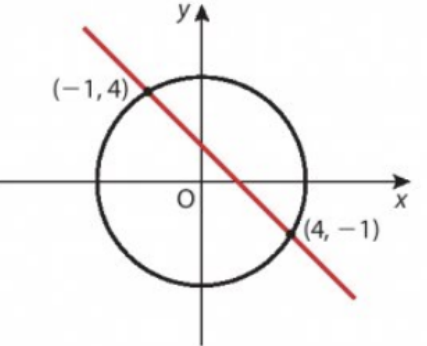
The diagram shows that represents a straight line and represents a circle. The intersection points (-1, 4) and (4, -1) are where the line crosses the circle.
Example
Worked Example: Line and parabola intersection
Problem: Find the coordinates of the intersection points A and B of the line and the curve .
Solution:
We have:
- ... (1)
- ... (2)
Substituting for y in equation (1):
Rearranging:
Factorising: Therefore: or
Finding the y-values using equation (2):
- When :
- When :
The line intersects the curve at points and
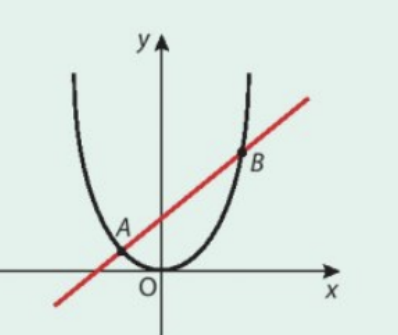
This diagram shows how a straight line can intersect a parabola at two distinct points.
Graphical interpretation
The number of solutions depends on how the line and curve interact:
- Two solutions: The line intersects the curve at two points (most common case)
- One solution: The line is tangent to the curve (touches at exactly one point)
- No real solutions: The line and curve don't intersect
Important
Always remember that the solutions you find algebraically correspond to actual points where the graphs intersect. If you get complex or no real solutions, this means the line and curve don't meet on the real coordinate plane.
Key formulas and concepts
Note
Essential equations to remember:
Circle equation: (where r is the radius) Parabola equation: or Linear equation: or
Important algebraic skills needed:
- Expanding brackets:
- Factorising quadratic expressions
- Solving quadratic equations
- Substitution techniques
Summary
Key Points to Remember:
- Always start with the linear equation when using substitution - it's much easier to rearrange
- Check your solutions by substituting back into both original equations
- Two intersection points are typical when a line crosses a curve
- The solutions represent coordinates where the line and curve meet on a graph
- Factorisation is usually the key to solving the resulting quadratic equation after substitution