Perimeter and Area of Triangles and Quadrilaterals (Leaving Cert Mathematics): Revision Notes
📚Revision Notes
Perimeter and Area of Triangles and Quadrilaterals
Understanding how to calculate the perimeter and area of geometric shapes is essential for solving many mathematical problems. The perimeter is the total distance around the outside edge of a shape, while the area measures the amount of space contained within the shape's boundaries.
Note
This topic builds on fundamental geometric concepts and provides the foundation for more advanced calculations involving composite shapes and real-world applications.
Fundamental formulas for regular shapes
The key to mastering area and perimeter calculations lies in understanding and memorising the standard formulas for common geometric shapes. Each shape has specific characteristics that determine how we calculate these measurements.
Rectangle
A rectangle is a four-sided shape with opposite sides that are equal in length and four right angles.
Important
Key formulas:
- Area = (length × breadth)
- Perimeter = (twice the sum of length and breadth)
To calculate the area of a rectangle, you multiply the length by the breadth. For the perimeter, you add the length and breadth together, then multiply by 2 since there are two of each side.
Square
A square is a special type of rectangle where all four sides are equal in length.
Important
Key formulas:
- Area = (side length squared)
- Perimeter = (four times the side length)
Since all sides of a square are equal, calculating the area means multiplying the side length by itself. The perimeter is simply four times the length of one side.
Triangle
A triangle is a three-sided polygon. To find its area, you need the base (any side of the triangle) and the height (the perpendicular distance from the base to the opposite vertex).
Important
Key formula:
- Area =
The triangle area formula tells us that the area is half the product of the base and height. The height must always be measured perpendicular to the base.
Parallelogram
A parallelogram is a four-sided shape with opposite sides that are parallel and equal in length.
Important
Key formulas:
- Area = (base × height)
- Perimeter = (twice the sum of adjacent sides)
For area calculation, use the base and the perpendicular height, not the slanted side length. The height is the shortest distance between the parallel sides.
Trapezium
A trapezium is a quadrilateral with exactly one pair of parallel sides. The parallel sides are called bases, and the perpendicular distance between them is the height.
Important
Key formulas:
- Area = where and are the parallel sides
- Perimeter = sum of all four sides
The trapezium area formula can be remembered as "half the sum of the parallel sides multiplied by the height". This formula works because a trapezium can be thought of as the average of the two parallel sides, multiplied by the height.
The Pythagorean theorem
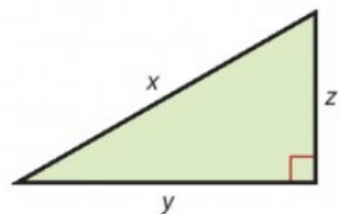
Many problems involving perimeter and area require the use of the Pythagorean theorem, which applies to right-angled triangles.
Important
The theorem states:
Where is the hypotenuse (longest side) and and are the other two sides.
This theorem is particularly useful when you need to find missing side lengths before calculating area or perimeter.
Worked examples
Example 1: Trapezium area calculation
Example
Worked Example: Trapezium Area Calculation
Let's calculate the area of a trapezium with parallel sides of 12 cm and 20 cm, and a height of 11 cm.
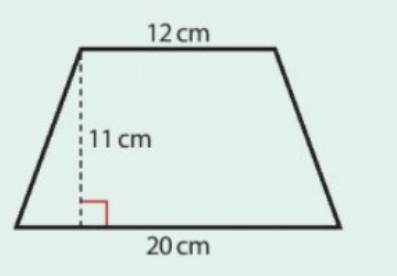
Using the formula: Area =
Step 1: Identify the values
- cm, cm, cm
Step 2: Substitute into the formula Area =
Step 3: Calculate step by step Area = Area = Area = 176 cm²
Example 2: Rectangle calculations
Example
Worked Example: Rectangle Calculations
For a rectangle measuring 8 cm by 6 cm:
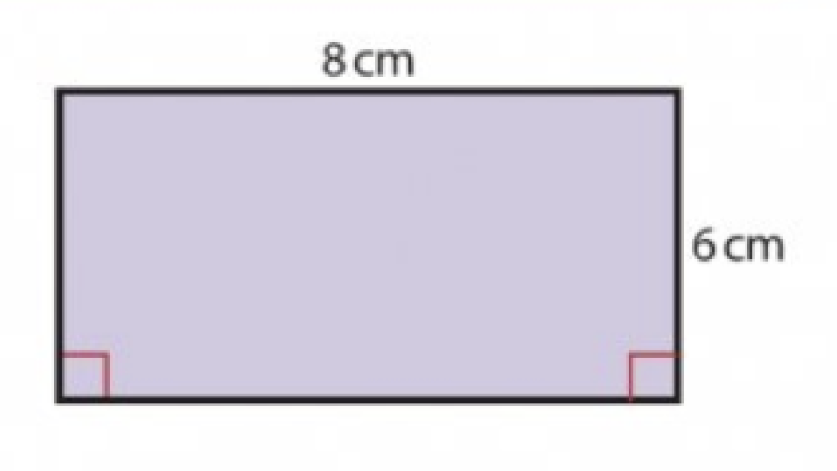
Area calculation: Area = 48 cm²
Perimeter calculation: Perimeter = 28 cm
Diagonal length using Pythagorean theorem: Diagonal = 10 cm
Example 3: Triangle area problems
Example
Worked Example: Finding Unknown Triangle Dimensions
When finding unknown dimensions in triangles, rearrange the area formula:
If Area = 24 square units and base = 8 units, find the height:
Step 1: Use the triangle area formula
Step 2: Simplify
Step 3: Solve for h 6 units
Example 4: Right triangle calculation
Example
Worked Example: Right Triangle Area
For a right triangle with base 6 cm and height 8.5 cm:
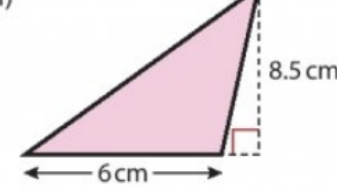
Area = 25.5 cm²
Example 5: Parallelogram calculation
Example
Worked Example: Parallelogram Area
For the parallelogram ABCD with base 14 cm and height 5 cm:
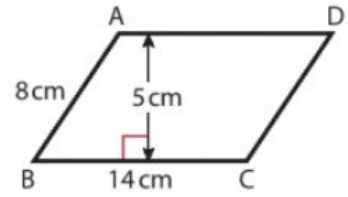
Area = base × height = 70 cm²
Problem-solving strategies
Note
Step-by-Step Problem-Solving Approach:
Step 1: Identify the shape type and what measurements you have.
Step 2: Choose the appropriate formula based on what you need to find.
Step 3: If any measurements are missing, use the Pythagorean theorem or rearrange formulas to find them.
Step 4: Substitute the values into the formula and calculate carefully.
Step 5: Check that your answer makes sense and includes the correct units.
Exam tips
Important
Essential Exam Tips:
- Always draw a quick sketch to visualise the problem
- Label known measurements clearly on your diagram
- For composite shapes, break them down into simpler shapes
- Remember that height in triangles and parallelograms must be perpendicular to the base
- Double-check your arithmetic, especially when working with fractions
- Include appropriate units in your final answer (cm², m², etc.)
Remember!
Summary
Key Points to Remember:
-
Perimeter measures the distance around a shape, while area measures the space inside it
-
Triangle area is always half base times height:
-
Rectangle area is length times breadth, and perimeter is
-
Trapezium area uses the average of parallel sides times height:
-
Pythagorean theorem () helps find missing sides in right triangles before calculating area or perimeter