The Cone (Leaving Cert Mathematics): Revision Notes
📚Revision Notes
The Cone
What is a cone?
A cone is a three-dimensional shape with a circular base that tapers smoothly to a single point called the vertex or apex. In mathematics, we typically work with right circular cones, where the vertex sits directly above the centre of the circular base.
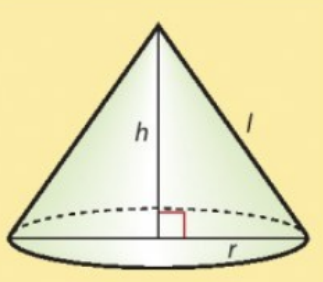
The cone has several key measurements that you need to understand:
Note
Essential Cone Measurements:
- Perpendicular height (h): The vertical distance from the vertex to the centre of the base
- Slant height (l): The distance from the vertex to any point on the edge of the base
- Radius (r): The distance from the centre of the base to its edge
These three measurements are fundamental to all cone calculations.
Key relationships
The three measurements of a cone are connected by Pythagoras' theorem:
This relationship is crucial because you often need to find one measurement when given the other two. The slant height forms the hypotenuse of a right triangle, with the perpendicular height and radius as the other two sides.
Important
Always use Pythagoras' theorem to find missing measurements before attempting volume or surface area calculations. This is one of the most common first steps in cone problems.
Essential formulas
There are three main formulas you must memorise for cone calculations:
Volume of a cone:
Curved surface area:
Total surface area of a solid cone:
The total surface area includes both the curved surface and the circular base.
Important
Critical Formula Distinction:
- The curved surface area uses the slant height (l)
- The volume uses the perpendicular height (h)
Many students mix these up in exams - always double-check which height you're using!
Worked example 1: Finding volume and curved surface area
Let's work through a typical exam problem step by step.
Example
Worked Example: Finding Volume and Curved Surface Area
Problem: The height of a cone is 12 cm and the radius of the base is 5 cm. Find correct to 1 decimal place: (i) the volume (ii) the curved surface area of the cone.
Solution:
First, we need to find the slant height using Pythagoras' theorem:
(i) Volume of cone:
(ii) Curved surface area:
Worked example 2: Composite shapes
Many exam questions involve composite shapes combining cones with cylinders or other shapes.
Example
Worked Example: Composite Rocket Ship Model
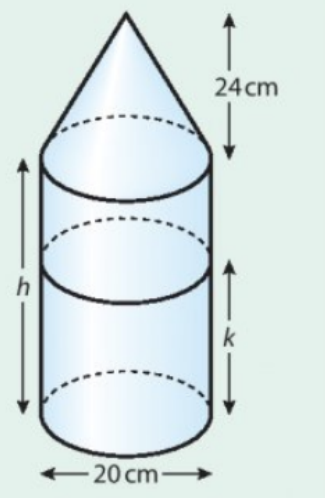
Problem: A rocket ship model consists of a solid cylinder and solid cone, both with circular base diameter 20 cm. The cone height is 24 cm. Find: (i) the volume of the cone in terms of π (ii) the height of the cylinder if its volume is 4 times the cone volume (iii) the value of k if the cylinder of height k has half the volume of the whole solid model.
Solution:
The radius is 10 cm (diameter ÷ 2).
(i) Volume of cone:
(ii) Finding cylinder height: If cylinder volume = 4 × cone volume:
Using cylinder volume formula:
(iii) Finding k: Total solid volume = cone volume + cylinder volume = 800π + 3200π = 4000π cm³
If cylinder of height k has half this volume:
Worked example 3: Using given measurements
Example
Worked Example: Finding Volume from Slant Height
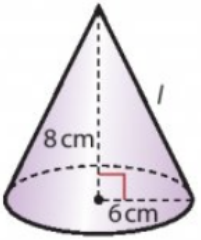
Problem: Find the volume of a cone with slant height 8 cm and base radius 6 cm.
Solution:
First find the perpendicular height using Pythagoras:
Now calculate volume:
Exam tips and common mistakes
Mastering cone problems requires both understanding the concepts and avoiding common pitfalls that catch many students.
Note
Key Exam Strategies:
- Always check whether you're given the height or slant height
- Use Pythagoras to find missing measurements before applying volume/area formulas
- Pay attention to whether answers should be in terms of π or as decimal approximations
- For composite shapes, calculate each part separately then combine
- Double-check your arithmetic, especially when squaring and taking square roots
Important
Common Mistakes to Avoid:
- Confusing height (h) and slant height (l) in formulas
- Forgetting to find missing measurements first
- Using diameter instead of radius in calculations
- Mixing up volume and surface area formulas
- Not showing clear working steps
These errors account for the majority of marks lost in cone problems!
Summary
Key Points to Remember:
- A right circular cone has its vertex directly above the centre of the circular base
- The relationship connects slant height, perpendicular height, and radius
- Volume formula: (uses perpendicular height)
- Curved surface area: (uses slant height)
- Total surface area: (curved surface plus base area)