Intersection of Two Lines (Leaving Cert Mathematics): Revision Notes
📚Revision Notes
Intersection of Two Lines
What is the intersection of two lines?
The intersection of two lines is the point where two lines meet or cross each other on a coordinate plane. This point has coordinates that satisfy both line equations simultaneously.
Note
When two lines intersect, they meet at exactly one point (unless they are parallel, in which case they never meet).
Finding the intersection point
There are two main methods to find where two lines intersect:
Method 1: Graphical method
You can find the intersection point by:
- Sketching both lines on the same coordinate grid
- Identifying where the lines cross
- Reading the coordinates of this crossing point
Note
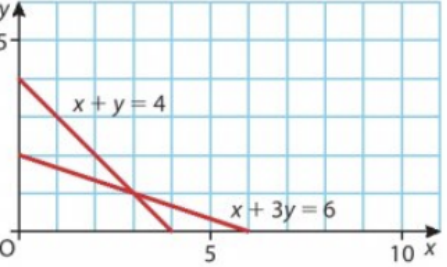
The diagram above shows the lines and . By looking at the graph, you can see they intersect at the point .
Method 2: Algebraic method using simultaneous equations
This method is more accurate and doesn't rely on drawing precise graphs. You solve the two equations together as a system of simultaneous equations.
Solving simultaneous equations
Important
Simultaneous equations are two or more equations that must be satisfied at the same time. The solution gives you the exact coordinates of the intersection point.
Step-by-step method:
- Write both equations clearly
- Use elimination or substitution to solve for one variable
- Substitute back to find the other variable
- Check your answer by substituting into both original equations
Worked examples
Example
Worked Example 1: Using elimination method
Find the intersection point of the lines:
Solution:
Adding equations ① and ②:
Substituting into equation ①:
The point of intersection is .
Example
Worked Example 2: Another elimination example
Find the intersection point of the lines:
Solution:
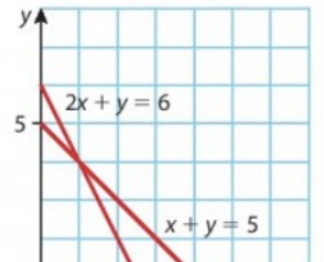
Subtracting equation ① from equation ②:
Substituting into equation ①:
The point of intersection is .
Example
Worked Example 3: Using substitution method
Find the intersection point of the lines:
Solution:
Substituting equation ① into equation ②:
Substituting into equation ①:
The point of intersection is .
Key techniques for solving simultaneous equations
Note
Elimination method:
- Add or subtract equations to eliminate one variable
- Best used when coefficients are easy to work with
- Look for opportunities where variables will cancel out
Substitution method:
- Solve one equation for one variable
- Substitute this expression into the other equation
- Best used when one equation is already solved for a variable
Checking your answer
Important
Always verify your solution by substituting the coordinates back into both original equations. If the point is correct, both equations should be satisfied.
For example, if you found the intersection point :
- Check in first equation: Does ? ✓
- Check in second equation: Does ? ✓
Note
Exam tips
- Show all working clearly - marks are awarded for method even if the final answer is wrong
- Check your arithmetic - simple calculation errors are common
- Always verify your answer by substituting back into both equations
- Be careful with signs when adding or subtracting equations
- Label your equations with numbers ① and ② to keep track
- State your final answer clearly in coordinate form
Summary
Key Points to Remember:
- The intersection of two lines is the point where they meet
- This point satisfies both line equations simultaneously
- You can find it graphically by sketching or algebraically using simultaneous equations
- Always check your answer by substituting back into both original equations
- Two non-parallel lines will always intersect at exactly one point