The Equation y = mx + c (Leaving Cert Mathematics): Revision Notes
📚Revision Notes
The Equation y = mx + c
What is the slope-intercept form?
The slope-intercept form of a line is one of the most important ways to express a linear equation. It is written as:
This form is extremely useful because it immediately reveals two key characteristics of any straight line. When we see an equation in this format, we can instantly identify both the steepness of the line and where it crosses the y-axis.
Note
The slope-intercept form is particularly valuable in coordinate geometry because it provides immediate visual information about a line's behaviour without requiring additional calculations.
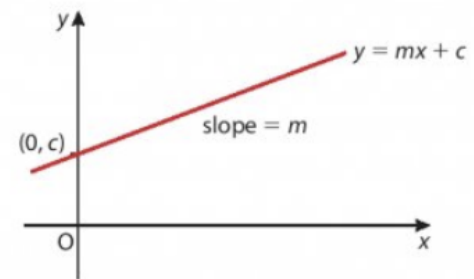
The slope-intercept form tells us that:
- The slope is m - this value determines how steep the line is
- The y-intercept is c - this is where the line crosses the y-axis at the point (0, c)
Understanding slope and y-intercept
Slope (m): The slope measures the rate at which the line rises or falls as we move from left to right across the graph. A positive slope indicates the line is increasing, while a negative slope shows the line is decreasing. The larger the absolute value of the slope, the steeper the line appears.
Y-intercept (c): This represents the exact point where our line intersects the y-axis. Since this intersection occurs when x equals zero, the y-intercept is always at the coordinates (0, c). This point is particularly useful for graphing lines quickly.
Note
Think of the y-intercept as the "starting point" of your line when reading a graph from left to right. It's where the line begins its journey across the coordinate plane.
Converting from general form to slope-intercept form
Many linear equations are initially presented in general form (such as axe + by + c = 0). To work effectively with these equations, we often need to rearrange them into slope-intercept form. This conversion process involves algebraic manipulation to isolate y on one side of the equation.
Important
Common Mistake Alert: When rearranging equations, be extremely careful with positive and negative signs. A single sign error will give you the wrong slope and y-intercept values.
The general method involves:
- Rearranging terms to get all y terms on one side
- Isolating y completely
- Identifying the coefficient of x as the slope and the constant term as the y-intercept
Example
Worked Example 1: Finding the Slope
Question: Find the slope of the line .
Solution: We need to rearrange this equation into the form .
Starting with:
Step 1: Move terms to isolate the y term (subtract 3x and add 9 to both sides)
Step 2: Multiply each term by -1 to make the y coefficient positive
Step 3: Divide every term by 2 to get y by itself
Therefore, comparing with , the slope of the line is .
Example
Worked Example 2: Perpendicular Lines
Question: Line has equation and line has equation . Show that is perpendicular to .
Solution: To prove the lines are perpendicular, we need to show that the product of their slopes equals -1.
Finding the slope of line :
Slope of
Finding the slope of line :
Slope of
Checking perpendicularity: Slope of × Slope of
Since the product of the slopes equals -1, the lines are perpendicular.
Example
Worked Example 3: Using Coordinate Points
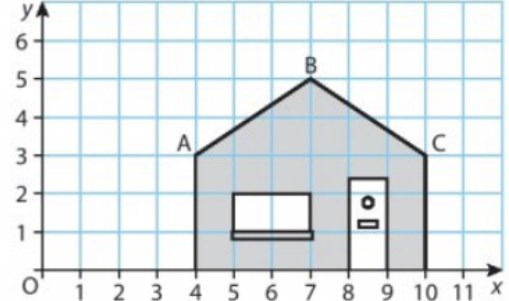
When working with coordinate geometry, we can use the slope-intercept form to find equations of lines passing through specific points.
Consider points A(4, 3) and B(7, 5) from the coordinate grid. To find the equation of line AB:
First, calculate the slope: Slope =
Now use the slope-intercept form with point A(4, 3):
Therefore, the equation of line AB is:
Key relationships between lines
Understanding the relationship between slopes helps us determine if lines are parallel or perpendicular.
Parallel lines: Two lines are parallel when they have identical slopes but different y-intercepts. If one line has slope , then any line parallel to it will also have slope .
Perpendicular lines: Two lines are perpendicular when the product of their slopes equals -1. If one line has slope , then a line perpendicular to it will have slope .
Note
A helpful way to remember perpendicular slopes: if one slope is a fraction, flip it and change the sign to get the perpendicular slope. For example, if one slope is , the perpendicular slope is .
Exam tips and common mistakes
Important
Critical Exam Tips:
- Always rearrange equations carefully, paying close attention to positive and negative signs
- Remember that the y-intercept occurs when x = 0, giving coordinates (0, c)
- For perpendicular lines, verify that the product of slopes equals exactly -1
- When converting from general form, ensure you completely isolate y
- Double-check your arithmetic, especially when working with fractions
- Show all working steps clearly in your solutions
Summary
Key Points to Remember:
- The equation immediately reveals the slope (m) and y-intercept (c)
- To convert from general form, rearrange algebraically to isolate y
- Parallel lines have identical slopes but different y-intercepts
- Perpendicular lines have slopes whose product equals -1
- The y-intercept is always at coordinates (0, c) where the line crosses the y-axis
- Be extra careful with signs when rearranging equations
- Always verify your final answer makes sense in the context of the problem