Quadratic Sequences (Leaving Cert Mathematics): Revision Notes
📚Revision Notes
Quadratic Sequences
What is a quadratic sequence?
Quadratic sequences are sequences where the nth term contains n² as the highest power. These sequences follow a specific pattern that can be identified using a mathematical technique called finding differences.
The general form of a quadratic sequence is:
where a, b, and c are constants, and a ≠ 0.
Key characteristic: constant second differences
Note
The most important feature that identifies a quadratic sequence is that the second differences are always constant. This means when you find the differences between consecutive terms, then find the differences of those differences, you get the same number throughout.
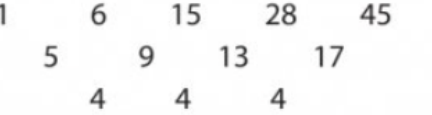
In the example above, the sequence 1, 6, 15, 28, 45 has:
- First differences: 5, 9, 13, 17
- Second differences: 4, 4, 4 (constant)
Since the second differences are constant, this confirms the sequence is quadratic.
The key rule for quadratic sequences
Important
Remember: In a quadratic sequence, the coefficient of n² in the nth term is half the second difference.
- If the second difference is 4, then the coefficient of n² is 2
- If the second difference is 6, then the coefficient of n² is 3
Finding the nth term formula
To find the formula for the nth term of a quadratic sequence, follow these steps:
Step 1: Create a differences table
Step 2: Use the general form
The nth term will be:
Where a = half the second difference
Step 3: Find the values of a, b, and c
Example
Worked Example: Finding the nth term
Find the nth term for the sequence: 3, 10, 21, 36
Solution:
Step 1: Find the differences:
- First differences: 7, 11, 15
- Second differences: 4, 4
Step 2: Since the second difference is 4: a = 4 ÷ 2 = 2
Step 3: So far we have:
Step 4: Use the first two terms to find b and c:
-
When n = 1:
-
So: b + c = 1 ... (equation 1)
-
When n = 2:
-
So: 2b + c = 2 ... (equation 2)
Step 5: Solve the simultaneous equations:
- From equation 1: b + c = 1
- From equation 2: 2b + c = 2
- Subtract: b = 1
- Substitute back: 1 + c = 1, so c = 0
Step 6: Therefore:
Pattern recognition in visual sequences
Quadratic sequences often appear in practical contexts, such as tiling patterns or geometric arrangements.
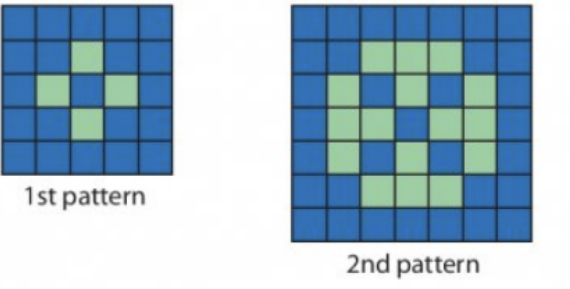
In the tiling example, we can see that:
- Pattern 1 has 21 blue tiles
- Pattern 2 has 33 blue tiles
To find the pattern, we would:
- Complete the table for patterns 3, 4, and 5
- Find the differences between consecutive terms
- Check if the second differences are constant
- Use the method above to find the nth term formula
Common exam tips
Note
Essential Exam Strategies:
- Always check second differences first - if they're constant, you have a quadratic sequence
- Remember the key relationship: coefficient of n² = ½ × second difference
- Show your working clearly in difference tables
- Substitute back to check your formula works for the original terms
- Watch out for sequences that might look quadratic but aren't - always verify with second differences
Example
Worked Example: Complete Solution
Find the nth term for: 5, 8, 13, 20, 29
Solution:
Step 1: Find the differences:
- First differences: 3, 5, 7, 9
- Second differences: 2, 2, 2
Step 2: Since second difference = 2, then a = 1
Step 3: Formula form:
Step 4: Using first two terms:
- , so b + c = 4
- , so 2b + c = 4
Step 5: Solving: b = 0, c = 4
Step 6: Therefore:
Summary
Key Points to Remember:
- Quadratic sequences have n² as the highest power in their nth term formula
- Second differences are constant in quadratic sequences - this is the key identifier
- The coefficient of n² equals half the second difference - use this rule to start finding the formula
- Always use a differences table to organise your working systematically
- Check your answer by substituting values back into your formula