Sequences from Shapes (Leaving Cert Mathematics): Revision Notes
📚Revision Notes
Sequences from Shapes
When we arrange objects like counters, matchsticks, or tiles in geometric patterns, we can create sequences — ordered lists of numbers that follow a specific rule. These visual patterns help us understand how mathematical sequences work and make it easier to find formulas for the nth term.
Note
Visual patterns using physical objects like counters and matchsticks provide an intuitive way to understand abstract mathematical concepts. This approach helps students see the underlying structure of sequences and makes formula derivation more meaningful.
Understanding sequences from geometric patterns
A sequence is a list of numbers arranged in a particular order, where each number is called a term. When we create patterns using shapes, we can count the objects in each design to form a sequence.
Important
The nth term is a formula that allows us to find any term in the sequence without having to draw all the previous patterns. This is essential for working with large design numbers efficiently.
Square number patterns
Square numbers are created when we arrange counters in square grids. These patterns form one of the most important sequences in mathematics.
The sequence begins: 1, 4, 9, 16, 25...
| Design number | 1 | 2 | 3 | 4 | 5 |
|---|---|---|---|---|---|
| Number of counters | 1 | 4 | 9 | 16 | 25 |
Key insight: Each term is the square of the design number.
Formula: For design number n, the number of counters = n²
So Tₙ = n²
Example
Worked Example: Square Patterns
Question: How many counters are needed for design 8?
Solution:
- Design number = 8
- Using the formula Tₙ = n²
- T₈ = 8² = 64
Therefore, 64 counters are needed for design 8.
L-shaped patterns
L-shaped patterns are created by arranging counters in an L formation. These create a different type of sequence.

Let's examine the pattern:
- Design 1: 1 counter
- Design 2: 3 counters
- Design 3: 5 counters
- Design 4: 7 counters
- Design 5: 9 counters
| Design number | 1 | 2 | 3 | 4 | 5 |
|---|---|---|---|---|---|
| Number of counters | 1 | 3 | 5 | 7 | 9 |
Pattern recognition: The sequence 1, 3, 5, 7, 9... consists of consecutive odd numbers.
Formula: Tₙ = 2n − 1
Example
Worked Example: L-shaped Patterns
Question: How many counters are needed for the 15th design?
Solution:
- Using the formula Tₙ = 2n − 1
- T₁₅ = 2(15) − 1 = 30 − 1 = 29
Therefore, 29 counters are needed for the 15th design.
Question: Which design uses exactly 99 counters?
Solution:
- Set Tₙ = 99
- 2n − 1 = 99
- 2n = 100
- n = 50
Therefore, design number 50 uses exactly 99 counters.
Triangular matchstick patterns
Triangular patterns are built using matchsticks to form connected triangular shapes.

These patterns show how triangular arrangements grow. The number of matchsticks needed depends on how the triangles are connected and arranged.
Note
Common pattern: For a sequence of connected triangles, each new triangle typically adds a fixed number of matchsticks to the total. The exact number depends on how many sides are shared between adjacent triangles.
House-shaped matchstick patterns
House patterns use matchsticks to create house-like structures.

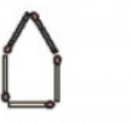
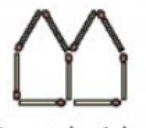
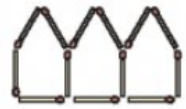
From the pattern, we can see:
- 1 house: 6 matchsticks
- 2 houses: 11 matchsticks
- 3 houses: 16 matchsticks
| Shape number | 1 | 2 | 3 | 4 | 5 |
|---|---|---|---|---|---|
| Number of matchsticks | 5 | 9 | ... | ... | ... |
Pattern analysis: The difference between consecutive terms is constant (usually 4 or 5 matchsticks per additional house).
Formula: Tₙ = 5n + 1 (for this specific house pattern)
Example
Worked Example: House Patterns
Question: How many matchsticks are needed for 10 houses?
Solution:
- Using the formula Tₙ = 5n + 1
- T₁₀ = 5(10) + 1 = 50 + 1 = 51
Therefore, 51 matchsticks are needed for 10 houses.
Square matchstick patterns
When creating squares with matchsticks, we need to consider how adjacent squares share common sides.

For connected squares:
- 1 square: 4 matchsticks
- 2 squares: 7 matchsticks
- 3 squares: 10 matchsticks
Pattern: Each additional square adds 3 matchsticks (since one side is shared).
Formula: Tₙ = 3n + 1
Cross and complex patterns
More complex geometric arrangements can create interesting sequences.
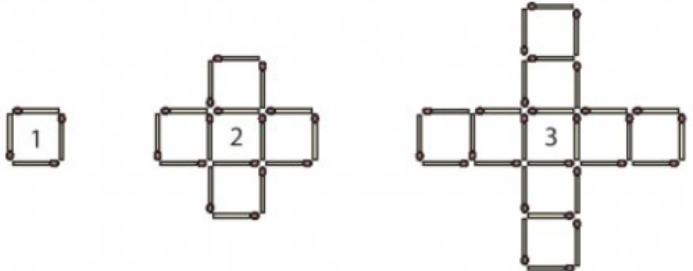
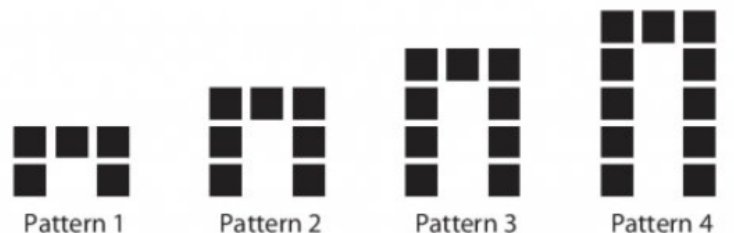
These patterns may involve:
- Cross-shaped arrangements
- T-shaped formations
- Other geometric configurations
Note
Each pattern type will have its own unique formula based on how the shapes are arranged and connected. The key is to identify the growth pattern by examining how many new elements are added with each additional design.
Problem-solving strategy
Note
Systematic Approach to Pattern Problems
When working with sequences from shapes:
- Draw or visualise the first few terms in the pattern
- Count carefully the number of objects in each design
- Look for differences between consecutive terms
- Identify the pattern (constant difference, squares, etc.)
- Write the formula for the nth term
- Check your formula by substituting back into known values
Important
Key Exam Tips
- Always check if a design number gives a whole number when solving for n
- If n is not a whole number, that design cannot exist in the pattern
- Square patterns use the formula Tₙ = n²
- Linear patterns typically use the formula Tₙ = an + b
- Draw diagrams when helpful to visualise the pattern
Summary
Key Points to Remember:
- Square patterns follow the formula Tₙ = n², giving the sequence 1, 4, 9, 16, 25...
- L-shaped patterns typically follow Tₙ = 2n − 1, giving odd numbers: 1, 3, 5, 7, 9...
- Linear growth patterns (like connected houses or squares) use formulas of the form Tₙ = an + b
- Always identify the pattern by looking at differences between consecutive terms
- Check your answers by substituting back into the original pattern to verify correctness