Collecting Data (Leaving Cert Mathematics): Revision Notes
📚Revision Notes
Collecting Data
Data is gathered for many different reasons and from various sources. Companies conduct market research to understand customer preferences and test new product ideas. The government carries out a national census every five years, and local authorities use this information for planning purposes.
Data can be collected through surveys, experiments, interviews, and questionnaires. Before you start collecting data, you need to have a clear aim in mind and decide what type of data to collect and the most suitable method for collecting it.
Note
The choice of data collection method significantly impacts the quality, cost, and usefulness of your results. Taking time to plan your approach will save resources and improve outcomes.
Types of data collection
The data you collect can be divided into two main categories: primary data and secondary data.
Primary data
Primary data is information that is collected by an organisation or individual who is going to use it themselves.
Primary data is typically obtained through:
- Using questionnaires
- Carrying out experiments
- Conducting investigations
- Making observations and recording the results
Secondary data
Secondary data is information which is already available or has been collected by somebody else for a different purpose.
Secondary data is obtained from:
- The internet
- Published statistics and databases
- Tables and charts in newspapers and magazines
Important
Critical Distinction: The key difference is who collected the data and for what purpose. Primary data is collected by you for your specific needs, while secondary data was collected by others for their purposes.
Comparing primary and secondary data
| Data | Advantages | Disadvantages |
|---|---|---|
| Primary data | - It is possible to collect exactly what you require - You know how it was collected - You know from whom it was collected | - Expensive - Time consuming |
| Secondary data | - Cheap to obtain - Easy to obtain | - Method of collection unknown - May be out of date - May not be exactly what is required |
Note
When deciding between primary and secondary data, consider your budget, timeline, and how precisely the data needs to match your specific requirements. Sometimes a combination of both types can be most effective.
Survey methods
Surveys are particularly useful for collecting personal information from people. There are several main survey methods, each with their own strengths and weaknesses.
The main survey methods include:
- Postal surveys where people are asked questions by post
- Personal interviews where people are asked questions face-to-face (widely used in market research)
- Telephone surveys where the interview is conducted by phone
- Observation which involves monitoring behaviour or information
Comparison of survey methods
| Survey method | Advantages | Disadvantages |
|---|---|---|
| Observation | Systematic and mechanical | Results are prone to chance |
| Personal interview and telephone survey | Many questions can be asked High response rate | Expensive Interviewer may influence responses |
| Postal survey | Relatively cheap Large amounts of data can be collected | Limited in the type of data that can be collected Poor response rate |
Important
Survey Method Selection: Choose your survey method based on your budget, the complexity of questions you need to ask, and your target response rate. Personal interviews give the best quality data but are the most expensive.
Worked example 1: Choosing a survey method
Example
Worked Example: Choosing a Survey Method
A businessman is considering building a leisure centre in the town centre. Which method of collecting primary data should he use to help him decide whether or not to build the leisure centre?
Solution: Data could be collected by using personal interviews or by doing a postal survey. The question "Would you use a leisure centre if it was available?" should be included in any method used.
This example shows how the choice of survey method depends on factors like cost, time available, and the type of information needed.
Experiments
Experiments are particularly useful for collecting scientific data. For example, drug companies carry out experiments to test whether a new drug has benefits or side-effects.
When you carry out an experiment, you can use a data capture sheet to record your results systematically.
Worked example 2: Recording experimental data
Example
Worked Example: Recording Experimental Data
Derek has a six-sided dice. He throws it 60 times and records his results in a data capture sheet.
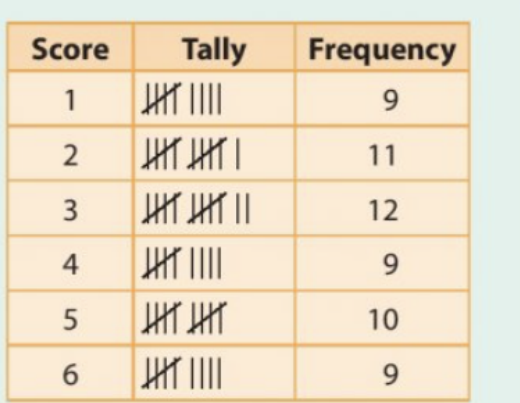
Derek expects that each number on the dice should appear 10 times. He concludes that the dice is fair as all the frequencies are close enough to 10.
This example demonstrates how experiments can be used to test hypotheses and how data capture sheets help organise results clearly.
Summary
Key Points to Remember:
- Primary data is collected by you for your specific purpose, whilst secondary data is collected by someone else
- Primary data is more expensive and time-consuming but gives you exactly what you need
- Secondary data is cheaper and quicker to obtain but may not be exactly what you require
- Different survey methods have different advantages - choose based on your budget, time, and data requirements
- Experiments are ideal for testing scientific hypotheses and require systematic data recording