Series and Parallel Circuits (Leaving Cert Physics): Revision Notes
📚Revision Notes
Series and Parallel Circuits
Series circuits
A series circuit is one where components are connected end-to-end to form a single path. In the circuit shown below, the battery, two bulbs, and switch are all connected in sequence, creating just one route for electric current to follow.
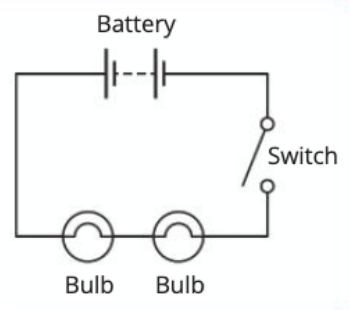
The most important characteristic of a series circuit is that the current is exactly the same at every point throughout the circuit. This happens because electric charge cannot appear or disappear at any point - it must be conserved.
Note
Think of it like water flowing through a single pipe - the same amount of water that enters one end must exit the other end. This analogy helps visualise why current must be identical throughout a series circuit.
When current flows out of the battery's positive terminal, it passes through each component one after another before returning to the battery's negative terminal. The size of the current flowing out of the battery is identical to the current flowing back into it, and it's the same as the current in each bulb.
This demonstrates the conservation of electric charge - charge cannot be created or destroyed in a circuit, only moved around.
Current at a junction of conductors
When several conductors meet at a single point, we call this meeting place a junction. The diagram below shows five conductors meeting at junction O.
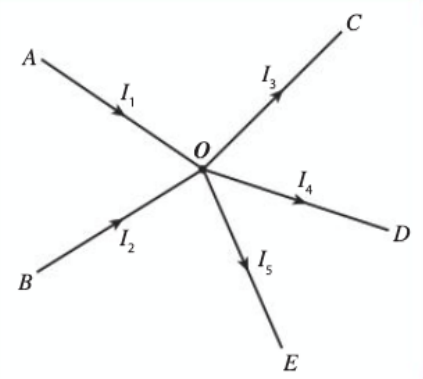
At any junction in an electrical circuit, there's a fundamental rule that governs current flow: the sum of the currents flowing into a junction equals the sum of the currents leaving the junction. This is known as Kirchhoff's Current Law.
Example
Worked Example: Junction Analysis
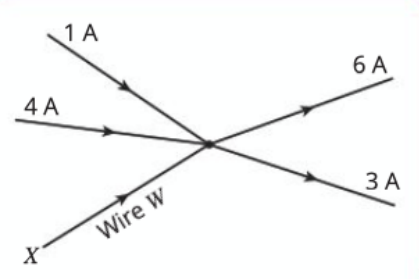
Let's see how this works in practice. In the junction shown above, we have currents of 1 A, 4 A, and 6 A flowing into the junction, while currents of 3 A and unknown value x flow out.
Using Kirchhoff's Current Law:
- Currents entering junction = A
- Currents leaving junction =
Since these must be equal:
Therefore: A
Important
This principle applies because electric charge cannot accumulate at a junction - whatever flows in must flow out. This is a direct consequence of charge conservation.
Parallel circuits
In a parallel circuit, the current has multiple paths to follow. At junction points, the current splits up, with some going through each available path.
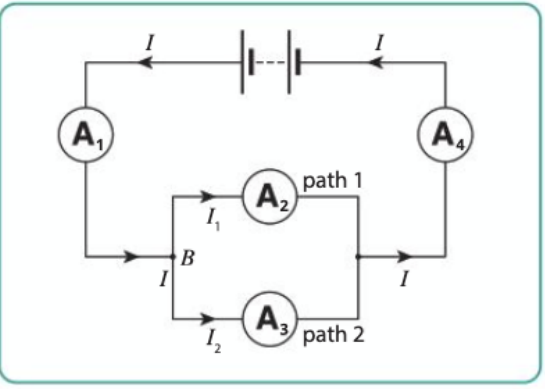
The key principle for parallel circuits is that the total current entering a parallel section equals the sum of the currents in each branch. This can be written as:
Where:
- = total current from the source
- = current through path 1
- = current through path 2
The current divides at point B in the diagram above, with each branch carrying part of the total current. When the branches reunite, the currents add back together to give the original total current.
Measuring current with an ammeter
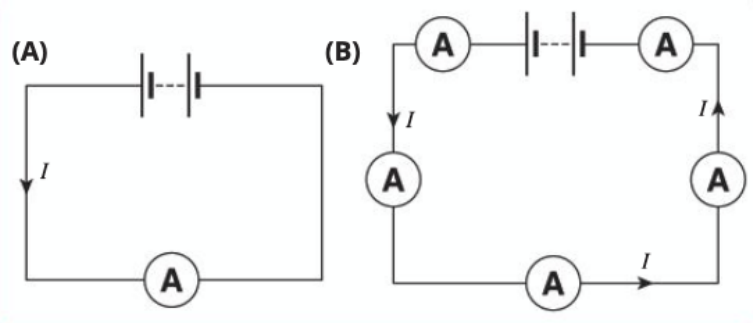
An ammeter is the instrument used to measure electric current in a circuit. However, there's a crucial rule about how to connect an ammeter properly.
Important
An ammeter must always be connected in series with the part of the circuit where you want to measure current. This means the ammeter becomes part of the current's path, allowing all the current to flow through it for measurement.
If you connected an ammeter in parallel (alongside a component), it would not measure the current through that component correctly and could damage the ammeter.
The diagrams above show correct ammeter placement. Notice that:
- In a series circuit, the ammeter can be placed anywhere since current is the same throughout
- The ammeter is inserted into the circuit path, not connected alongside it
- Multiple ammeters can be used to measure current at different points
Current splitting in parallel branches
When analysing parallel circuits, remember that current behaves like water flowing through branching pipes. At each junction, the total current splits between available paths, but the total amount is always conserved.
Note
A diagram may show how current splits into and at the junction. These individual currents then recombine after passing through their respective paths. The relationship always holds true, regardless of the resistance values in each branch.
Summary
Key Points to Remember:
-
Series circuits: Current is identical everywhere in the circuit - there's only one path for current to follow
-
Junction rule: Current flowing into any junction must equal current flowing out - charge cannot accumulate at junction points
-
Parallel circuits: Total current splits between branches, but the sum of branch currents equals the total current ()
-
Ammeter connection: Always connect ammeters in series with the component or circuit section where you want to measure current
-
Conservation principle: Electric charge cannot be created or destroyed in circuits - this fundamental law governs all current behaviour