The Principle of Conservation of Momentum (Leaving Cert Physics): Revision Notes
📚Revision Notes
The Principle of Conservation of Momentum
What is conservation of momentum?
When objects interact with each other - whether they collide, explode apart, or stick together - something very important happens: the total momentum of the system stays exactly the same. This fundamental law of physics is called the principle of conservation of momentum, and it's one of the most powerful tools we have for understanding motion.
Think about it this way: momentum can't just disappear or appear from nowhere. It can only be transferred from one object to another. This principle helps us predict what happens in collisions, explosions, and many other situations involving moving objects.
Note
Understanding momentum conservation is like understanding a cosmic accounting system - the books must always balance! What one object loses in momentum, another must gain.
The fundamental principle
Important
The Principle of Conservation of Momentum
The principle of conservation of momentum tells us that when two or more objects interact, their combined momentum before the interaction equals their combined momentum after the interaction - but only if no external forces are acting on the system.
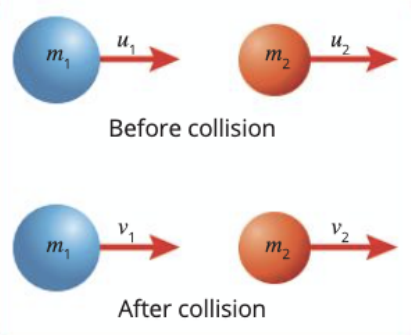
This means that in any collision or interaction between bodies, the total momentum remains constant. The individual objects might speed up, slow down, or change direction, but the total momentum of the system stays the same.
Key condition: This law only applies when no external forces act on the system. Internal forces (like the forces between colliding objects) don't change the total momentum - they only redistribute it between the objects.
Mathematical representation
We can express conservation of momentum mathematically. For two objects colliding:
Before collision: Object 1 has momentum , Object 2 has momentum After collision: Object 1 has momentum , Object 2 has momentum
The conservation equation is:
Where:
- , = masses of the objects
- , = initial velocities (before collision)
- , = final velocities (after collision)
This equation is your key tool for solving momentum problems. You can rearrange it to find any unknown quantity if you know the others.
Understanding collisions
When studying collisions, we need to consider several important points:
Direction matters: Momentum is a vector quantity, which means direction is crucial. If two objects move in opposite directions, their momenta have opposite signs.
Total momentum calculation: To find the total momentum of multiple objects, we add up all individual momenta, taking direction into account.
System analysis: Always identify your system clearly. The conservation law applies to the complete system, not individual objects within it.
Note
Remember the Vector Nature
Since momentum is a vector, you must always consider both magnitude and direction. This is why we use positive and negative signs to indicate opposite directions in our calculations.
Types of momentum problems
You'll encounter several types of momentum conservation problems:
Collision problems: Two objects collide and either stick together or bounce apart. Use the conservation equation to find unknown velocities or masses.
Explosion problems: One object breaks apart into multiple pieces. The initial momentum (often zero) equals the sum of final momenta.
Recoil problems: When one object is ejected from another (like a bullet from a gun), both objects gain momentum in opposite directions.
Worked examples from collisions
Let's look at some practical applications of momentum conservation:
Example
Worked Example 1: Collision and Sticking
A 20 kg mass moving at 4 m/s collides with a 14 kg mass at rest. After collision, they stick together. Find the final velocity.
Step 1: Identify the known values
- kg, m/s
- kg, m/s (at rest)
- Final mass = kg (stuck together)
Step 2: Apply conservation of momentum
Step 3: Solve for final velocity m/s in the direction of the original 20 kg mass
Example
Worked Example 2: Collision with Separation
A 4 kg mass moving at 5 m/s collides with a 20 kg mass moving at 20 m/s in the opposite direction. After collision, the 4 kg mass moves at 0.86 m/s. Find the final velocity of the 20 kg mass.
Step 1: Set up the conservation equation with correct signs Taking the 4 kg mass direction as positive:
Step 2: Solve algebraically m/s
The 20 kg mass continues in its original direction at 19.17 m/s.
Vector analysis in momentum problems
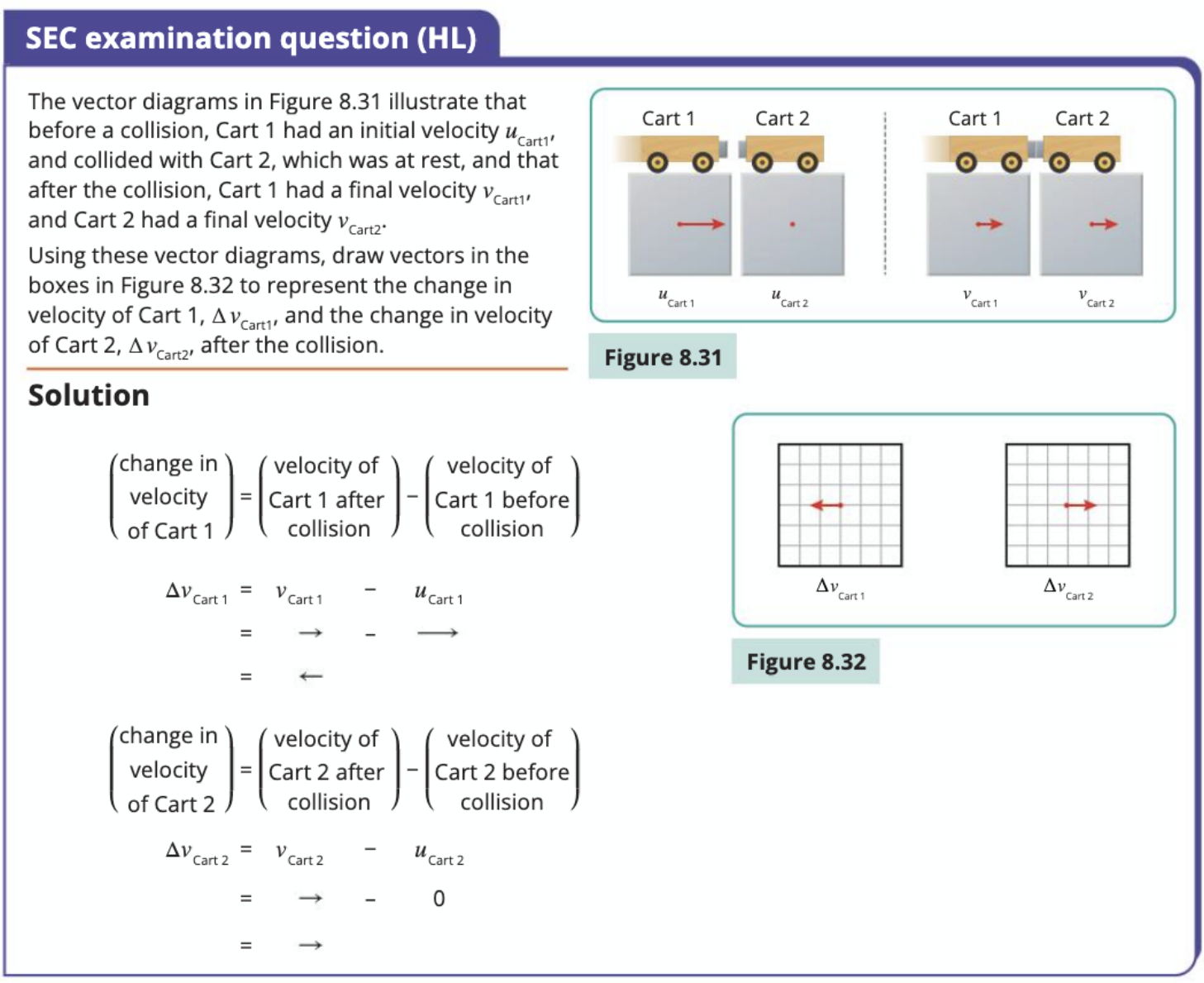
When solving momentum problems, vector diagrams are extremely helpful. They show:
- Initial velocities of all objects
- Final velocities of all objects
- Changes in velocity ()
- Direction of momentum transfer
Note
Exam Success Tip
Always draw clear before and after diagrams. This helps you set up the conservation equation correctly and avoid sign errors. A good diagram is often worth several marks in exams!
Recoil applications
One fascinating application is recoil - when one object is ejected from another:
Example
Worked Example: Gun Recoil
A 3 kg gun fires a 0.01 kg bullet at 500 m/s. What's the gun's recoil velocity?
Step 1: Identify initial conditions Before firing: total momentum = 0 (both gun and bullet at rest)
Step 2: Apply conservation of momentum After firing:
Step 3: Solve for recoil velocity m/s
Conclusion: The gun recoils backwards at 1.67 m/s. The negative sign shows it moves opposite to the bullet.
Problem-solving strategy
When tackling momentum conservation problems, follow this systematic approach:
- Identify the system - What objects are involved?
- Check for external forces - Can you apply conservation?
- Set up before and after states - List all known quantities
- Choose a positive direction - Be consistent with signs
- Apply conservation equation - Set up
- Solve algebraically - Rearrange to find the unknown
- Check your answer - Does the direction make sense?
Important
Common Mistake to Avoid
The biggest error students make is with vector directions. Always establish a positive direction at the start and stick to it throughout your calculation. Use negative values for objects moving in the opposite direction.
Remember!
Summary
Key Points to Remember:
- Momentum is conserved in isolated systems - No external forces means total momentum stays constant
- Direction matters - Momentum is a vector, so always consider positive and negative directions carefully
- The conservation equation is your key tool - works for all collision problems
- Draw diagrams - Before and after sketches help you set up problems correctly and avoid errors
- Internal forces don't change total momentum - They only redistribute momentum between objects in the system