Weight and Mass (Leaving Cert Physics): Revision Notes
📚Revision Notes
Weight and Mass
Centre of mass
When you apply a force to an object, that object will accelerate in response. However, the way the object moves depends on exactly where you apply the force. If the force passes through a special point called the centre of mass, the object will accelerate in a straight line without rotating.
The centre of mass is a crucial concept in physics. It represents the point where you can imagine all the mass of an object to be concentrated. For objects with uniform density and regular shapes, the centre of mass is simply located at the geometric centre. However, for irregular objects or those with non-uniform density, the centre of mass might be located elsewhere - it could even be outside the physical boundaries of the object itself.
Note
Understanding how forces interact with the centre of mass helps us predict motion. When a force acts along a line that passes through the centre of mass, the object accelerates without rotating. When the force acts away from this line, the object will both accelerate and rotate.
The mathematical relationship governing this behaviour is expressed as:
Where is the net force applied, is the total mass, and is the acceleration of the centre of mass.
Important
Key Definition: The centre of mass of a body is the point through which the line of action of a force must pass if the body is to accelerate without rotating.
Weight
Weight is a force, not a property like mass. This is one of the most fundamental concepts we encounter in everyday physics.
Near Earth's surface, all objects experience a constant downward acceleration when falling freely (ignoring air resistance). This acceleration is called the acceleration due to gravity and has a value of approximately .
The gravitational force that causes this acceleration is what we call weight. Weight represents the force of Earth's gravity acting on an object.
Since weight is a force, it's measured in newtons (N), the SI unit for force. This is different from mass, which is measured in kilogrammes (kg).
Important
Critical Distinction: Unlike mass, which remains constant, weight can change depending on the gravitational field strength. An object's mass stays the same whether it's on Earth, the Moon, or in space, but its weight varies because gravitational acceleration differs in these locations.
The relationship between weight, mass, and gravitational acceleration is given by:
Where:
- = weight (in newtons)
- = mass (in kilogrammes)
- = acceleration due to gravity (9.8 m s⁻¹)
Example
Worked Example 1: Finding Weight from Mass
Question: Find the weight of an object with mass 24 kg near Earth's surface.
Solution: Using :
Example
Worked Example 2: Finding Mass from Weight
Question: What is the mass of a car that weighs 15,000 N near Earth's surface?
Solution: Using , we can rearrange to find mass:
Centre of gravity
When you drop an object like a hammer, it falls straight down without rotating. This happens because the gravitational force (weight) acts through a special point called the centre of gravity.
The centre of gravity is defined as the point through which the entire weight of an object appears to act. Since weight doesn't cause the object to rotate when it falls, the weight must be acting through the centre of mass.
Note
For the purposes of this course, the centre of gravity and centre of mass refer to the same point. This equivalence holds true because gravitational acceleration is essentially uniform across the small dimensions of everyday objects.
Types of forces
Understanding different types of forces helps explain how objects interact with their environment.
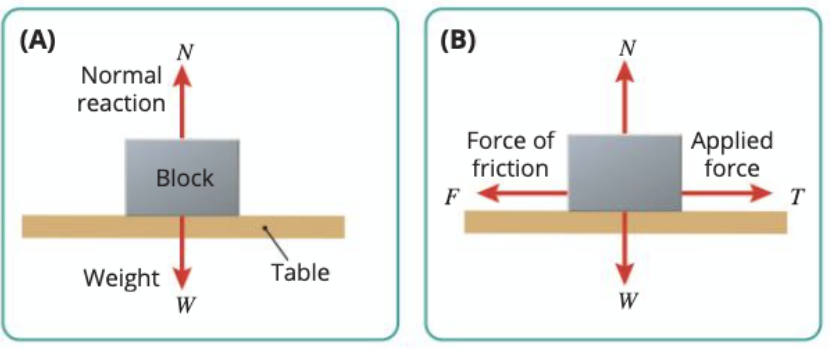
Gravitational force (Weight)
This is the downward force that Earth exerts on all objects. As we've learned, weight acts through the centre of gravity and has magnitude .
Normal reaction force
When an object rests on a surface, such as a book on a table, the surface pushes back with an upward force. This normal reaction force prevents the object from falling through the surface. The word "normal" means perpendicular - this force acts perpendicular to the surface.
Note
For an object at rest on a horizontal surface, the normal reaction force exactly balances the weight, preventing vertical acceleration.
Tension force
When a rope, string, or cable is used to pull an object, it exerts a tension force. This force acts along the direction of the rope and tends to pull objects together. Tension forces are particularly important in problems involving pulleys, hanging objects, or towing situations.
Friction force
Friction is a force that opposes motion between surfaces in contact. When you try to slide an object across a surface, friction acts in the opposite direction to the intended motion.
Note
Static friction prevents objects from starting to move, while kinetic friction acts on objects that are already sliding. The magnitude of friction depends on the surfaces involved and the normal force pressing them together.
Air resistance
When objects move through air, they experience air resistance - a type of friction that opposes their motion through the fluid. Air resistance increases with:
- Higher speeds
- Larger cross-sectional areas perpendicular to motion
- Less streamlined shapes
Similar resistance forces occur when objects move through liquids, making this an important consideration in many real-world applications.
Summary
Key Points to Remember:
- Weight is a force measured in newtons (N), while mass is a property measured in kilogrammes (kg)
- The fundamental relationship is W = mg, where g = 9.8 m s⁻¹ near Earth's surface
- The centre of mass is where forces must act to cause pure translation without rotation
- Centre of gravity equals centre of mass for objects in uniform gravitational fields
- Multiple forces act on objects simultaneously - normal force, tension, friction, and air resistance all play important roles in determining motion