Diffraction Grating (Leaving Cert Physics): Revision Notes
📚Revision Notes
Diffraction Grating
What is a diffraction grating?
A diffraction grating is a precise optical device that splits light into its component wavelengths through the process of diffraction. It consists of a transparent material (usually glass or plastic) with thousands of parallel lines engraved very close together on its surface. These lines act as obstacles that cause light waves to bend and interfere with each other.
The most important characteristic of a diffraction grating is that it contains an enormous number of equally spaced parallel slits - typically several hundred lines per millimetre. This high line density is what makes diffraction gratings so effective at separating different wavelengths of light.
Note
The precision of diffraction gratings comes from their incredibly fine structure - imagine fitting hundreds of parallel lines into just one millimetre! This precise spacing is what allows them to create such clear and predictable interference patterns.
Grating constant
The grating constant (represented by the symbol d) is the distance between the centres of two adjacent slits on the grating. This measurement is crucial for all diffraction grating calculations.
If a grating has a certain number of lines per millimetre, you can calculate the grating constant using:
For example, if a grating has 400 lines per millimetre:
- d = 1/400 mm = 0.0025 mm = 2.5 × 10⁻⁶ m
Important
Key Relationship: The grating constant determines how much the light will be spread out - smaller values of d (more lines per mm) create greater diffraction angles. This inverse relationship is fundamental to understanding diffraction grating behaviour.
How diffraction gratings work
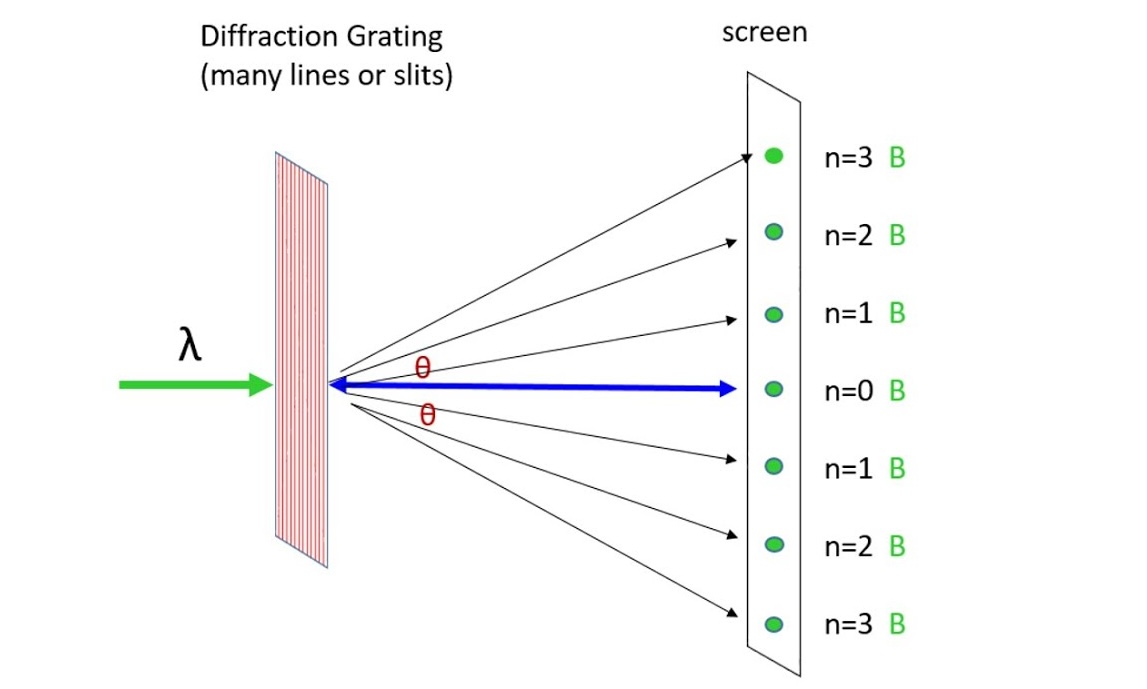
When monochromatic (single wavelength) light passes through a diffraction grating, it creates a distinctive interference pattern. This happens because light waves from adjacent slits interfere with each other - sometimes constructively (creating bright spots) and sometimes destructively (creating dark areas).
The interference pattern consists of:
- A central bright image (zero order, n = 0) where light passes straight through
- First order images (n = ±1) on either side of the central image
- Second order images (n = ±2) further out
- Third order images (n = ±3) and so on
Note
Pattern Symmetry: The pattern is symmetrical, with bright images appearing at equal angles on both sides of the central position. This symmetry is a key characteristic that helps in making accurate measurements.
The diffraction grating formula
The key equation for diffraction grating calculations is:
Where:
- n = order of diffraction (0, ±1, ±2, ±3, etc.)
- λ = wavelength of light (in metres)
- d = grating constant (in metres)
- θ = angle of diffraction from the straight-through position
Important
Understanding the Formula: This formula tells us that for the nth bright image, the path difference between light from adjacent slits equals n wavelengths, creating constructive interference. This is the fundamental principle behind all diffraction grating calculations.
Monochromatic light patterns
When a beam of monochromatic light hits a diffraction grating at right angles, it produces a series of bright spots on a screen positioned behind the grating. The central spot (n = 0) is always the brightest, with the intensity decreasing for higher orders.
The maximum number of diffracted images depends on the relationship between the wavelength and the grating constant. Since sin θ cannot exceed 1, the maximum order occurs when:
Note
Physical Limitation: Since the sine function cannot exceed 1, there's a natural limit to how many orders of diffraction can be observed. This limit depends on both the grating spacing and the wavelength of light being used.
Worked examples
Example
Worked Example 1: Finding the grating constant
A diffraction grating has 400 lines per mm. Calculate the grating constant.
Solution:
- Lines per mm = 400
- d = 1/400 mm = 0.0025 mm = 2.5 × 10⁻⁶ m
Example
Worked Example 2: Calculating wavelength
A laser produces diffraction at a grating with constant d = 2.5 × 10⁻⁶ m. The first order diffracted image is at an angle of 14.6° from the straight-through position. Calculate the wavelength.
Solution: Using nλ = d sin θ, where n = 1:
- λ = d sin θ = (2.5 × 10⁻⁶) × sin(14.6°)
- λ = (2.5 × 10⁻⁶) × 0.251 = 6.30 × 10⁻⁷ m
Example
Worked Example 3: Finding the highest order
A diffraction grating has 350 lines per mm. Monochromatic light of wavelength 5.2 × 10⁻⁷ m is incident normally. What is the highest order diffracted image formed?
Solution: First find the grating constant:
- d = 1/350 mm = 2.857 × 10⁻⁶ m
For maximum order: n = d/λ
- n_max = (2.857 × 10⁻⁶)/(5.2 × 10⁻⁷) = 5.49
Since n must be a whole number, the highest order is n = 5.
Example
Worked Example 4: Calculating angular separation
Sodium emits visible light with a wavelength of 589 nm. This light passes through a diffraction grating of 300 lines per mm. Calculate the angular separation between the first line to the left of the central image and the first line to the right of the central image.
Solution:
- d = 1/300 mm = 3.33 × 10⁻⁶ m
- λ = 589 nm = 589 × 10⁻⁹ m
For first order (n = 1):
- sin θ = λ/d = (589 × 10⁻⁹)/(3.33 × 10⁻⁶) = 0.1769
- θ = 10.2°
Angular separation = 2 × θ = 20.4°
Applications and advantages
Diffraction gratings are superior to other methods for measuring wavelengths because they:
- Produce very sharp, well-defined bright lines
- Allow precise measurement of angles
- Can separate closely spaced wavelengths
- Are used in spectrometers for chemical analysis
Note
Why Gratings Work So Well: The accuracy comes from having hundreds or thousands of slits working together, creating much clearer interference patterns than simpler two-slit arrangements. This collective effect is what makes diffraction gratings such powerful analytical tools.
Summary
Key Points to Remember:
- Diffraction gratings contain hundreds of parallel lines per millimetre that split light into component wavelengths
- The grating constant d equals 1/(lines per mm) × 10⁻³ metres - smaller d values create greater diffraction
- The diffraction grating formula nλ = d sin θ relates order, wavelength, spacing and angle
- Bright images appear at angles where constructive interference occurs, creating orders n = 0, ±1, ±2, ±3...
- The maximum order is limited by n_max = d/λ since sin θ cannot exceed 1