The Electromagnetic Spectrum (Leaving Cert Physics): Revision Notes
📚Revision Notes
The Electromagnetic Spectrum
What are electromagnetic waves?
Electromagnetic waves are a special type of wave that can travel through empty space as well as through materials. These waves are transverse waves, which means they vibrate at right angles to the direction they're moving. What makes them truly remarkable is that they all travel at the same speed in a vacuum - the speed of light, which is metres per second.
All electromagnetic waves share the same fundamental properties. They can undergo interference and diffraction just like other waves, and they follow the wave equation that relates their speed, frequency, and wavelength:
Where:
- = speed of light ( m/s)
- = frequency (Hz)
- = wavelength (m)
Note
The wave equation is fundamental to understanding electromagnetic radiation. Since the speed of light is constant in a vacuum, this means that as frequency increases, wavelength must decrease proportionally.
The electromagnetic spectrum arrangement
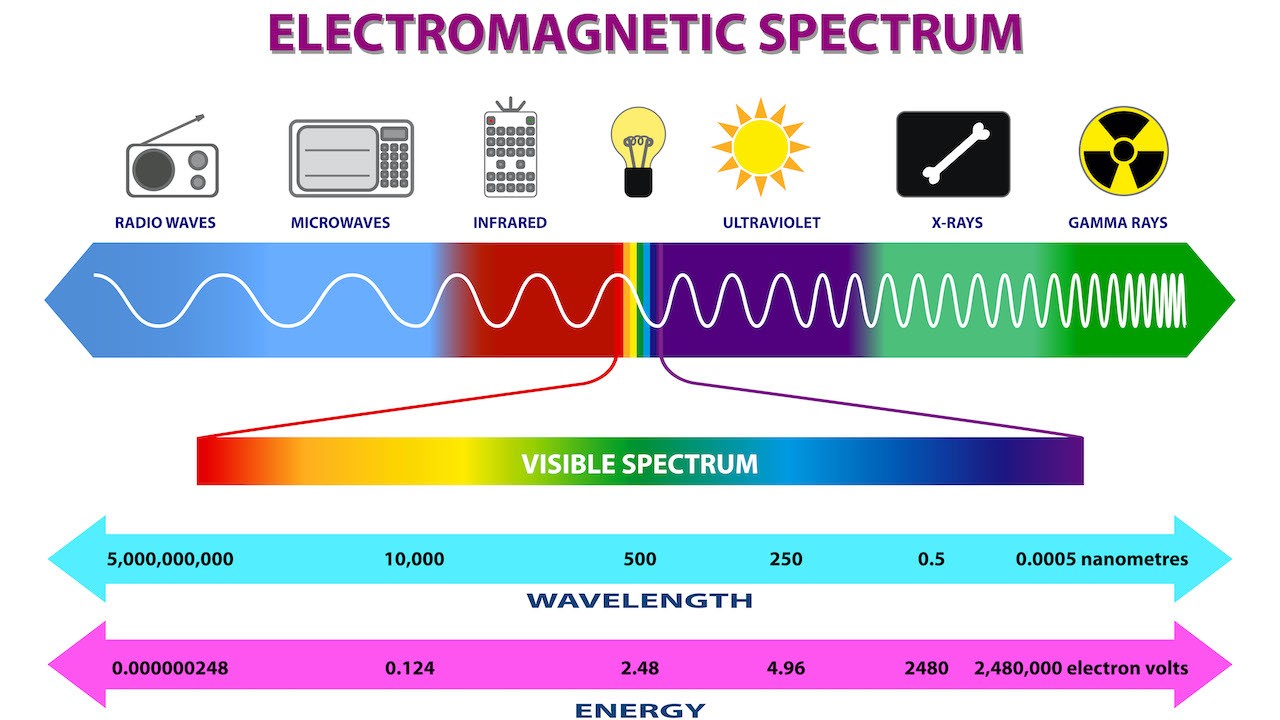
The electromagnetic spectrum is the complete range of electromagnetic waves arranged in order of increasing frequency and decreasing wavelength. Think of it as nature's rainbow, but much broader than what our eyes can see.
From lowest frequency to highest frequency, the spectrum includes:
- Radio waves
- Microwaves
- Infrared radiation
- Visible light
- Ultraviolet radiation
- X-rays
- Gamma rays
Note
The boundaries between different types aren't sharply defined - they gradually blend from one region into the next. For example, high frequency ultraviolet radiation is very similar to low frequency X-ray radiation.
Radio waves
Radio waves have the longest wavelengths and lowest frequencies in the electromagnetic spectrum. These waves are the workhorses of modern communication, carrying information across vast distances.
Key applications:
- Radio broadcasting for music and news
- Television signal transmission
- Mobile phone communication
- WiFi and wireless internet connections
Radio waves can travel long distances and pass through many materials, making them perfect for communication purposes.
Microwaves
Microwaves have shorter wavelengths than radio waves but longer than infrared radiation. You encounter these waves daily, often without realising it.
Key applications:
- Microwave ovens for heating food (they make water molecules vibrate, producing heat)
- Radar systems for detecting aircraft and weather patterns
- Satellite communication for GPS and television
- WiFi networks and Bluetooth connections
Example
How Microwave Ovens Work:
Step 1: Microwaves are generated at approximately 2.45 GHz frequency
Step 2: These waves penetrate the food and make water molecules vibrate rapidly
Step 3: The vibration creates friction, which generates heat throughout the food
Step 4: This heats food from the inside out, unlike conventional ovens
Infrared radiation
Infrared radiation is often called "heat radiation" because we associate it with warmth. All objects emit some infrared radiation, and the warmer an object is, the more infrared it gives off.
Key applications:
- Night vision equipment for military and security use
- Thermal imaging cameras to detect heat sources
- Remote controls for televisions and other devices
- Heating systems in homes and buildings
- Medical imaging to detect blood flow problems
Infrared radiation can be detected by special sensors, allowing us to "see" heat even in complete darkness. This makes it invaluable for search and rescue operations and medical diagnostics.
Visible light
Visible light is the narrow band of electromagnetic radiation that human eyes can detect. This represents only a tiny fraction of the entire electromagnetic spectrum, with wavelengths approximately between 380 and 750 nanometres.
Key characteristics:
- Different wavelengths appear as different colours to our eyes
- Red light has the longest wavelength in visible light
- Violet light has the shortest wavelength in visible light
- Essential for photosynthesis in plants
- Used in photography and digital imaging
Note
Visible light represents less than 1% of the entire electromagnetic spectrum, yet it's the only part we can naturally perceive. This tiny window gives us our entire visual experience of the world.
Ultraviolet radiation
Ultraviolet (UV) radiation lies just beyond the violet end of visible light, with shorter wavelengths and higher energy than visible light.
Key properties:
- Emitted by the Sun in large quantities
- Can cause certain substances to fluoresce (glow)
- Harmful to human skin and eyes in large doses
- Has sterilising properties, killing bacteria and microbes
Key applications:
- Detecting counterfeit currency (special inks fluoresce under UV)
- Sterilising medical equipment and water supplies
- Creating vitamin D in human skin (in small amounts)
- Forensic investigations to reveal hidden evidence
Important
Safety Warning: UV radiation can cause sunburn and skin cancer, so protection from excessive exposure is essential. This marks the beginning of ionising radiation in the spectrum.
X-rays
X-rays have much shorter wavelengths and higher energy than visible light. They're a form of ionising radiation, which means they have enough energy to remove electrons from atoms.
Key applications:
- Medical imaging to see inside the human body
- Dental examinations to check for tooth problems
- Airport security scanners
- Industrial testing of materials and welds
- Cancer treatment (radiation therapy)
X-rays can pass through soft tissues but are absorbed by denser materials like bones and metals, making them perfect for medical imaging.
Important
Safety Consideration: X-rays are ionising radiation and can damage living tissue. Medical professionals use lead aprons and limit exposure time to minimise risks.
Gamma rays
Gamma rays have the shortest wavelengths and highest frequencies in the electromagnetic spectrum. They're the most energetic form of electromagnetic radiation and are highly ionising.
Key applications:
- Sterilising medical equipment and food
- Cancer treatment to destroy tumour cells
- Industrial radiography to check for flaws in materials
- Research in nuclear physics and astronomy
Important
Critical Safety Information: Gamma rays are extremely dangerous to living tissue and require heavy shielding (like lead) for protection. They represent the highest energy end of the electromagnetic spectrum.
Ionising vs non-ionising radiation
An important distinction exists within the electromagnetic spectrum:
- Non-ionising radiation: Radio waves, microwaves, infrared, and visible light. These don't have enough energy to remove electrons from atoms
- Ionising radiation: Ultraviolet (high energy), X-rays, and gamma rays. These have enough energy to ionise atoms, making them potentially harmful to living tissue
Note
The dividing line between non-ionising and ionising radiation occurs in the ultraviolet range. As we move to higher frequencies (shorter wavelengths), the radiation becomes increasingly dangerous to biological systems.
Summary
Key Points to Remember:
-
All electromagnetic waves travel at the speed of light ( m/s) in a vacuum and follow the equation
-
The electromagnetic spectrum is arranged by frequency: radio waves (lowest) → microwaves → infrared → visible → ultraviolet → X-rays → gamma rays (highest)
-
As frequency increases, wavelength decreases and energy increases across the spectrum
-
Each type of radiation has specific applications based on its properties - from communication (radio) to medical imaging (X-rays)
-
Higher energy radiation (UV, X-rays, gamma rays) can be ionising and potentially harmful, requiring appropriate safety precautions