The Wave Nature of Light, Wavelength, and Colour (Leaving Cert Physics): Revision Notes
📚Revision Notes
The Wave Nature of Light, Wavelength, and Colour
Introduction to the wave nature of light
Light can be understood through two different models: the ray model and the wave model. While the ray model works well for many everyday situations, it cannot explain certain behaviours of light, particularly when light encounters obstacles that are similar in size to its wavelength.
The wave model of light becomes essential when we need to understand phenomena like diffraction and interference. This model treats light as electromagnetic waves that can spread out, bend around obstacles, and interact with each other.
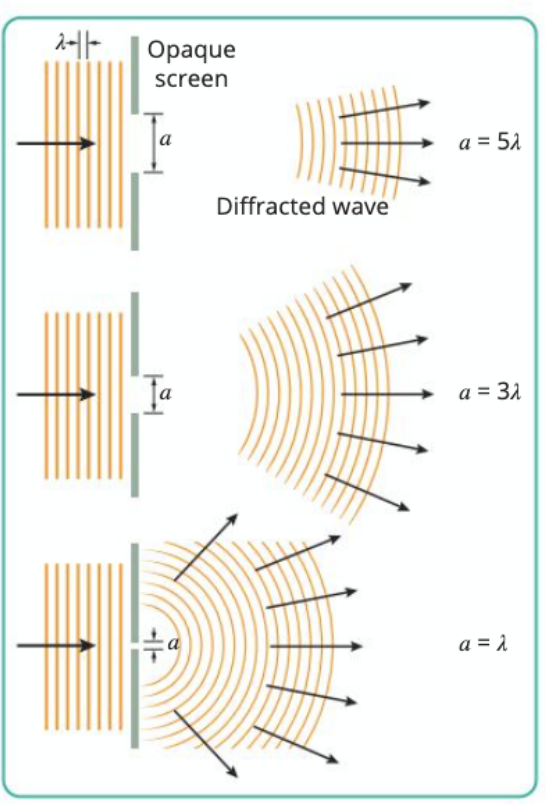
When light waves encounter an aperture (opening) with a width approximately equal to the wavelength of light, diffraction occurs. This means the light spreads out in curved wave patterns rather than travelling in straight lines.
Note
The amount of diffraction depends on the relationship between the aperture size and the wavelength - the more similar they are, the more pronounced the diffraction effect.
Young's double-slit experiment
Historical background
The English scientist Thomas Young (1773-1829) was instrumental in establishing the wave theory of light. In 1801, his famous double-slit experiment provided the first conclusive evidence that light behaves as a wave by demonstrating interference - a phenomenon that can only be explained by wave behaviour.
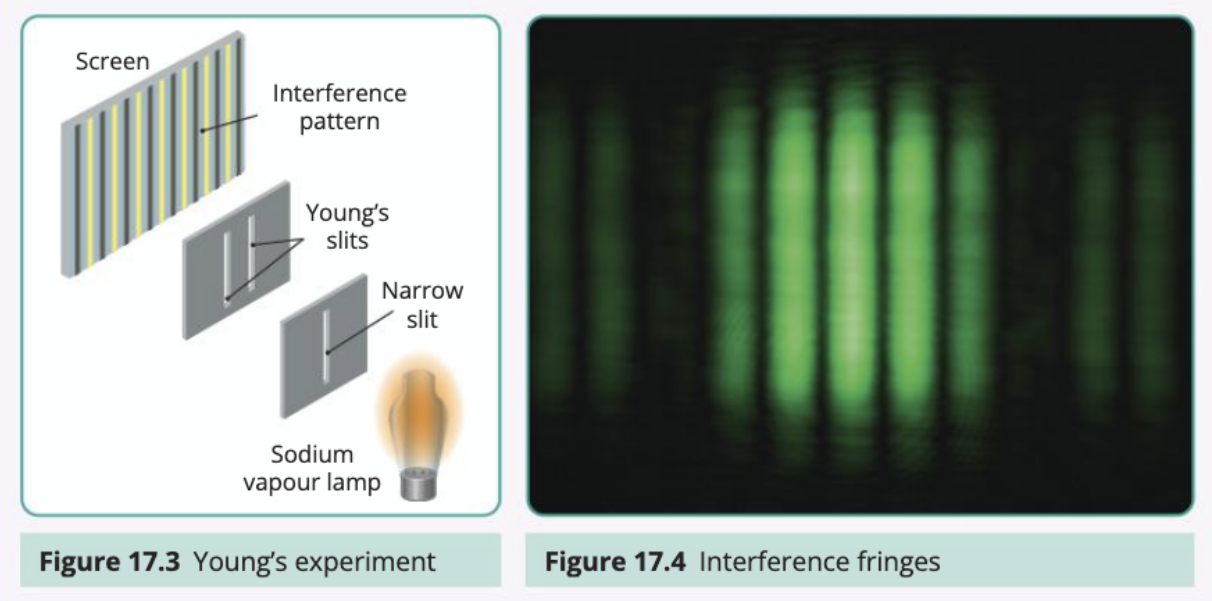
The experimental setup
Young's experiment involves several key components:
- A monochromatic light source (light of a single wavelength, such as a sodium vapour lamp)
- A narrow slit to create a coherent light source
- Young's slits - two parallel slits placed close together
- A detection screen to observe the resulting pattern
Understanding interference patterns
When light passes through Young's double slits, something remarkable happens. Instead of seeing just two bright lines corresponding to the two slits, an interference pattern is created on the screen. This pattern consists of:
- Bright fringes (constructive interference) - where light waves from both slits arrive in phase
- Dark fringes (destructive interference) - where light waves from both slits arrive out of phase
Important
For this interference to occur, the light sources must be coherent. This means the waves from each slit must maintain a constant phase relationship with each other. The light from a single source that passes through both slits naturally satisfies this condition.
Key principle
The fact that light undergoes interference demonstrates that light travels as a wave. This was groundbreaking because it challenged the prevailing particle theory of light that had been supported by Newton.
Mathematical analysis of Young's slits
The path difference concept
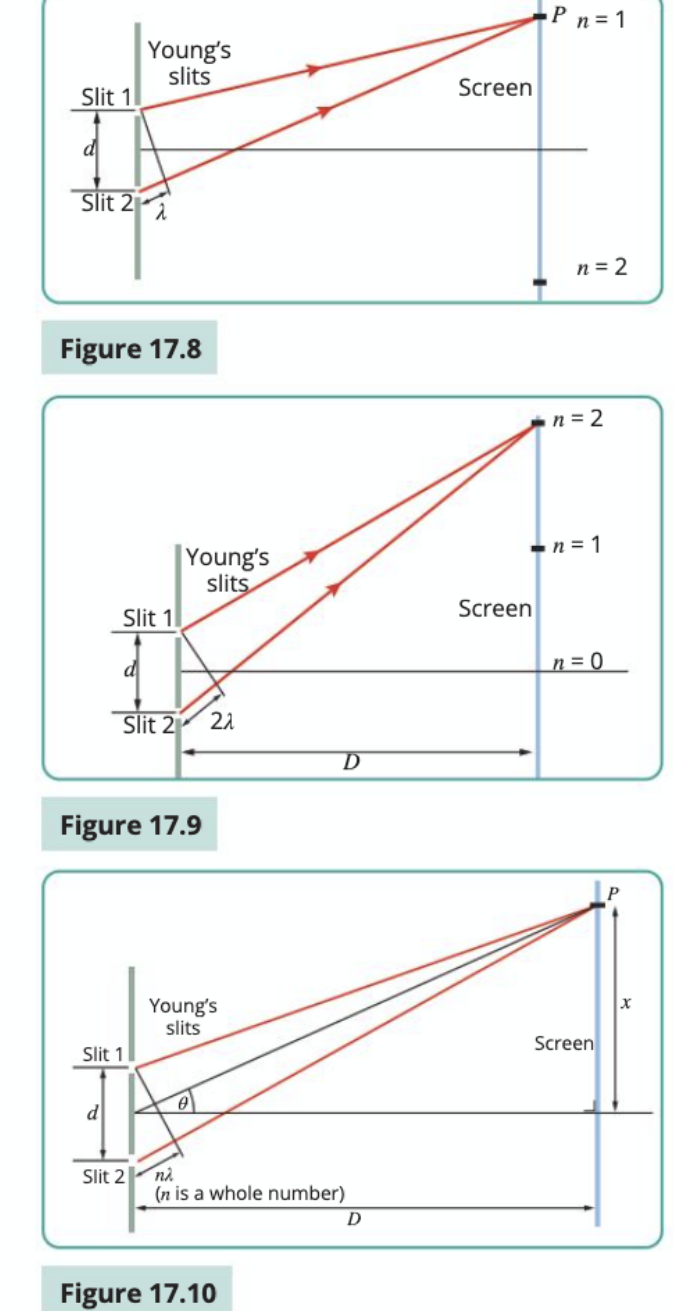
The interference pattern occurs because light from the two slits travels slightly different distances to reach each point on the screen. This path difference determines whether constructive or destructive interference occurs at that point.
Key formulas
For constructive interference (bright fringes), the path difference must be a whole number of wavelengths:
where
The mathematical relationship for Young's slits is:
Where:
- = order of interference (whole number)
- = wavelength of light
- = distance between the two slits
- = angle from the central axis to the bright fringe
For small angles, this can be approximated as:
Where:
- = distance from central bright fringe to the nth bright fringe
- = distance from slits to screen
Example
Worked Example: Calculating Fringe Position
Consider Young's experiment where slits are 0.6 mm apart, placed 2.0 m from a screen, with monochromatic light of wavelength m:
Step 1: For the first bright fringe ():
Step 2: Calculate the angle:
Step 3: Find distance from centre:
Wavelength and colour
Light as an electromagnetic wave
Light is a form of electromagnetic wave that travels as a transverse wave. Different wavelengths of light correspond to different colours that we can see.
The visible spectrum
The visible spectrum represents the range of wavelengths that the human eye can detect, approximately from 400 nm to 700 nm:
- Violet: ~400 nm (shortest visible wavelength)
- Blue: ~450 nm
- Green: ~550 nm
- Yellow: ~580 nm
- Orange: ~620 nm
- Red: ~700 nm (longest visible wavelength)
Note
The visible spectrum is just a tiny portion of the entire electromagnetic spectrum, which includes radio waves, microwaves, infrared, ultraviolet, X-rays, and gamma rays.
Monochromatic vs white light
Monochromatic light consists of only one wavelength and appears as a single colour. Examples include:
- Sodium vapour lamps (yellow, nm)
- Laser light (various specific wavelengths)
White light is a mixture of all visible wavelengths. When white light is dispersed (such as by a prism), it separates into its component colours, revealing the full spectrum.
Key relationships
Important
- Shorter wavelengths correspond to higher frequencies and appear blue/violet
- Longer wavelengths correspond to lower frequencies and appear red
- The colour we see depends entirely on the wavelength of the light
Colours in thin films
Interference in soap bubbles and oil films
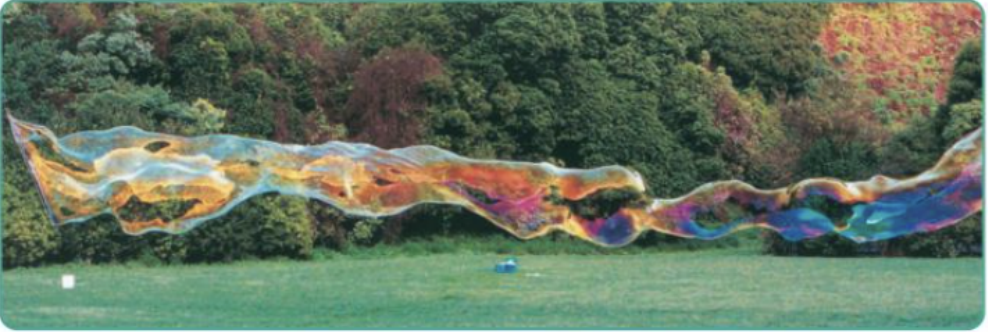
Beautiful colours often appear in soap bubbles and thin films of oil on water. These colours result from interference between light reflected from different surfaces of the thin film.
How thin film interference works
When light hits a thin film:
- Some light reflects from the top surface of the film
- Some light travels through the film and reflects from the bottom surface
- These two reflected beams have slightly different path lengths
- Depending on the film thickness and viewing angle, different wavelengths interfere constructively or destructively
- This creates the brilliant colours we observe
Note
The specific colour seen depends on:
- The thickness of the film
- The angle at which you view the film
- The wavelength of the incident light
This is why soap bubbles and oil slicks display such vibrant, shifting colour patterns as you move around them.
Summary
Key Points to Remember:
-
Light behaves as a wave when it encounters obstacles similar in size to its wavelength, leading to diffraction and interference effects
-
Young's double-slit experiment provided the first definitive proof of light's wave nature through the creation of interference patterns
-
Constructive interference occurs when the path difference between two light sources equals a whole number of wavelengths (), creating bright fringes
-
Different wavelengths of light correspond to different colours, with the visible spectrum ranging from violet (~400 nm) to red (~700 nm)
-
Thin film interference explains the beautiful colours seen in soap bubbles and oil films, where light reflecting from different surfaces creates interference patterns