Converging and Diverging Lenses (Leaving Cert Physics): Revision Notes
📚Revision Notes
Converging and Diverging Lenses
Introduction to lens types
Lenses are curved pieces of transparent material that bend light rays as they pass through them. Understanding how lenses work is crucial for explaining many optical devices we use every day. There are two main types of lenses that behave very differently when light passes through them.
Note
Lens behaviour is fundamental to understanding how many everyday devices work, from eyeglasses to cameras to telescopes. Mastering the basic principles will help you understand more complex optical systems.
Basic lens shapes and structure
When you look at a lens from the side, you can immediately tell what type it is by its shape:
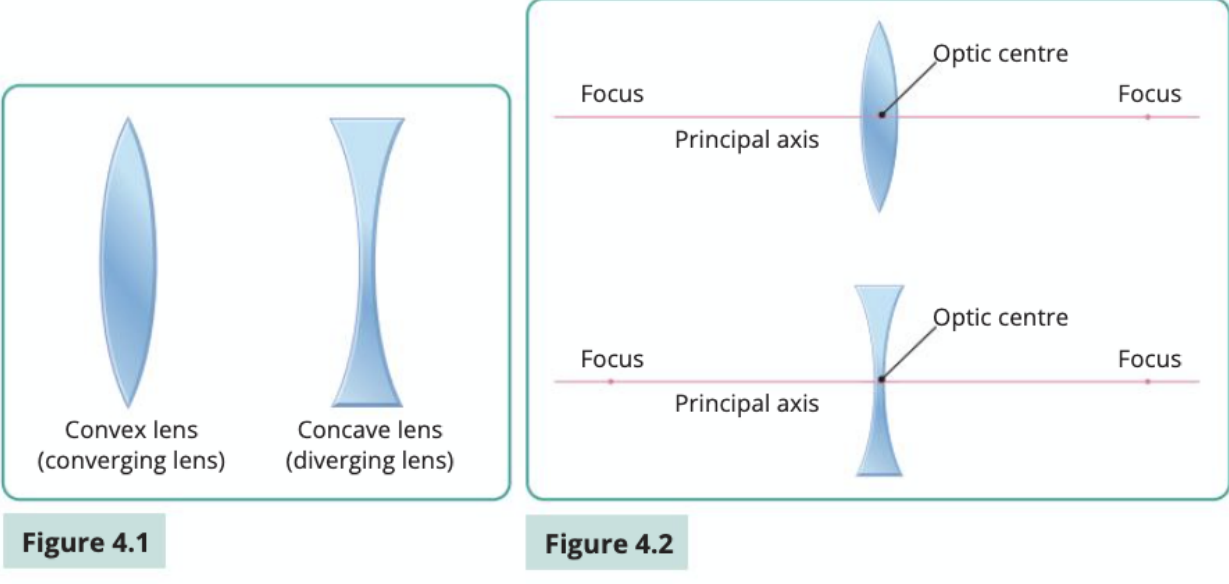
Converging lenses (convex lenses) are thicker in the middle than at the edges. They bulge outward and have a characteristic curved shape that brings light rays together.
Diverging lenses (concave lenses) are thinner in the middle than at the edges. They curve inward and spread light rays apart as they pass through.
Important
Quick Identification Tip: You can instantly identify lens type by shape alone - if it's thicker in the middle, it's converging; if it's thinner in the middle, it's diverging. This simple visual check works every time.
Key terminology you need to know
Understanding lens behaviour requires knowing some important terms that describe the key parts and properties of lenses:
Note
Essential Lens Terminology
- Optic centre: The central point of the lens where light rays can pass through without being bent
- Principal axis: An imaginary straight line that runs horizontally through the optic centre, perpendicular to the lens surface
- Principal focus (focal point): The special point where parallel light rays either converge to (converging lens) or appear to diverge from (diverging lens)
- Focal length: The distance measured from the optic centre to the principal focus
Every lens has two focal points - one on each side of the lens, positioned at equal distances from the optic centre.
How converging lenses work
Converging lenses have a fascinating property: they bring parallel light rays together at a single point.
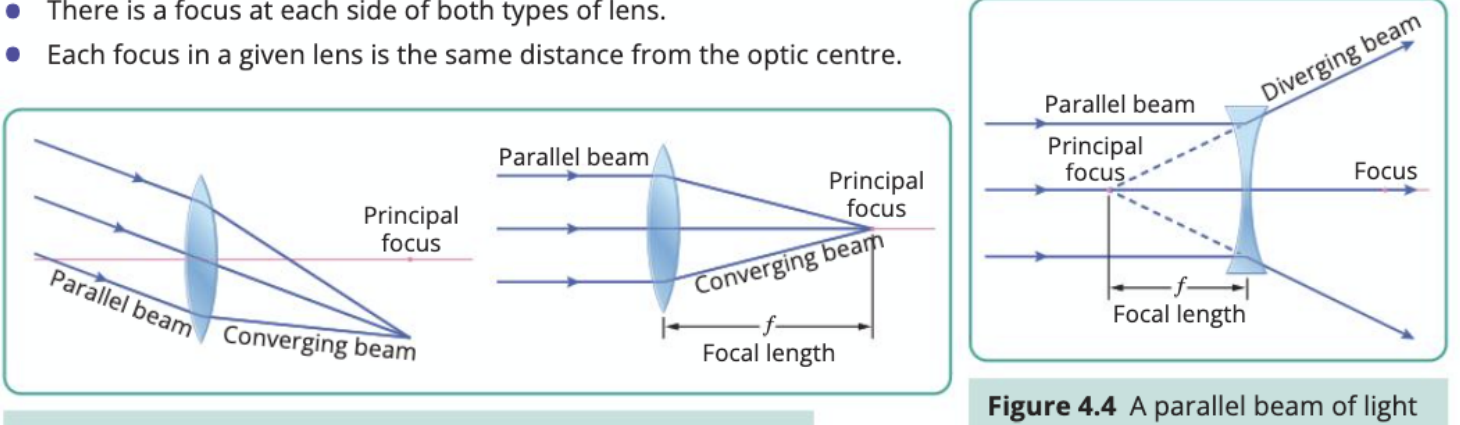
When a parallel beam of light hits a converging lens, all the rays bend inward and meet at the principal focus. This creates what we call a converging beam. The lens acts like a funnel, concentrating the light energy at the focal point.
The focal length of a converging lens determines its strength. A lens with a shorter focal length has greater converging power - it bends light rays more dramatically. This means it can bring parallel rays together more quickly after they pass through the lens.
Example
Demonstration: Sunlight Focusing
When you use a magnifying glass to focus sunlight onto paper:
- Parallel sunlight rays enter the converging lens
- The lens bends all rays inward towards the principal focus
- At the focal point, all light energy concentrates into a bright spot
- This concentrated energy can even start a fire!
This demonstrates the power of converging lenses to concentrate light energy.
How diverging lenses work
Diverging lenses do the opposite of converging lenses. When parallel light rays enter a diverging lens, they spread apart as they exit.
The rays appear to be coming from the principal focus on the same side as the incoming light, but this is actually a virtual focus - the rays don't actually pass through this point. Instead, if you trace the diverging rays backwards, they would appear to meet at the focal point.
Just like converging lenses, diverging lenses with shorter focal lengths have a greater effect - they cause light rays to spread apart more dramatically.
The three fundamental ray rules for converging lenses
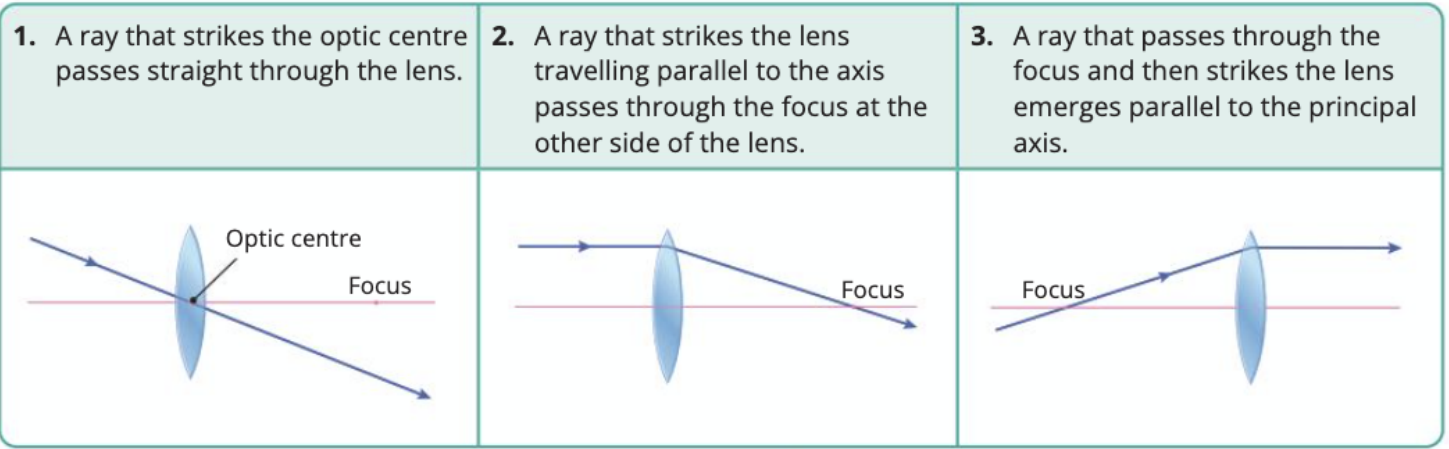
There are three essential rules that describe how light rays behave when passing through a converging lens. These rules help us predict exactly where images will form:
Important
The Three Ray Rules for Converging Lenses
-
Ray through the optic centre: Any light ray that passes through the optic centre continues straight through the lens without bending
-
Parallel ray to principal axis: A light ray that travels parallel to the principal axis will bend as it passes through the lens and then pass through the principal focus on the far side
-
Ray through the focus: A light ray that passes through the principal focus before hitting the lens will emerge parallel to the principal axis after passing through the lens
These three rules are fundamental to understanding how lenses form images and are essential for solving lens problems.
Real-world applications
Lenses are everywhere in our daily lives, making possible many devices that enhance our vision and understanding of the world:
- Eyeglasses and contact lenses: Correct vision problems by converging or diverging light appropriately
- Cameras: Use converging lenses to focus light from objects onto the sensor or film
- Telescopes: Combine multiple lenses to magnify distant objects
- Microscopes: Use lenses to magnify tiny specimens for detailed observation
- Binoculars: Employ lens systems to bring distant objects closer
Understanding lens behaviour helps explain how all these devices work to improve our ability to see the world around us.
Summary
Key Points to Remember
- Converging (convex) lenses are thicker in the middle and bring parallel light rays together at the focal point
- Diverging (concave) lenses are thinner in the middle and cause parallel light rays to spread apart
- Focal length is the distance from the optic centre to the principal focus - shorter focal length means stronger lens effect
- The three ray rules help predict how converging lenses will affect light: rays through the centre go straight, parallel rays converge to the focus, and rays from the focus emerge parallel
- Lenses are found in many everyday optical devices from glasses to cameras to telescopes