Converging Lenses (Leaving Cert Physics): Revision Notes
📚Revision Notes
Converging Lenses
Introduction
A converging lens, also known as a convex lens, is thicker at the centre than at the edges. When parallel light rays pass through a converging lens, they bend inward and meet at a point called the focal point. Understanding how these lenses form images is crucial for explaining many optical devices we use every day, from cameras to magnifying glasses.
How images are formed in converging lenses
When light from an object passes through a converging lens, each point on the object emits light rays in all directions. The lens refracts these rays, causing them to change direction as they pass through.
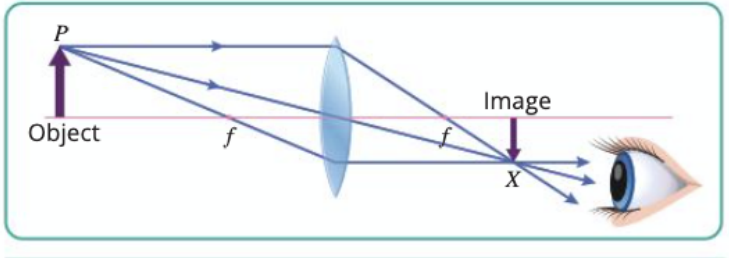
The key principle is that after refraction at the lens, rays from the same point on the object will either:
- Converge (meet) at a specific point to form a real image
- Appear to diverge from a point to form a virtual image
Note
For any point on an object, you can trace the path of light rays to determine where the image of that point will appear. When this process is repeated for all points on the object, a complete image is formed.
Properties of real images
A real image is formed when light rays actually intersect after passing through the lens. This type of image has several important characteristics:
Note
Key Characteristics of Real Images:
- Can be projected onto a screen - because the light rays physically meet at the image location
- Always inverted (upside down) when formed by a single converging lens
- Different size from the object - depending on the object's position relative to the lens
- Located on the opposite side of the lens from the object
Real images are commonly seen in cameras, projectors, and our eyes, where the image forms on the retina.
Image formation at different object positions
The position of an object relative to a converging lens determines the type, size, and location of the image formed. There are several key scenarios to understand:
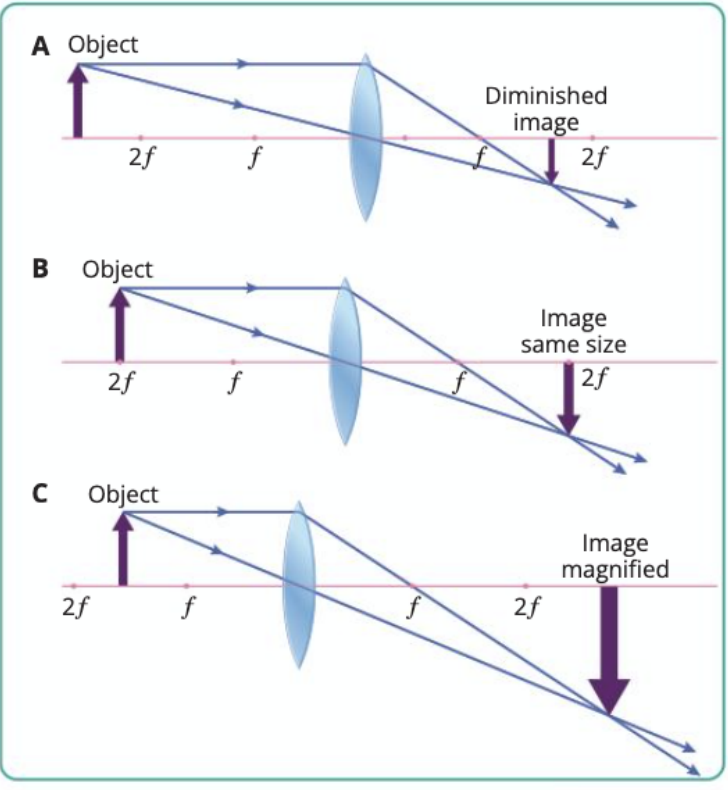
Object beyond twice the focal length (beyond 2f)
When the object is placed at a distance greater than twice the focal length from the lens:
- A real image is formed
- The image is diminished (smaller than the object)
- The image is inverted
- The image forms between f and 2f on the opposite side
Object at twice the focal length (at 2f)
When the object is positioned exactly at twice the focal length:
- A real image is formed
- The image is the same size as the object
- The image is inverted
- The image forms at 2f on the opposite side
Object between the focal length and twice the focal length (between f and 2f)
When the object is placed between f and 2f:
- A real image is formed
- The image is magnified (larger than the object)
- The image is inverted
- The image forms beyond 2f on the opposite side
Note
Memory Aid for Real Images:
- Beyond 2f = diminished
- At 2f = same size
- Between f and 2f = magnified
Object at the focal point (at f)
When the object is positioned exactly at the focal point:
- Light rays emerge parallel after refraction
- No image is formed (or the image is said to be at infinity)
Object inside the focal length (between lens and f)
When the object is closer to the lens than the focal point:
- A virtual image is formed
- The image is magnified
- The image is upright (right way up)
- The image appears on the same side as the object
Virtual images in converging lenses
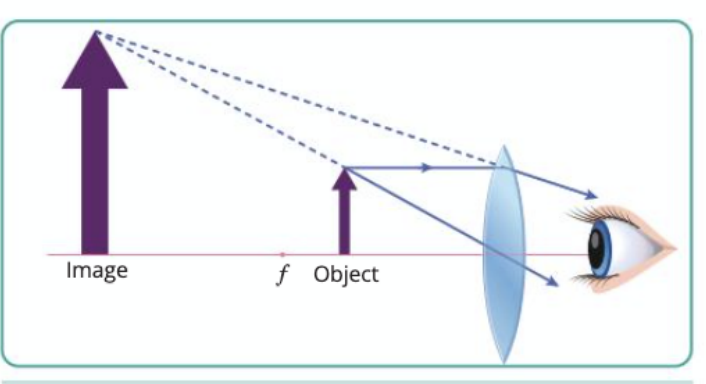
Virtual images are formed when the refracted light rays appear to diverge from a point, even though they don't actually meet there. When you trace these diverging rays backwards, they appear to come from the image location.
Important
Key Properties of Virtual Images:
- Cannot be projected onto a screen - the light rays don't physically meet
- Always upright when formed by a converging lens
- Magnified when the object is inside the focal length
- Located on the same side of the lens as the object
The magnifying glass
A magnifying glass is a practical application of virtual image formation. When you hold a magnifying glass close to an object (placing the object inside the focal length), you see a magnified, upright, virtual image.
Example
Practical Application: How a Magnifying Glass Works
Step 1: Position the object closer to the lens than the focal point Step 2: Light rays diverge after passing through the lens Step 3: Your eye interprets these diverging rays as coming from a larger, virtual image Step 4: The virtual image appears magnified and upright
Images of distant objects
When observing very distant objects (effectively at infinity), the light rays arriving at the lens are essentially parallel. These parallel rays converge at the focal point of the lens, forming a real image at the focal plane.
This principle is fundamental to:
- Cameras - where distant scenes form sharp images on the sensor/film
- Telescopes - where distant stars and planets form images at the focal point
- The human eye - where the crystalline lens focuses distant objects onto the retina
The lens formula
The mathematical relationship between object distance, image distance, and focal length is given by the lens formula:
Where:
- f = focal length of the lens
- u = distance from object to lens (object distance)
- v = distance from lens to image (image distance)
Sign conventions
Note
Sign Convention Rules:
- Focal length (f) is always positive for a converging lens
- Object distance (u) is always positive (object is always on the left of the lens)
- Image distance (v) is positive for real images, negative for virtual images
Using the formula
The lens formula allows you to:
- Calculate where an image will form when you know the object position and focal length
- Determine if an image is real or virtual from the sign of v
- Find the focal length of an unknown lens using object and image measurements
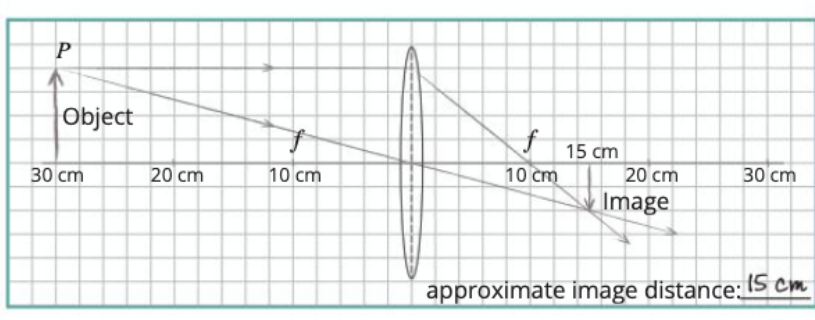
Example
Worked Example: Solving Lens Problems
Step 1: Identify known values (usually f and u) Step 2: Substitute into the lens formula Step 3: Solve for the unknown quantity (usually v) Step 4: Interpret the result - positive v means real image, negative v means virtual image Step 5: Check reasonableness - does the answer match expectations from ray diagrams?
Remember!
Summary
Key Points to Remember:
-
Real images are formed by actual intersection of light rays, can be projected on screens, and are always inverted when formed by a single converging lens
-
Virtual images appear to come from ray intersections, cannot be projected on screens, and are upright and magnified when the object is inside the focal length
-
Object position determines image type: beyond 2f gives diminished real images, between f and 2f gives magnified real images, inside f gives magnified virtual images
-
The lens formula relates focal length, object distance, and image distance, with positive v for real images and negative v for virtual images
-
Magnifying glasses work by placing objects inside the focal length to create enlarged, upright, virtual images that appear magnified to the observer