Uses of Lenses (Leaving Cert Physics): Revision Notes
📚Revision Notes
Uses of Lenses
Lenses are incredibly important in our daily lives, appearing in many devices that help us see the world more clearly. From correcting our vision to capturing photos and exploring the microscopic and distant worlds, lenses play a crucial role in modern technology and medicine.
Correcting defects of vision
The human eye
The human eye is a remarkable optical system that works very much like a camera. Understanding its basic structure helps us appreciate how vision problems occur and how lenses can correct them.

The eye contains three main optical components that work together to create vision:
- Cornea: The clear front surface that begins focusing incoming light
- Lens: The transparent structure that fine-tunes the focus of light
- Retina: The light-sensitive layer at the back where images are formed
Note
When light enters the eye, it travels through the cornea and lens, which work together to focus the light rays onto the retina. The retina then converts this light into electrical signals that travel through the optic nerve to the brain, allowing us to see.
Vision problems and their correction
Not everyone's eyes focus light perfectly onto the retina. Two common vision problems can be corrected using different types of lenses.
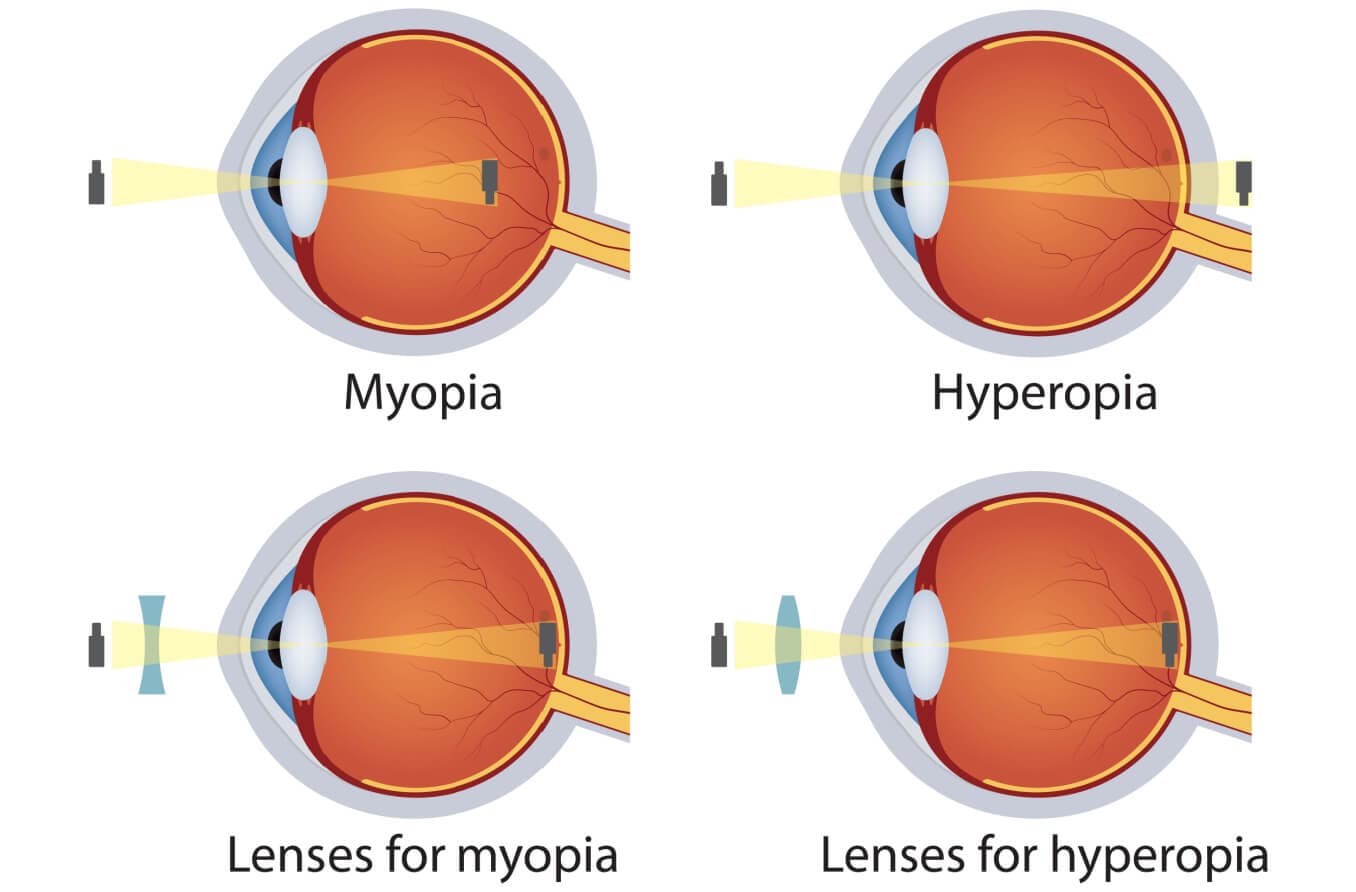
Short-sightedness (Myopia)
People with short-sightedness can see nearby objects clearly, but distant objects appear blurred. This happens because their eye focuses light rays in front of the retina instead of directly on it.
Important
To correct myopia, diverging (concave) lenses are used in distance glasses. These lenses spread out the light rays slightly before they enter the eye, allowing the eye to focus them correctly on the retina.
Long-sightedness (Hyperopia)
People with long-sightedness can see distant objects clearly, but nearby objects appear blurred. This occurs because light from close objects would focus behind the retina.
Important
To correct hyperopia, converging (convex) lenses are used in reading glasses. These lenses begin converging the light rays before they enter the eye, helping the eye focus them properly on the retina.
The camera
Digital cameras and film cameras work on the same basic optical principle as the human eye, but instead of a retina, they use a digital sensor or photographic film to capture images.
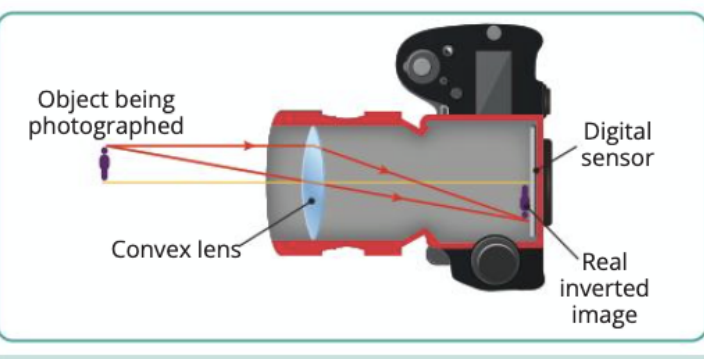
A camera uses a converging lens to focus light from the object being photographed onto the digital sensor. The lens creates a real, inverted image on the sensor surface. This image is then processed digitally or chemically developed in the case of film photography.
Note
The camera lens system allows photographers to capture sharp, detailed images of objects at various distances. Modern cameras often have multiple lenses working together to improve image quality and provide features like zooming and autofocus.
The compound microscope
When we need to examine very small objects that are invisible to the naked eye, we use a compound microscope. This instrument uses two converging lenses working together to produce highly magnified images.
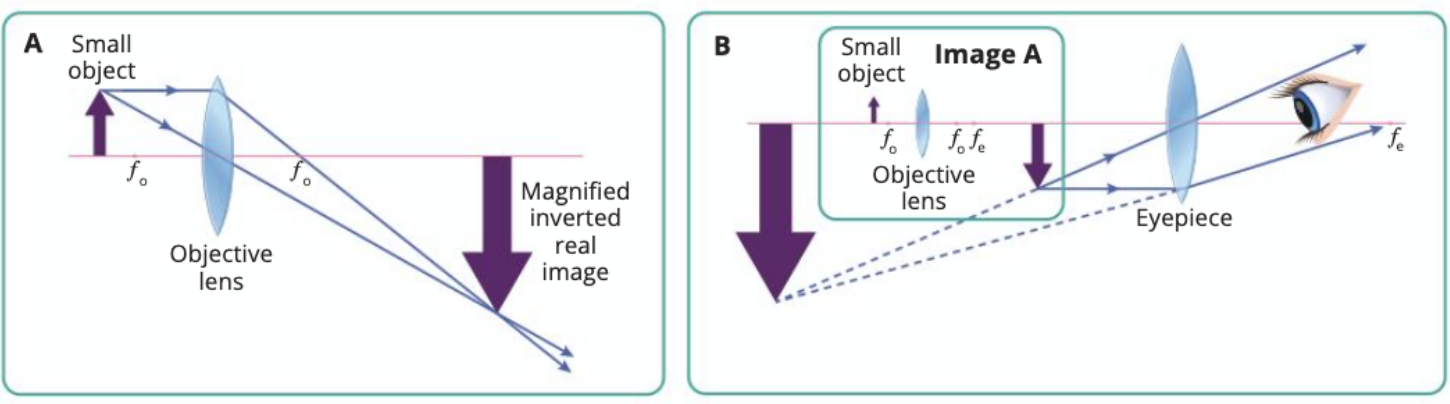
The compound microscope consists of two essential components:
- Objective lens: The lens closest to the specimen that creates an initial magnified, real image
- Eyepiece lens: The lens you look through that further magnifies the image from the objective lens
Example
How a Compound Microscope Works:
Step 1: The objective lens produces a magnified, inverted real image of the small specimen
Step 2: This first image becomes the object for the eyepiece lens
Step 3: The eyepiece lens acts as a magnifying glass, creating a final virtual image that appears much larger than the original specimen
The total magnification of a compound microscope is the magnification of the objective lens multiplied by the magnification of the eyepiece lens. This system allows scientists and students to observe details of cells, bacteria, and other microscopic structures.
The astronomical telescope
To observe distant objects in space, astronomers use telescopes that make faraway objects appear larger and brighter than they would to the naked eye.
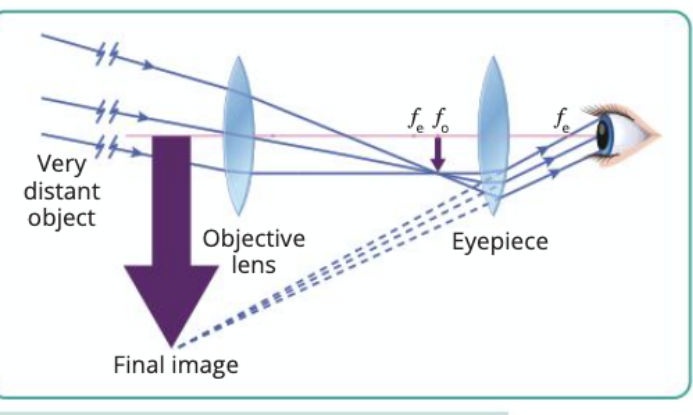
A refracting telescope uses two converging lenses with specific functions:
- Objective lens: A large lens that collects light from the distant object and forms a real image
- Eyepiece lens: A smaller lens that magnifies this image for viewing
Example
How an Astronomical Telescope Works:
Step 1: Parallel light rays from a very distant object (like a star or planet) enter the objective lens
Step 2: The objective lens focuses these rays to form a real, inverted image
Step 3: The eyepiece lens then magnifies this image, allowing the observer to see details that would be impossible with the naked eye
Note
The large objective lens is crucial because it collects more light than the human eye can, making faint objects visible and bright objects appear much clearer.
Summary
Key Points to Remember:
- Diverging lenses correct short-sightedness by spreading light rays before they enter the eye
- Converging lenses correct long-sightedness by beginning to focus light rays before they reach the eye
- Cameras use converging lenses to form real, inverted images on digital sensors or film
- Compound microscopes use two lenses - the objective creates a magnified real image, and the eyepiece further magnifies it
- Telescopes collect and focus light from distant objects using a large objective lens and a smaller eyepiece lens for viewing