Critical Angle and Total Internal Reflection (Leaving Cert Physics): Revision Notes
📚Revision Notes
Critical Angle and Total Internal Reflexion
What is the critical angle?
When light travels from an optically denser medium (like glass or water) to an optically rarer medium (like air), something special happens as we increase the angle of incidence. The critical angle is the specific angle of incidence at which the refracted ray travels along the boundary between the two media - essentially parallel to the surface with an angle of refraction of exactly 90°.
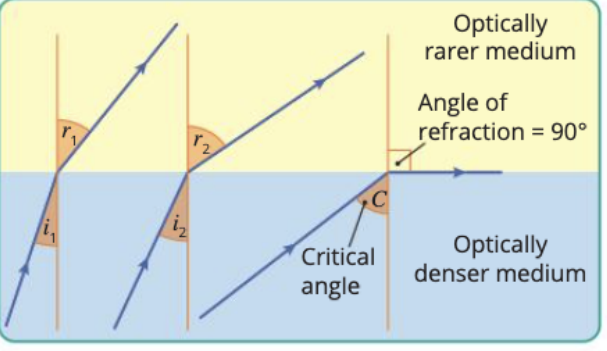
At angles smaller than the critical angle, light continues to refract normally into the second medium. However, when the angle of incidence equals the critical angle, the refracted ray skims along the surface of the boundary.
Note
The critical angle represents a threshold - it's the boundary between normal refraction and the phenomenon of total internal reflexion. This concept is fundamental to understanding how optical devices like fibre optics work.
Total internal reflexion
When the angle of incidence becomes greater than the critical angle, something remarkable occurs - the light ray cannot enter the second medium at all. Instead, it is completely reflected back into the first medium, following the normal laws of reflexion where the angle of incidence equals the angle of reflexion.
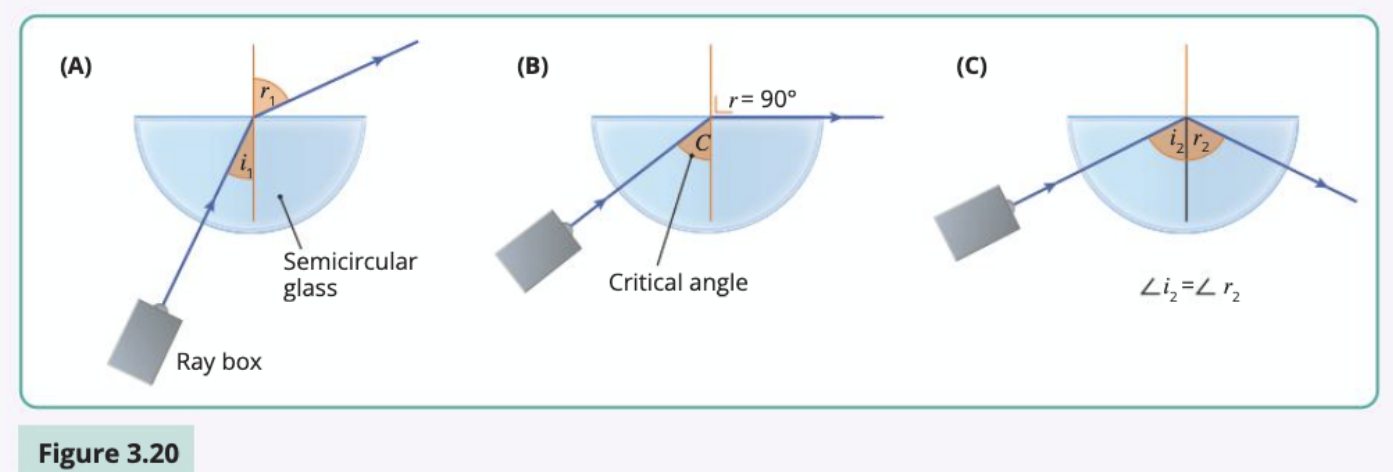
This phenomenon is called total internal reflexion because:
- All of the incident light is reflected (none is transmitted)
- The reflexion follows the law of reflexion perfectly
- No light energy is lost in the process
Essential conditions for total internal reflexion
Important
Critical Conditions for Total Internal Reflexion:
Total internal reflexion can only occur when:
- Light travels from a denser medium to a rarer medium
- The angle of incidence is greater than the critical angle
Remember: Total internal reflexion never occurs when light travels from a rarer medium to a denser medium.
Mathematical relationship between refractive index and critical angle
We can derive a useful mathematical relationship using Snell's law. At the critical angle, the angle of refraction is 90°, so:
Since and if the second medium is air ():
Therefore:
Or rearranged:
Where:
- is the refractive index of the denser medium
- is the critical angle
Note
Key Insight: This relationship tells us that materials with higher refractive indices have smaller critical angles. For example, diamond (with a very high refractive index) has a much smaller critical angle than glass.
Worked examples
Example
Worked Example: Finding Critical Angle
Question: The refractive index of glass is 1.5. What is the critical angle for this glass surrounded by air?
Solution: Using :
So the critical angle is approximately 41.8°.
Example
Worked Example: Finding Refractive Index
Question: The critical angle for a certain medium at a boundary with air is 50°. Find its refractive index.
Solution: Using :
The refractive index is 1.3.
Applications: Prisms and optical devices
Total internal reflexion has practical applications in optical devices. A common example is the 45°-90°-45° prism, which can turn a light ray through 90° or 180°.
When light enters the prism at 45° to the hypotenuse face, it undergoes total internal reflexion because this angle exceeds the critical angle for most optical materials. This allows the prism to redirect light efficiently without any loss of intensity.
Note
Prism Design Requirement: For total internal reflexion to occur in such a prism, the refractive index must be greater than . This is why most optical glass types work perfectly for this application.
Snell's window phenomenon
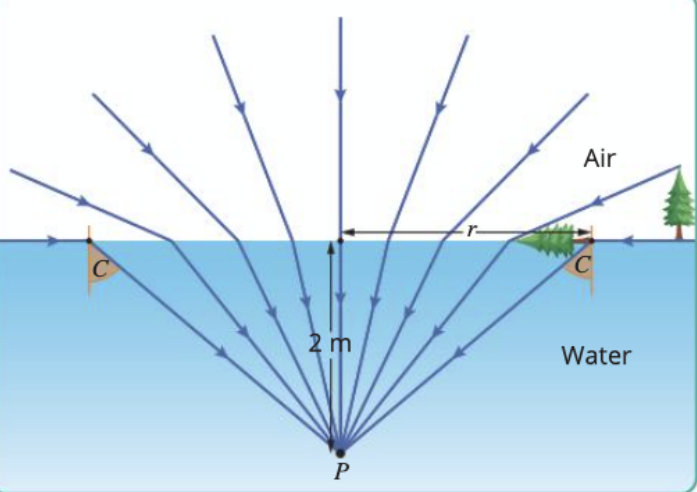
An interesting natural application occurs when observing light underwater. When you look up from beneath the water surface, you can see the entire above-water world compressed into a circular region called Snell's Window.
Note
Understanding Snell's Window:
This fascinating phenomenon happens because:
- Light rays from the underwater point source travel in all directions
- Only rays within the critical angle cone can escape to the air above
- Light from the entire above-water world gets refracted into this critical angle cone
- The result is a circular window showing the compressed above-water scene
The radius of this circle is determined by the critical angle for water-air interface, where the refractive index of water is approximately .
Key mathematical relationships
| Formula | Description | When to use |
|---|---|---|
| Find critical angle from refractive index | When is known | |
| Find refractive index from critical angle | When is known | |
| Angle of incidence > | Condition for total internal reflexion | To predict if TIR occurs |
Important
Exam Strategy - Common Mistakes to Avoid:
- Always check that light is travelling from denser to rarer medium before applying total internal reflexion
- Remember that at the critical angle, the refracted ray is parallel to the boundary (90° to the normal)
- When solving problems, clearly state whether total internal reflexion will occur based on comparing the angle of incidence to the critical angle
- Use the relationship - this is one of the most important formulas in optics
Summary
Key Points to Remember:
- Critical angle occurs when the refracted ray travels parallel to the boundary (angle of refraction = 90°)
- Total internal reflexion happens when the angle of incidence exceeds the critical angle
- Essential condition: Light must travel from a denser medium to a rarer medium
- Key formula: relates critical angle to refractive index
- Applications include optical fibres, prisms, and explains natural phenomena like Snell's Window