The Internal Structure of Earth (Grade 10 NSC Matric Geography): Revision Notes
📚Revision Notes
The Internal Structure of Earth
Understanding Earth's internal structure is fundamental to studying geomorphology, which examines our planet's physical features and the processes that shape them. Scientists have discovered that Earth consists of four distinct layers, each with unique characteristics and properties.
Note
Understanding Earth's internal structure is essential because surface processes are directly influenced by what happens deep within our planet. The heat and movements from Earth's interior drive many of the geological processes that shape the landscapes we see today.
What is geomorphology?
Geomorphology is the scientific study of Earth's physical features and the geological processes that create and modify them. This field helps us understand how mountains, valleys, plains, and other landforms develop over time. To fully grasp these surface processes, we must first understand what lies beneath our feet - the internal structure of our planet.
The layered structure of Earth
Earth's internal structure can be compared to a hard-boiled egg, making it easier to visualise and remember the different layers. Just as an egg has a shell, white, and yolk, Earth has four main layers that become progressively hotter and denser towards the centre.
Important
The Hard-Boiled Egg Analogy
This comparison is extremely helpful for remembering Earth's layers:
- Eggshell = Crust (thin, hard outer layer)
- Egg white = Mantle (thick middle layer)
- Egg yolk = Core (dense centre)
Keep this analogy in mind as you study each layer!
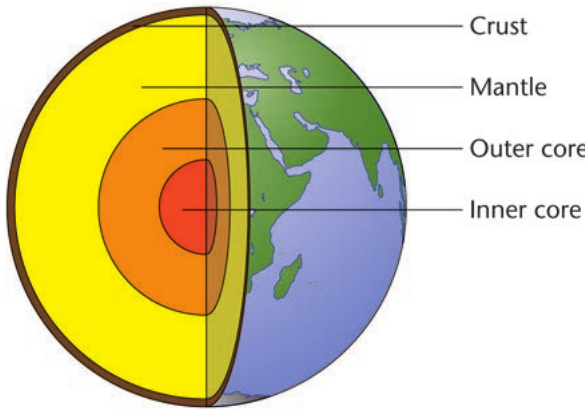
The four main layers of Earth are:
- Crust (the outermost solid layer)
- Mantle (the thick, hot rocky layer)
- Outer core (liquid metallic layer)
- Inner core (solid metallic centre)
The crust - Earth's protective shell
The crust forms Earth's solid outer shell, similar to an eggshell. This layer is where all life exists and includes the land surfaces and ocean floors we see around us. The crust is remarkably thin compared to Earth's total size, but it varies significantly in thickness depending on location.
There are two types of crust:
- Oceanic crust: Found beneath the ocean floors, measuring 5-10 km thick
- Continental crust: Forms the land masses we live on, measuring 35-70 km thick
Note
Despite being called "solid," the crust is not a single, unbroken piece. It's actually made up of several large pieces called tectonic plates that can move slowly over time. This movement is responsible for earthquakes, mountain formation, and continental drift.
The crust consists of solid rock that has cooled and hardened over millions of years. Despite being the coolest layer, temperatures can still reach several hundred degrees Celsius at its base where it meets the mantle.
The mantle - Earth's largest layer
Beneath the crust lies the mantle, which can be compared to the white of a hard-boiled egg. This layer is truly massive, making up approximately 80% of Earth's total volume. The mantle extends from the bottom of the crust down to about 2,900 km below the surface.
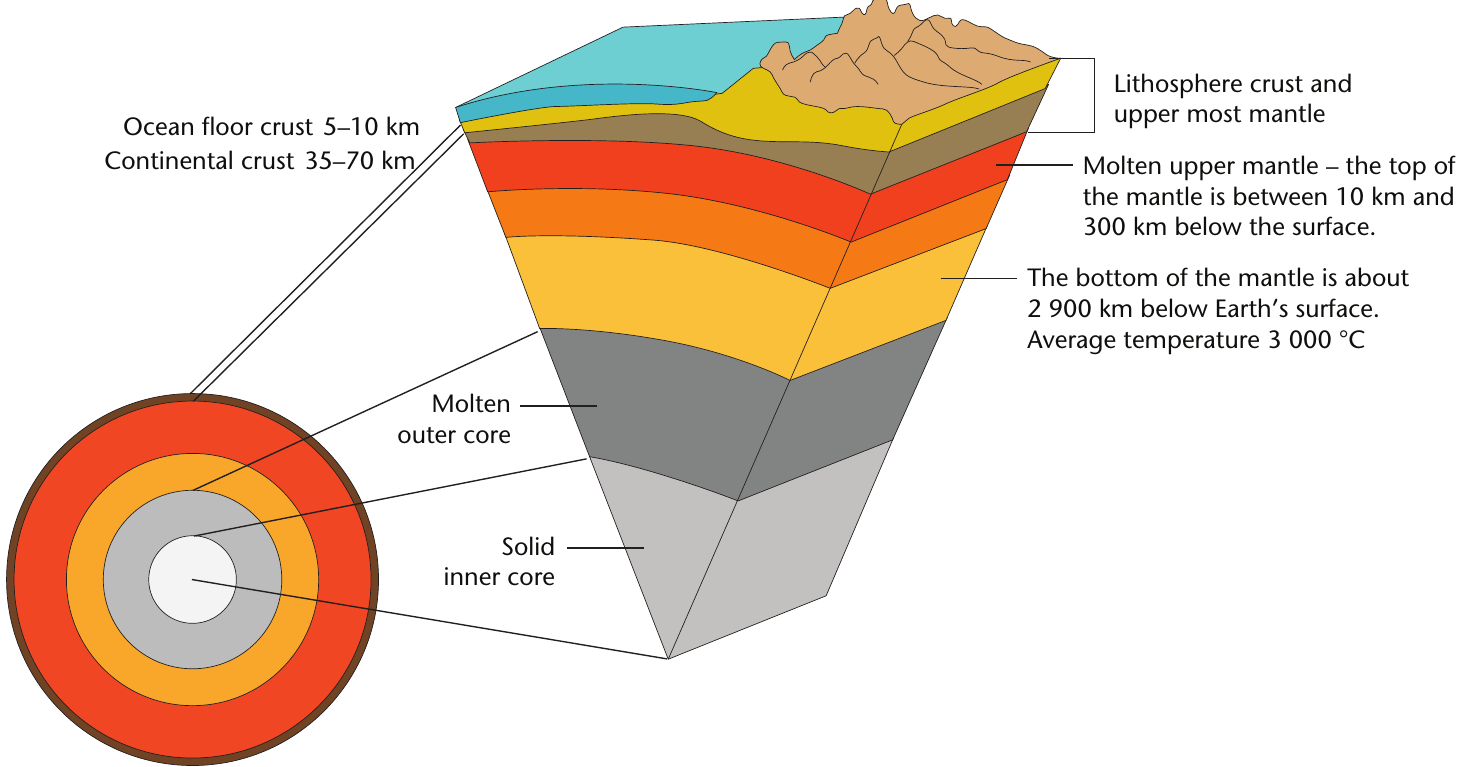
The mantle consists primarily of hot, dense rock that behaves differently at various depths:
- Upper mantle: The top portion (10-300 km below surface) contains some molten (melted) rock material that flows like thick honey
- Lower mantle: Extends to 2,900 km depth with temperatures reaching 3,000°C
Important
Convection Currents in the Mantle
The extreme heat in the mantle causes the rock to become soft and pliable, allowing it to move slowly in circular patterns called convection currents. These movements are crucial for many geological processes, including the movement of tectonic plates on Earth's surface.
Think of this like heating soup in a pot - the hot material rises, cools, then sinks back down, creating a circular flow pattern.
The outer core - Earth's liquid metal layer
The outer core begins where the mantle ends, approximately 2,900 km below Earth's surface. This layer consists of extremely hot, molten (liquid) metal, primarily iron and nickel. The temperatures here are so intense that these metals cannot remain solid, despite the enormous pressure.
Note
Earth's Magnetic Field Generator
The liquid metal in the outer core moves and flows, creating Earth's magnetic field through a process similar to how a dynamo generates electricity. This magnetic field is essential for protecting our planet from harmful solar radiation - without it, life on Earth would not be possible!
The inner core - the solid centre
At Earth's very centre lies the inner core, comparable to the yolk of our boiled egg analogy. Despite temperatures reaching an average of 5,000°C (hotter than the Sun's surface!), the inner core remains solid due to the incredible pressure from all the layers above it.
The inner core has a radius of approximately 1,200 km and, like the outer core, consists primarily of iron and nickel. The pressure here is so intense that these metals are compressed into a solid state, even at such extreme temperatures.
Important
Pressure vs Temperature
This might seem confusing - how can something be solid at 5,000°C when iron melts at only 1,538°C at Earth's surface? The answer is extreme pressure. The weight of all the layers above creates such intense pressure that it forces the metals to remain solid despite the incredible heat.
Key measurements and facts
Understanding the scale of Earth's internal structure helps put these layers into perspective:
- Total depth to Earth's centre: Approximately 6,400 km
- Crust thickness: 5-70 km (less than 1% of Earth's radius)
- Mantle extent: Surface to 2,900 km depth
- Core radius: Approximately 3,500 km total
- Temperature increase: Temperatures rise from surface conditions to over 5,000°C at the centre
Example
Putting Earth's Scale into Perspective
If Earth were shrunk down to the size of an apple:
- The crust would be thinner than the apple's skin
- The mantle would make up most of the apple's flesh
- The core would be about the size of the apple's core
This shows just how thin our crust really is compared to the entire planet!
Temperature patterns within Earth
One of the most important characteristics of Earth's internal structure is how temperature increases with depth. This temperature gradient drives many geological processes:
- Surface temperature: Varies with climate and weather
- Crust base: Several hundred degrees Celsius
- Mantle: 1,000°C to 3,000°C
- Outer core: 4,000°C to 5,000°C
- Inner core: Approximately 5,000°C to 6,000°C
Note
Sources of Earth's Internal Heat
This heat comes from two main sources:
- Primordial heat - leftover heat from Earth's formation billions of years ago
- Radiogenic heat - heat produced by the decay of radioactive elements within the planet
These heat sources ensure that Earth's interior remains hot and active, driving the geological processes that continue to shape our planet today.
Why understanding Earth's structure matters
Knowledge of Earth's internal structure helps explain many phenomena we observe at the surface:
- Earthquakes occur when stress builds up in the crust and upper mantle
- Volcanic eruptions happen when molten material from the mantle reaches the surface
- Mountain formation results from movements in the crust and upper mantle
- Continental drift occurs due to convection currents in the mantle
Note
Relevance for South African Students
For South African students, this knowledge is particularly relevant as our country sits on the African Plate and contains some of the world's deepest mines, giving us direct access to observe crustal rocks formed billions of years ago. The Witwatersrand Basin and the Bushveld Complex are excellent examples of how we can study Earth's ancient history through its internal structure.
Summary
Key Points to Remember:
- Earth has four main layers: crust, mantle, outer core, and inner core
- The crust is thin (5-70 km) and solid, forming the surface we live on
- The mantle makes up 80% of Earth's volume and contains hot, moving rock
- The outer core is liquid metal that creates Earth's magnetic field
- The inner core is solid metal despite extreme temperatures due to intense pressure
- Temperature increases with depth, reaching over 5,000°C at Earth's centre
- Understanding these layers helps explain surface phenomena like earthquakes, volcanoes, and mountain formation