Water Vapour in the Air (Grade 10 NSC Matric Geography): Revision Notes
📚Revision Notes
Water Vapour in the Air
Water vapour is an invisible gas that exists in our atmosphere all around us. Understanding how this moisture behaves is crucial for understanding weather patterns, climate, and why we experience different types of weather conditions. This topic explores how we measure and understand the water vapour content in our atmosphere.

What is humidity?
Humidity refers to the amount of moisture or water vapour present in the air. You've probably experienced humidity on a hot, sticky day when the air feels heavy and damp. Places like Durban are very humid because there's lots of water vapour in the air from being near the ocean. In contrast, inland areas like Bloemfontein in winter have very little water vapour in the air, making them feel dry.
Note
The difference between coastal and inland humidity is a perfect example of how location affects moisture levels. Coastal areas have ready access to water for evaporation, while inland areas, especially in winter, have limited moisture sources.
When we measure humidity, we can do it in several different ways:
Types of humidity measurements
- Specific humidity - This measures the mass of water vapour (in grams) contained in a kilogram of dry air
- Absolute humidity - This measures the mass of water vapour (in grams) contained in a cubic metre of dry air
- Relative humidity - This compares the proportion of water vapour in the air to the maximum amount it could hold at a given temperature, expressed as a percentage
Why relative humidity matters most
Relative humidity is the most useful measurement for understanding how the air feels and predicts weather conditions. When air reaches 100% relative humidity, we say it's saturated - it cannot hold any more water vapour at that temperature. Air with high humidity levels feels damp and sticky to us.
The key formula for relative humidity is:
Factors affecting relative humidity
Two important factors control how much moisture the air can hold and how humid it feels:
Temperature effects
Warm air can hold much more water than cooler air. This is a fundamental principle that explains many weather patterns. For example, air at 25°C can hold significantly more water than the same air at 20°C. This relationship between temperature and the air's capacity to hold moisture is why relative humidity changes throughout the day.
Water content in the air
The actual amount of water present in the air also affects humidity. Areas near oceans or that experience rainy conditions tend to have higher humidity levels because there's more water available to evaporate into the atmosphere.
Daily humidity changes
Humidity levels change throughout the day due to temperature variations. During the day, heating raises air temperature and increases evaporation, so the air's ability to hold more water increases. By late afternoon, the air may become full of water, leading to afternoon thunderstorms on the Highveld. When air temperatures drop in the evening, the water condenses out of the air and falls as rain.
Note
This daily cycle of heating and cooling explains why many inland areas experience predictable afternoon thunderstorms during summer months. The morning sun heats the air, increasing its capacity to hold moisture, but as evening approaches and temperatures drop, the excess moisture condenses and falls as rain.
Calculating relative humidity
Understanding the maths behind relative humidity helps explain why it changes. Let's look at a practical example:
Example
Worked Example: Calculating Relative Humidity
Scenario 1: If we have 1 kg of air that currently holds 5 g of water vapour, but could actually hold 50 g of water vapour at that temperature:
This means the air is only 10% saturated with moisture.
Scenario 2: If the water content increases to 10 g but the capacity stays at 50 g:
The key insight from these calculations is that temperature is the main factor affecting relative humidity because temperature determines the air's water vapour capacity. When temperature changes, the capacity changes, which affects the relative humidity percentage.
Dew point and condensation level
Understanding the dew point
The dew point is the temperature at which water vapour in the air will condense into tiny water droplets. When air cools down to its dew point temperature, condensation begins to occur. This is why you see dew forming on grass in early morning when temperatures are coolest.
Condensation level in the atmosphere
When air rises in the atmosphere, it cools down. The condensation level is the specific height above sea level where the air reaches its dew point and condensation begins to take place. This is extremely important for cloud formation - the base or bottom of clouds occurs at the condensation level.
Important
Critical Concept: Cloud Formation
The condensation level explains why clouds have relatively flat bottoms - they all form at the same height where condensation begins. This is a fundamental principle in meteorology that helps explain weather patterns and cloud behaviour.
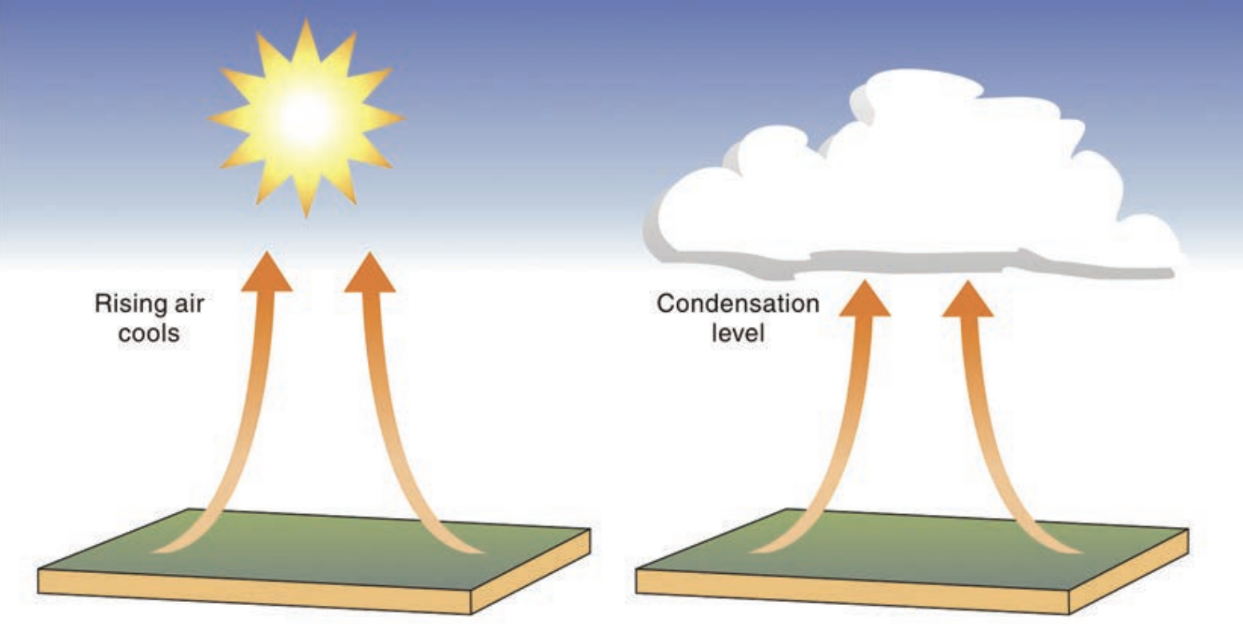
The diagram shows how rising air cools until it reaches the condensation level, where clouds begin to form. This process explains why clouds have relatively flat bottoms - they all form at the same height where condensation begins.
Key concepts summary
Understanding moisture in the atmosphere involves several interconnected concepts. The relationship between temperature, water content, and humidity determines weather patterns and cloud formation. Warmer air can hold more moisture, which is why tropical areas tend to be more humid than cooler regions.
Summary
Key Points to Remember:
- Relative humidity is the most useful way to measure atmospheric moisture - it tells us what percentage of water saturation the air has reached
- Warm air holds more water than cool air - this fundamental relationship drives most humidity changes
- Temperature and water content are the two main factors that affect relative humidity levels
- Dew point is the temperature where condensation begins, and condensation level is the height where clouds form
- Saturated air at 100% relative humidity cannot hold any more water vapour and will produce condensation