Resistance (Grade 10 NSC Matric Physical Sciences): Revision Notes
📚Revision Notes
Resistance
What causes resistance?
Resistance occurs when electrons moving through a conductor collide with the particles that make up the material. During these collisions, electrons transfer their kinetic energy to the particles in the conductor, causing them to lose speed. This energy transfer creates resistance to the flow of current.
The transferred energy causes the resistor to heat up. You can experience this directly when you touch a mobile phone charger while it's charging - the charger becomes warm because its internal circuits contain resistors that convert electrical energy into heat energy.
Note
The heating effect of resistance is not just a side effect - it's a fundamental consequence of energy conservation. Every time electrons collide with particles in a conductor, kinetic energy must go somewhere, and it becomes thermal energy.
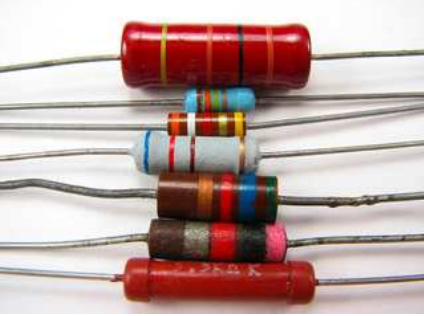
Definition and unit
Definition: Resistance slows down the flow of charge in a circuit. It is measured in ohms (Ω), which is defined as one volt per ampere of current.
Important
Key Technical Specifications:
- Quantity: Resistance (R)
- Unit: ohm (Ω)
- Unit symbol: Ω
The relationship can be expressed as:
All conductors have some resistance. For example, a piece of wire has less resistance than a lightbulb, but both still have some resistance to current flow.
Examples of resistance in practice
Lightbulb filaments
Example
Practical Example: How Lightbulbs Work
A lightbulb contains a very thin wire filament surrounded by glass housing. The high resistance of this thin filament causes electrons to transfer significant kinetic energy as heat. This heat energy is sufficient to make the filament glow white-hot, producing light.
Comparison: The connecting wires from the lamp to the battery barely get warm while conducting the same current. This happens because these wires have much lower resistance due to their larger cross-sectional area (they are thicker).
Fluorescent vs incandescent bulbs
Fluorescent lightbulbs are more efficient than traditional incandescent bulbs because they don't rely on thin wires. Instead, they use gases that glow when current flows through them, resulting in much less resistance and greater efficiency.
Physical factors affecting resistance
The physical properties of a resistor determine its total resistance value:
Length
If you increase the length of a resistor, its resistance will increase proportionally. When you double the length of a resistor, you typically double its resistance as well.
Cross-sectional area
If a resistor has a larger pathway (wider or broader), more current can flow through it. When the cross-sectional area increases by a certain factor, the resistance typically decreases by the same factor.
Important
Key Relationship for Resistance:
This relationship can be summarised as:
Where:
- = resistance
- = length
- = cross-sectional area
Energy conversion in resistors
An important function of resistors is that they convert electrical energy into heat energy. Light energy is produced as a by-product of this heat in some cases, such as in lightbulb filaments.
Superconductors
Note
Fascinating Physics: Superconductors
There exists a special type of conductor called a superconductor that has no resistance. However, the materials that make up superconductors only demonstrate this property at extremely low temperatures. Most superconductors only work at temperatures below -140°C.
Why batteries go flat
Batteries store chemical potential energy. When connected to a circuit, a chemical reaction converts this stored energy into electrical energy, which powers electrons to move through the circuit.
All circuit components (conducting leads, resistors, and lightbulbs) have some resistance that opposes current flow. This resistance converts the electrical energy into heat energy and, in lightbulbs, light energy.
Important
Energy Conservation Principle
Since energy is always conserved, the battery goes flat when all its chemical potential energy has been converted into other forms of energy through the circuit's resistance.
Resistors in electric circuits
Understanding how resistors affect circuits is crucial for circuit analysis. Adding resistors to a circuit impacts both the total resistance of the circuit and the amount of current that can flow through it.
When resistors are added to circuits, they work together to determine the overall resistance, which directly affects how much current the circuit can carry.
Summary
Key Points to Remember:
- Resistance occurs when electrons collide with particles in conductors, transferring kinetic energy and creating heat
- Resistance is measured in ohms (Ω), defined as one volt per ampere of current
- Length increases resistance - longer conductors have higher resistance
- Cross-sectional area decreases resistance - thicker conductors allow more current flow
- Resistors convert electrical energy into heat energy, and sometimes light energy as a by-product