Series Resistors (Grade 10 NSC Matric Physical Sciences): Revision Notes
📚Revision Notes
Series Resistors
What are series resistors?
When we connect resistors in series, we place them one after another in a single line, creating only one path for electric current to flow through the circuit. Think of it like cars travelling on a single-lane road - they must all follow the same route and travel at the same speed.
Note
The key defining feature of a series circuit is that there is only one continuous path for current to flow. This single path is what creates all the unique characteristics we'll explore in this topic.
Key characteristics of series circuits
Understanding series circuits becomes much easier when you remember these three important features:
Current remains the same
In a series circuit, the current is identical at every point in the circuit. This means that if you measure the current before, between, or after any resistor, you will always get the same reading. This happens because there is only one path for the current to follow.
Important
Critical Concept: Current conservation in series circuits
Since there's only one path for current to travel, the same amount of current must flow through every component. Think of it like water flowing through a single pipe - the same amount must pass through each section.
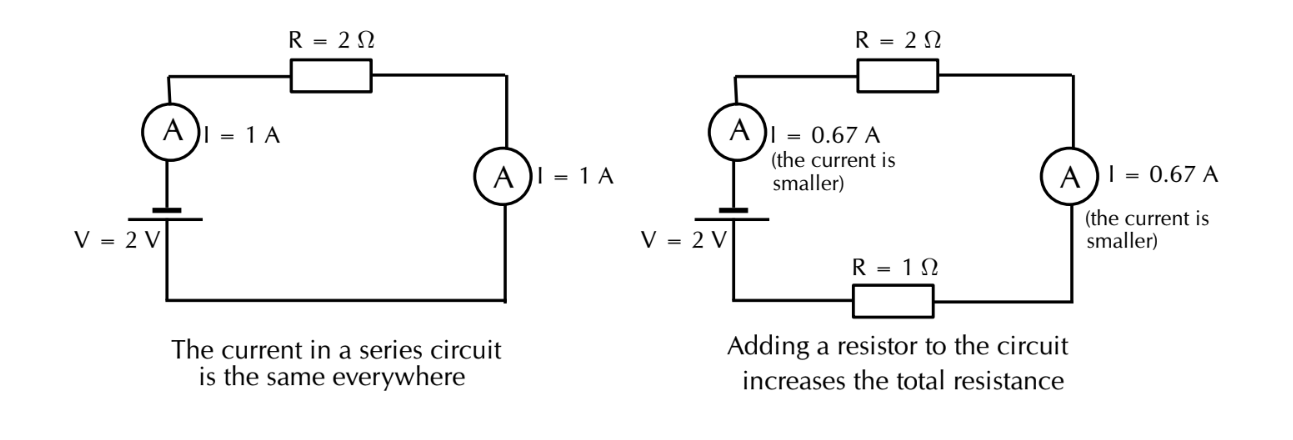
The diagram above shows how adding more resistance to a series circuit reduces the total current, but notice that the current remains the same at all measurement points within each circuit.
Voltage is divided across resistors
The total voltage from the power source gets divided up between all the resistors in the circuit. Each resistor uses up some of the total voltage, and when you add up all the individual voltages, they equal the battery voltage.
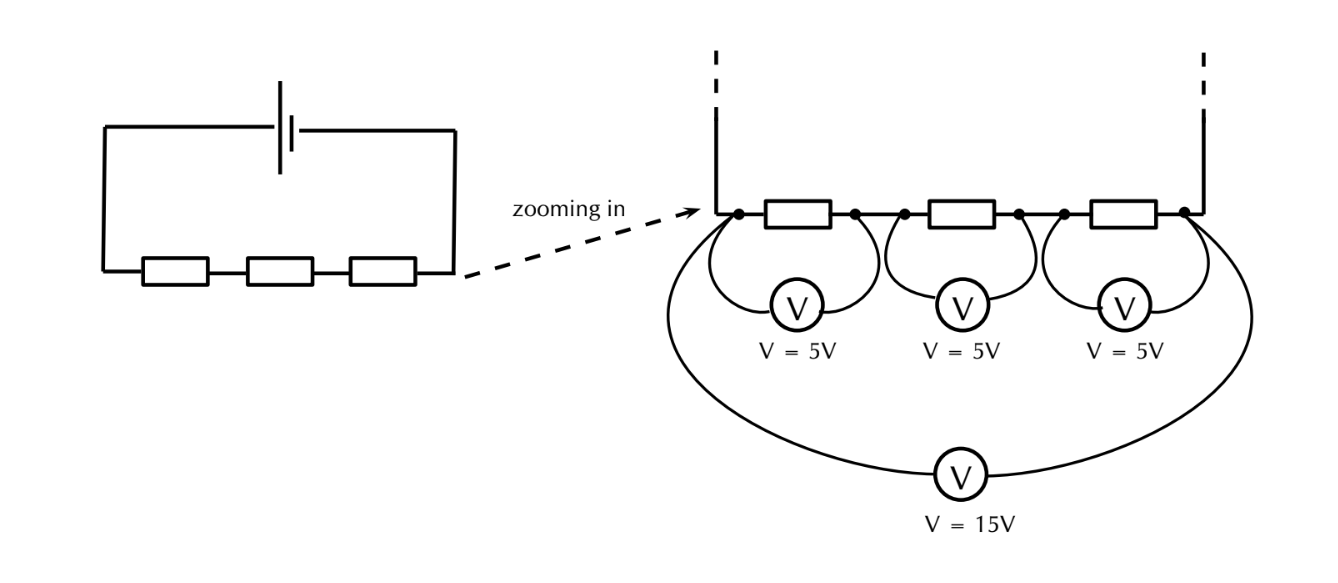
Formula for voltage division:
This diagram demonstrates voltage division perfectly. Notice how three identical resistors each use 5V, and the total adds up to 15V from the battery.
Total resistance increases
When you add resistors in series, you are making it harder for current to flow through the circuit. The total resistance becomes the sum of all individual resistances.
Formula for total resistance:
This means that adding even a small resistor will increase the total resistance and reduce the current in the entire circuit.
Understanding voltage division in detail
When resistors are connected in series, each one creates a potential difference across itself. The total potential difference across all resistors equals the sum of individual potential differences. This principle is fundamental to understanding how series circuits work.
The voltage across each resistor depends on its resistance value. Higher resistance means more voltage drop across that particular component, because more work must be done to push the current through it.
Note
Voltage Division Principle
In series circuits, voltage divides proportionally based on resistance values. A resistor with twice the resistance will have twice the voltage drop across it compared to a smaller resistor in the same circuit.
Calculating total resistance
The beauty of series resistance calculations lies in their simplicity - you simply add all resistance values together. This works regardless of how many resistors you have or what their individual values are.
For any number of resistors in series:
- Two resistors:
- Three resistors:
- Any number:
Example
Worked Example: Two resistors in series
Question: A circuit contains two resistors in series with resistance values of 5Ω and 17Ω. What is the total resistance?
Solution:
Step 1: Analyse the question
We have a series circuit with two known resistance values (5Ω and 17Ω), and we need to find the total resistance.
Step 2: Apply the relevant principles
For resistors in series:
Since we have two resistors:
Step 3: Calculate the result
Step 4: Quote the final result
The total resistance of the resistors in series is 22Ω.
Example
Worked Example: Three resistors in series
Question: A circuit contains three resistors in series with resistance values of 0.5Ω, 7.5Ω and 11Ω. What is the total resistance?
Solution:
Step 1: Analyse the question
We have a series circuit with three known resistance values, and we need to calculate the total resistance.
Step 2: Apply the relevant principles
For resistors in series:
With three resistors:
Step 3: Calculate the result
Step 4: Quote the final result
The total resistance of the resistors in series is 19Ω.
Example
Worked Example: Large resistance values
Question: A circuit contains two resistors in series with resistance values of 750kΩ and 1.7MΩ. What is the total resistance?
Solution:
Step 1: Analyse the question
We have two resistors in series with large resistance values given in different units (kΩ and MΩ).
Step 2: Apply the relevant principles
First, convert to the same units: 1.7MΩ = 1700kΩ
Then use:
Step 3: Calculate the result
Step 4: Quote the final result
The total resistance is 2.45MΩ.
General experiment: Voltage dividers
Aim: To investigate what happens to current and voltage in series circuits when additional resistors are added.
Note
Experimental Investigation: Series Circuit Behavior
Apparatus:
- Battery
- Voltmeter
- Ammeter
- Wires
- Various resistors
Method:
- Construct circuits with one, two, and three resistors in series
- Measure the voltage across each resistor in every circuit
- Measure the current before and after each resistor
- Compare your measurements with theoretical calculations
Expected results:
- The sum of voltages across all resistors equals the battery voltage:
- Current measurements remain identical throughout each circuit
- Total resistance equals the sum of individual resistances:
This experiment helps you see the principles of series circuits in action and confirms the theoretical relationships you've learned.
Summary
Key Points to Remember:
-
Same current everywhere: Current is identical at all points in a series circuit - there's only one path for it to follow
-
Voltage divides: The battery voltage gets split between all resistors, with the sum always equalling the total supply voltage:
-
Add resistances: Total resistance in series circuits is simply the sum of all individual resistances:
-
More resistance, less current: Adding resistors in series increases total resistance and decreases the current throughout the entire circuit
-
Higher resistance takes more voltage: Resistors with larger values will have bigger voltage drops across them in series circuits