Electromagnetic Spectrum (Grade 10 NSC Matric Physical Sciences): Revision Notes
📚Revision Notes
Electromagnetic Spectrum
What is the electromagnetic spectrum?
Electromagnetic (EM) radiation is energy that travels through space as waves. These waves can travel through a vacuum at the speed of light. The electromagnetic spectrum is the complete range of all electromagnetic radiation, organised by frequency and wavelength.
Note
The electromagnetic spectrum encompasses all forms of electromagnetic energy, from radio waves with wavelengths longer than buildings to gamma rays with wavelengths smaller than atomic nuclei. Understanding this spectrum is fundamental to modern physics and has countless practical applications.
EM radiation is classified into different types based on the frequency of the waves. In order of increasing frequency, these types include radio waves, microwaves, infrared radiation, visible light, ultraviolet radiation, X-rays, and gamma rays.
Wave equation and calculations
All electromagnetic waves follow the fundamental wave equation:
Where:
- c = speed of light in a vacuum =
- f = frequency (measured in Hz)
- λ = wavelength (measured in metres)
Important
This equation shows the inverse relationship between frequency and wavelength - when one increases, the other must decrease to maintain the constant speed of light. This is one of the most fundamental relationships in physics.
Example
Worked Example: Calculating Frequency
Calculate the frequency of electromagnetic radiation with a wavelength of 200 nm.
Step 1: Identify the known values
- Wavelength (λ) = 200 nm = m
- Speed of light (c) = m·s⁻¹
Step 2: Apply the wave equation
Step 3: State the final answer
- The frequency is Hz.
Categories of electromagnetic radiation
The electromagnetic spectrum contains seven main categories, each with distinct properties and uses.
Note
The table below shows how the electromagnetic spectrum is divided into categories. Notice that the boundaries between these categories are somewhat arbitrary - the spectrum is actually continuous with no sharp divisions.
| Category | Range of wavelengths (nm) | Range of frequencies (Hz) |
|---|---|---|
| Gamma rays | < 1 | > |
| X-rays | 1-10 | |
| Ultraviolet light | 10-400 | |
| Visible light | 400-700 | |
| Infrared | 700- | |
| Microwave | ||
| Radio waves | > | < |
Notice the inverse relationship between wavelength and frequency: as wavelength increases, frequency decreases, and vice versa.
Applications of electromagnetic waves
Each type of electromagnetic radiation has specific practical applications based on its properties:
| Category | Uses |
|---|---|
| Gamma rays | Used to kill bacteria in marshmallows and to sterilise medical equipment |
| X-rays | Used to image bone structures |
| Ultraviolet light | Bees can see into the ultraviolet because flowers stand out more clearly at this frequency |
| Visible light | Used by humans to observe the world |
| Infrared | Night vision, heat sensors, laser metal cutting |
| Microwave | Microwave ovens, radar |
| Radio waves | Radio, television broadcasts |
Note
The applications of electromagnetic waves are directly related to their energy levels and interaction properties. Higher energy waves (like X-rays) can penetrate materials, while lower energy waves (like radio) can travel long distances without significant absorption.
Understanding the complete spectrum
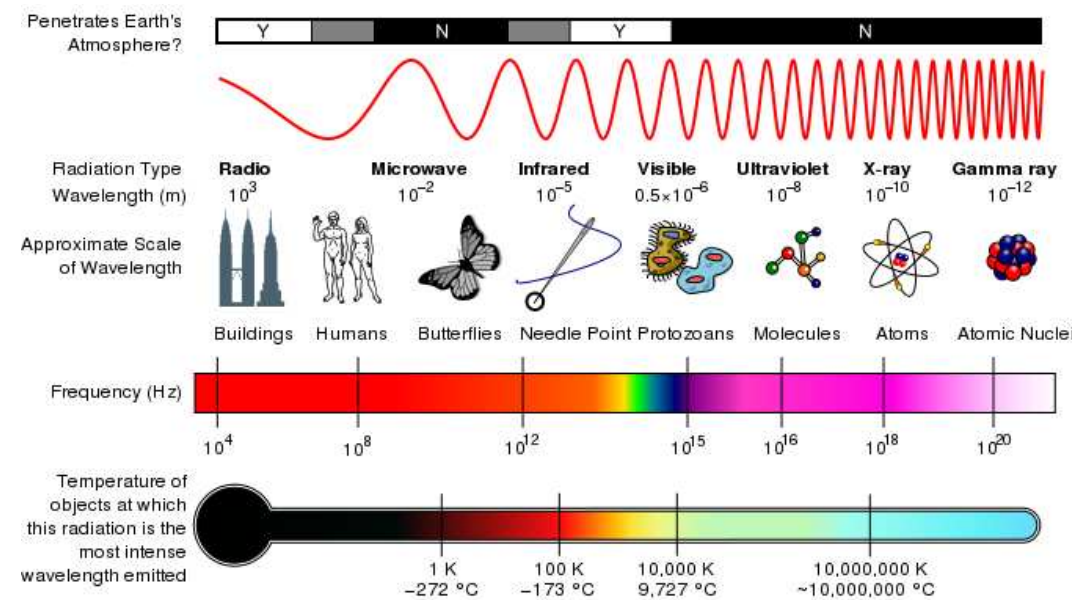
The electromagnetic spectrum is continuous, meaning there are no gaps between the different categories. The boundaries between categories are not sharp divisions but rather gradual transitions.
Important
Visible light represents only a tiny portion of the entire electromagnetic spectrum. This is the range of frequencies that human eyes can detect, allowing us to see the world around us. The visible spectrum includes all the colours we can see, from red (longest wavelength) to violet (shortest wavelength).
The spectrum extends infinitely in both directions - towards longer wavelengths (radio waves) and shorter wavelengths (gamma rays). Due to technological limitations, we can only detect and use certain portions of this infinite spectrum.
Key relationships and properties
Energy and frequency: Higher frequency electromagnetic radiation carries more energy. This explains why gamma rays and X-rays can be dangerous to living tissue, while radio waves are generally harmless.
Atmospheric penetration: Different types of electromagnetic radiation interact differently with Earth's atmosphere. Some wavelengths can penetrate the atmosphere easily, while others are absorbed or scattered.
Wave behaviour: All electromagnetic waves travel at the same speed in a vacuum (the speed of light), but they have different wavelengths and frequencies.
Note
Practical applications: Each region of the spectrum has specific uses based on how the radiation interacts with matter. For example:
- Long wavelengths (radio) can travel long distances and penetrate obstacles
- Short wavelengths (X-rays) can penetrate soft tissue but are absorbed by bones
- Visible light provides the information our eyes need to see
Summary
Key Points to Remember:
- The electromagnetic spectrum consists of seven main categories: radio waves, microwaves, infrared, visible light, ultraviolet, X-rays, and gamma rays
- All EM waves travel at the speed of light ( m·s⁻¹) in a vacuum
- The wave equation links wavelength and frequency - as one increases, the other decreases
- Higher frequency waves carry more energy and can be more dangerous to living tissue
- Visible light is only a tiny portion of the complete electromagnetic spectrum that human eyes can detect