Two Kinds of Charge (Grade 10 NSC Matric Physical Sciences): Revision Notes
📚Revision Notes
Two Kinds of Charge
What is electric charge?
Electric charge is a fundamental property of matter that exists in all objects around us, including people. Every object contains enormous amounts of both positive and negative charges. Understanding how these charges behave is essential for studying electrostatics, which focuses on electric charges that are at rest (not moving).
Note
Electrostatics is just one branch of electricity - it deals specifically with charges that aren't flowing as current. This makes it easier to study the basic principles of how charges interact with each other.
The two types of electric charge
There are exactly two types of electric charge:
- Positive charge - carried by protons in the nucleus of atoms
- Negative charge - carried by electrons that orbit the nucleus
These charges have opposite properties and interact with each other in predictable ways.
Note
Remember that protons are much heavier than electrons and are tightly bound in the nucleus, while electrons are much lighter and can move more easily between atoms. This difference is crucial for understanding how objects become charged.
Neutral vs charged objects
Neutral objects
When an object contains equal amounts of positive and negative charges, we say it has no net charge. This makes the object electrically neutral. Most objects around us start off as neutral.
Charged objects
When an object has unequal amounts of positive and negative charges, it becomes electrically charged. The object will have either:
- Positive charge - when there are more positive charges than negative charges
- Negative charge - when there are more negative charges than positive charges
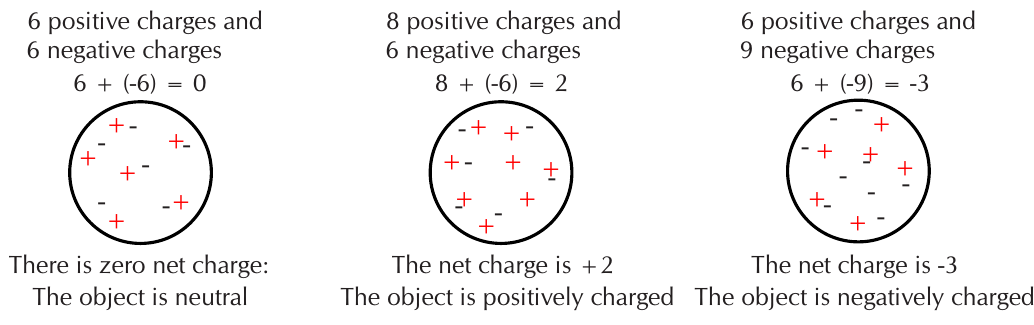
The net charge of any object can be calculated using:
For example:
- 6 positive + 6 negative = 0 (neutral object)
- 8 positive + 6 negative = +2 (positively charged)
- 6 positive + 9 negative = -3 (negatively charged)
How objects become charged
In practice, the number of positive charges (protons) in an object remains constant because protons are locked in the nucleus. Instead, objects become charged when the number of electrons changes:
Important
Critical Concept: Only Electrons Move
In everyday charging processes, protons stay fixed in the atomic nucleus while electrons can move freely between objects. This is why all charging happens through electron transfer, never proton transfer.
Positively charged objects
- Electrons are removed from the object
- This makes the object electron deficient
- More protons than electrons creates a positive net charge
Negatively charged objects
- Electrons are added to the object
- This gives the object an excess of electrons
- More electrons than protons creates a negative net charge
Tribo-electric charging
Tribo-electric charging is the process where objects become charged through contact or rubbing against each other. This is how you can create static electricity.
How tribo-electric charging works
When you rub two different materials together:
- Electrons transfer from one material to the other
- One material becomes positively charged (loses electrons)
- The other material becomes negatively charged (gains electrons)
- The total charge is conserved - no charge is created or destroyed
Note
Real-World Application: Static Electricity
When you rub your feet on carpet:
- Negative charge transfers from carpet to you
- You become negatively charged
- The carpet becomes positively charged by the same amount
- When you touch a metal door handle, you feel a shock as the excess charge discharges
Important
Key Principle: Charge Conservation
Charge cannot be created or destroyed - it can only be transferred from one object to another. This means the total amount of charge in the system always remains the same. This is one of the fundamental laws of physics.
The tribo-electric series
Materials can be arranged in a tribo-electric series based on their tendency to gain or lose electrons when rubbed together.
| Material | Position in Series |
|---|---|
| Glass | Very positive |
| Human hair | |
| Nylon | |
| Wool | |
| Fur | |
| Lead | |
| Silk | |
| Aluminium | |
| Paper | |
| Cotton | |
| Steel | |
| Wood | |
| Amber | |
| Hard rubber | |
| Nickel, Copper | |
| Gold, Platinum | |
| Polyester | |
| Polyurethane | |
| Polypropylene | |
| Silicon | |
| Teflon | Very negative |
Using the tribo-electric series
- Materials higher up in the series tend to lose electrons (become positive)
- Materials lower down in the series tend to gain electrons (become negative)
- The further apart two materials are in the series, the more charge transfer occurs
Example
Worked Example: Tribo-electric Charging
Question: If you rub cotton cloth with silk cloth, which becomes negatively charged?
Solution:
Step 1: Locate materials in the tribo-electric series
- Silk appears higher up than cotton in the series
Step 2: Apply the principle
- The material lower in the series (cotton) gains electrons
- The material higher in the series (silk) loses electrons
Step 3: Conclusion
- Cotton becomes negatively charged (gains electrons)
- Silk becomes positively charged (loses electrons)
Forces between charges
The electrostatic force is the force that charged objects exert on each other, even when they're not touching.
Important
Fundamental Rules for Electrostatic Forces
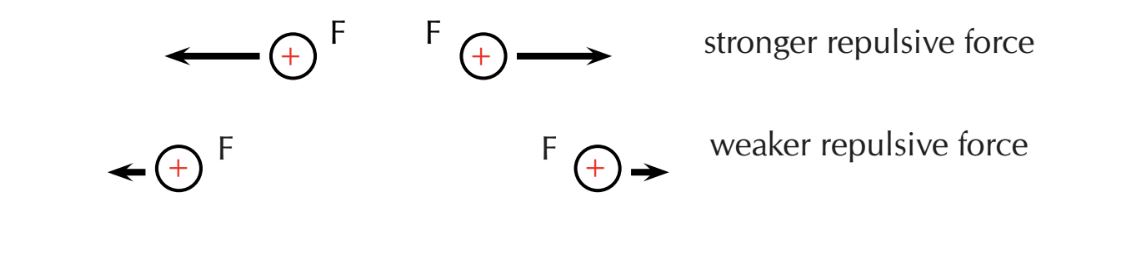
- Like charges repel each other - Two positive charges or two negative charges push each other away
- Opposite charges attract each other - A positive charge and negative charge pull towards each other
These rules are universal and apply to all charged objects, regardless of size or material.
Like charges repel each other
- Two positive charges push each other away
- Two negative charges push each other away
Opposite charges attract each other
- A positive charge and negative charge pull towards each other

Strength of electrostatic forces
The strength of the electrostatic force depends on:
- Distance between charges - closer charges exert stronger forces
- Amount of charge - objects with more charge exert stronger forces
Example
Worked Example: Electrostatic Forces
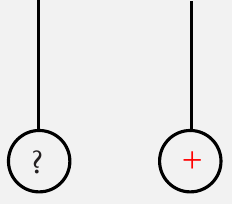
Question: Two charged metal spheres hang from strings. The right sphere is positively charged. When brought close together, the left sphere swings towards the right sphere. What can you conclude about the charge on the left sphere?
Solution:
Step 1: Analyse the motion
- The left sphere is attracted to the right sphere
- This means the spheres have opposite charges
Step 2: Apply force rules
- Since opposite charges attract each other
- The right sphere is positive
- The left sphere must be negative
Step 3: Conclusion
- The left sphere has a negative charge
Remember!
Summary
Key Points to Remember:
- All objects contain both positive and negative charges - the balance determines if they're neutral or charged
- Only electrons move - protons stay fixed in the nucleus, so charging happens through electron transfer
- Tribo-electric charging conserves charge - when one object gains electrons, another loses the same amount
- Use the tribo-electric series - materials higher up lose electrons, materials lower down gain electrons
- Like charges repel, opposites attract - this is the fundamental rule for electrostatic forces