Magnetism (Grade 10 NSC Matric Physical Sciences): Revision Notes
📚Revision Notes
Magnetism and Magnetic Fields
Introduction to magnetism
Magnetism is a fascinating force that allows certain objects to interact with each other without actually touching. This non-contact force occurs between objects called magnetic objects.
When a magnetic object creates a magnetic field around itself, other magnetic objects within this field experience magnetic forces. The strength of these forces decreases as objects move further apart from each other.
Note
Magnetism represents one of the fundamental forces in nature, allowing objects to influence each other across empty space without any physical contact between them.
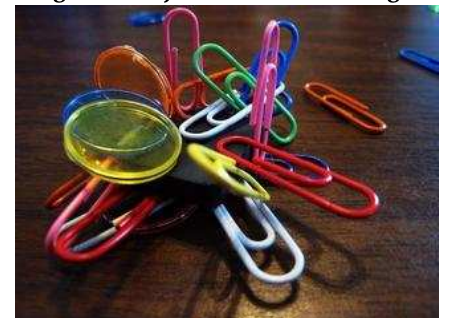
Humans have understood magnetism for thousands of years. Ancient civilisations discovered lodestone, a naturally magnetised form of iron oxide called magnetite, which could attract iron objects.
Magnetic fields
What is a magnetic field?
A magnetic field is a region in space where any magnet or magnetic material will experience a non-contact magnetic force. Think of it as an invisible area of influence surrounding a magnetic object.
Moving charges and magnetic fields
All moving charged particles create magnetic fields around them. In most materials, electrons orbit the nucleus of atoms and create tiny magnetic fields. However, in ordinary materials like plastic, these electron magnetic fields point in random directions and cancel each other out.
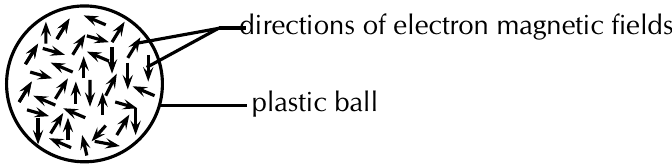
The diagram shows how electron magnetic fields in a plastic ball point in all directions, resulting in no overall magnetic field for the entire object.
Ferromagnetic materials and domains
Ferromagnetic materials (such as iron, nickel, and cobalt) behave differently. In these materials, regions called domains exist where electrons' magnetic fields line up in the same direction.
Important
Definition: A ferromagnetic material is a substance that shows spontaneous magnetisation, meaning it can develop magnetic properties without needing an external magnetic field to be present continuously.
In an unmagnetised piece of iron, domains point in random directions. However, when you magnetise the iron (by rubbing it with a magnet), the domains align in the same direction, creating a strong overall magnetic field.
Note
The key to understanding ferromagnetism lies in the concept of domains. When these microscopic regions align their magnetic fields in the same direction, the material becomes strongly magnetic.
Permanent magnets
Definition and characteristics
A permanent magnet maintains its magnetic properties over long periods without needing an external magnetic field. Once magnetised, ferromagnetic materials can stay magnetic indefinitely.
Magnetic poles
Every magnet has two distinct ends called magnetic poles:
- North pole (usually marked N)
- South pole (usually marked S)
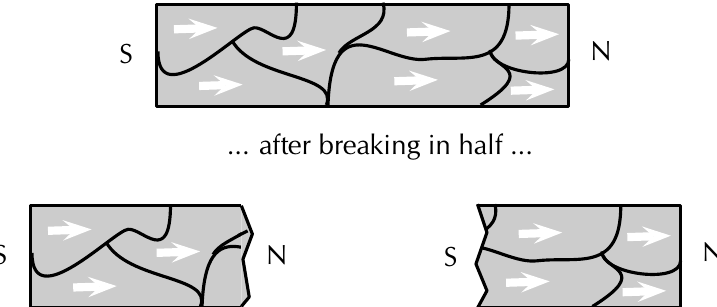
Important
Critical Rule: Magnetic poles always come in pairs. You cannot have a north pole without a south pole, or vice versa. Even if you break a magnet in half, each piece will still have both a north and south pole.
This differs from electric charges, where you can have positive or negative charges existing independently.
Magnetic forces
Attraction and repulsion rules
The fundamental rules governing magnetic forces demonstrate predictable patterns of interaction between magnetic poles.
Important
Fundamental Magnetic Force Rules:
- Like poles repel each other (N-N or S-S push apart)
- Unlike poles attract each other (N-S pull together)
These rules are absolute and apply to all magnetic interactions.

The image shows two bar magnets positioned so their north poles face each other, demonstrating repulsion between like poles.
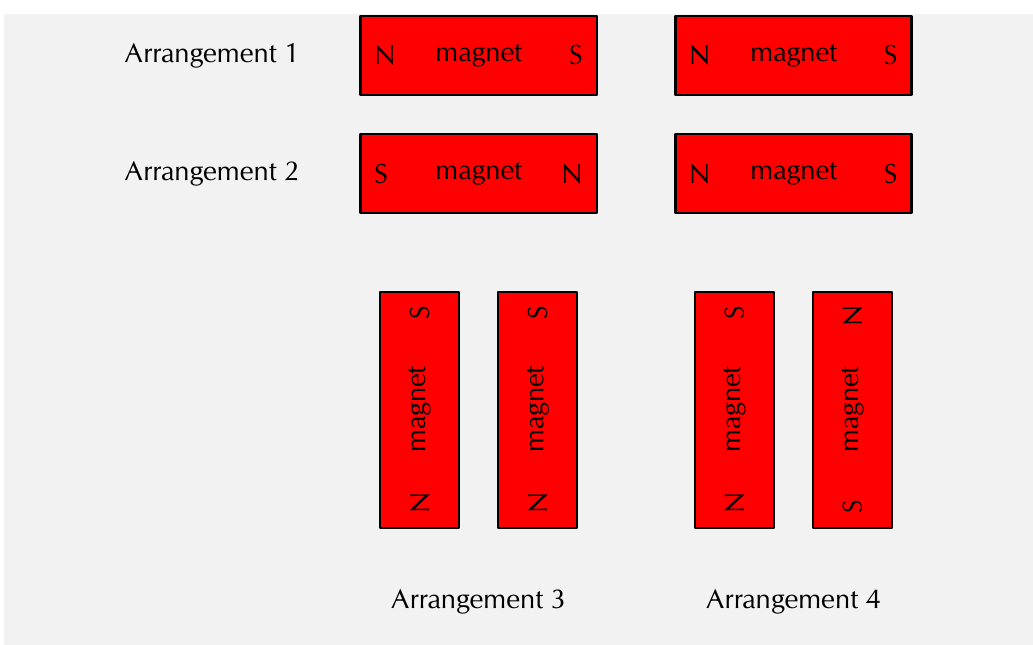
This diagram shows four different arrangements of bar magnets, illustrating various combinations of pole interactions.
Representing magnetic fields
Magnetic field lines
We represent magnetic fields using magnetic field lines. These imaginary lines help us visualise the direction and strength of magnetic fields.
Note
Key Properties of Magnetic Field Lines:
- They start at the north pole and end at the south pole
- They never cross each other
- Closer lines indicate stronger magnetic fields
- Further apart lines indicate weaker magnetic fields
Remember: Field lines are a tool for visualisation - they don't physically exist but represent the invisible magnetic field.
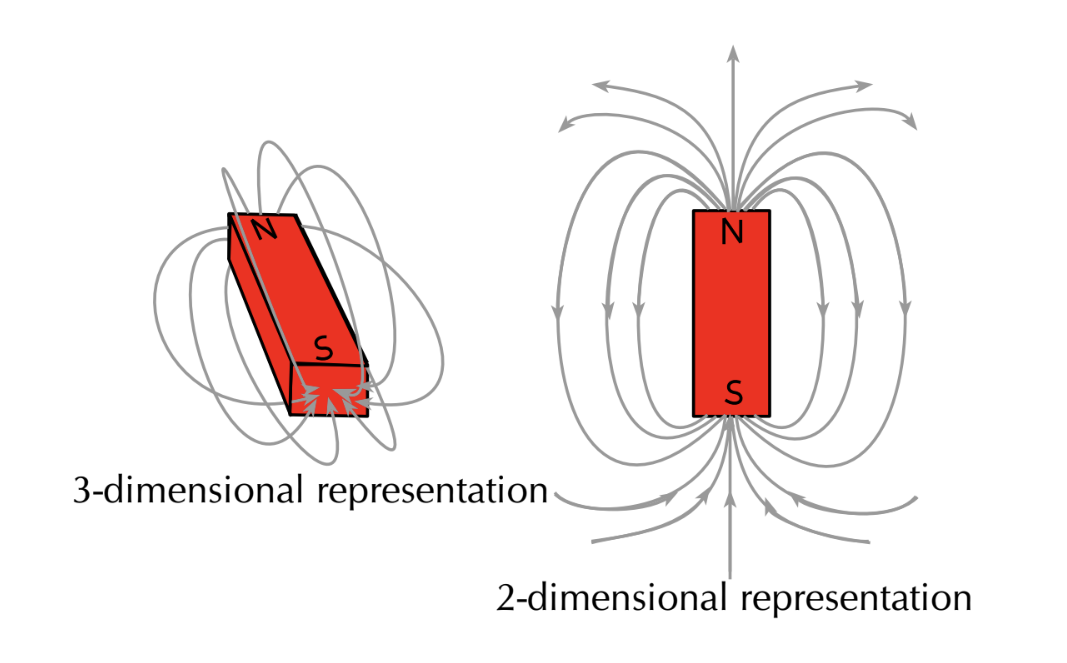
This shows both 3-dimensional and 2-dimensional representations of magnetic field lines around a bar magnet.
Magnetic flux
The number of magnetic field lines passing through a given area is called magnetic flux. This measurement helps us understand the strength of the magnetic field in that region.
Visualising magnetic fields with iron filings
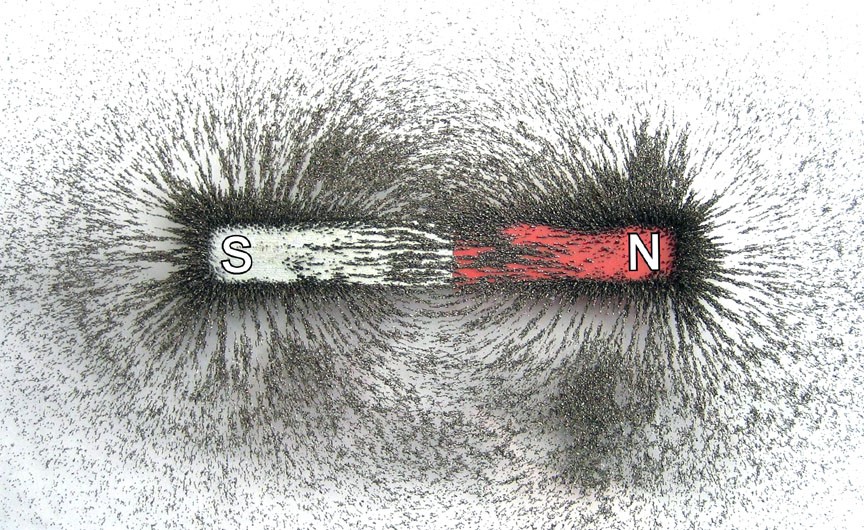
This photograph demonstrates how iron filings align themselves along magnetic field lines when sprinkled around a magnet. The filings create a clear visual pattern showing the field's shape and direction.
Example
Practical Investigation: Iron Filing Pattern
Method:
- Place a sheet of paper over a bar magnet
- Sprinkle iron filings evenly over the paper
- Gently tap the paper to help filings move
Result: The iron filings align parallel to the magnetic field lines, revealing the invisible field pattern and showing how field strength varies with distance from the magnet.
Types of magnetic materials
Understanding how different materials respond to magnetic fields helps us classify them into distinct categories based on their magnetic behaviour.
Ferromagnetism
Ferromagnetism occurs in materials like iron, nickel, and cobalt. These materials can form permanent magnets and are strongly attracted to existing magnets, regardless of which magnetic pole approaches them.
Other magnetic materials
Paramagnetic materials (like aluminium or platinum) become magnetised in external magnetic fields but lose their magnetism when the external field is removed.
Diamagnetic materials (like copper or bismuth) are slightly repelled by magnets and become magnetised with polarity opposite to the external magnetic field.
Retentivity
Retentivity refers to a ferromagnetic material's ability to retain its magnetisation after an external magnetic field is removed. Materials with high retentivity make good permanent magnets.
Note
Material selection for permanent magnets depends on retentivity. High-retentivity materials like certain steel alloys maintain their magnetic properties for years, while low-retentivity materials like soft iron lose magnetisation quickly.
The compass
A compass is a practical instrument that uses magnetism to find direction. It consists of a small magnetised needle that can rotate freely on a pivot.
When placed in a magnetic field, the compass needle aligns itself with the field lines. The north-seeking end of the needle points towards the magnetic field's direction.
Note
How a Compass Works: The magnetised needle in a compass acts like a tiny bar magnet. In Earth's magnetic field, it aligns with the field lines, with one end pointing towards magnetic north. This simple principle has been used for navigation for over a thousand years.
Worked example: Magnetic pole interactions
Example
Worked Example: Predicting Magnetic Interactions
Question: Two bar magnets are placed near each other. Magnet A has its north pole facing the south pole of Magnet B. What will happen?
Solution: Step 1: Identify the poles facing each other
- Magnet A: North pole (N)
- Magnet B: South pole (S)
- Configuration: N facing S
Step 2: Apply the magnetic force rule
- Unlike poles attract each other
- N and S are unlike poles
Step 3: Predict the outcome Answer: The magnets will be attracted to each other and move together.
Exam tip: Always identify which specific poles are facing each other before applying the attraction/repulsion rules.
Practical investigations
Investigation 1: Testing ferromagnetic materials
Example
Investigation: Identifying Ferromagnetic Materials
Method:
- Collect various objects (paper clips, coins, keys, aluminium foil, etc.)
- Test each object by bringing a strong magnet close to it
- Observe and record which materials are attracted
- Classify materials as ferromagnetic or non-ferromagnetic
Expected Results: Iron, nickel, and cobalt objects will be strongly attracted; most other materials (plastic, copper, aluminium) will show no response.
Investigation 2: Magnetising materials
Example
Investigation: Creating Temporary Magnets
Method:
- Take a metal needle or nail (iron-based)
- Rub the object with one pole of a bar magnet 20-30 times in the same direction
- Test if the needle now attracts small iron objects like paper clips
- Observe how long the magnetisation lasts
Expected Results: The needle becomes magnetised and can attract iron filings or small metal objects. The strength of magnetisation depends on the material and may fade over time.
Summary
Key Points to Remember:
- Magnetism involves non-contact forces between magnetic objects in magnetic fields
- Ferromagnetic materials can be magnetised due to domain alignment in iron, nickel, and cobalt
- All magnets have both north and south poles in pairs - you cannot separate them
- Like poles repel, unlike poles attract - this rule never changes
- Magnetic field lines visualise field direction and strength, always running from north to south poles
- Compass navigation relies on a magnetised needle aligning with Earth's magnetic field
- Practical applications include motors, generators, speakers, and navigation instruments