Mechanical Energy (Grade 10 NSC Matric Physical Sciences): Revision Notes
📚Revision Notes
Kinetic Energy
Definition
Kinetic energy is the energy that moving objects possess. Any object that is in motion has kinetic energy, while stationary objects have zero kinetic energy.
Note
The key distinction is simple: if an object is moving, it has kinetic energy. If it's completely still, its kinetic energy is zero.
- Quantity: Kinetic energy (EK)
- Unit: Joule (J)
- Symbol: J
The kinetic energy formula
The amount of kinetic energy an object has can be calculated using the fundamental formula:
Important
Where:
- = kinetic energy (measured in joules, J)
- = mass of the object (measured in kilograms, kg)
- = velocity of the object (measured in metres per second, m·s⁻¹)
Factors affecting kinetic energy
Kinetic energy is determined by two main factors:
- Mass: The heavier an object is, the more kinetic energy it has
- Velocity: The faster an object moves, the more kinetic energy it has
Important
Critical Concept: Velocity has a greater effect on kinetic energy than mass because velocity is squared in the formula. A truck moving at 100 km·hr⁻¹ has more kinetic energy than a car with half the mass moving at the same speed.
Understanding through examples
Consider an object at rest on a cupboard. Since it's not moving, its kinetic energy equals zero:
When the same object falls and reaches a velocity of 6.26 m·s⁻¹, its kinetic energy becomes:
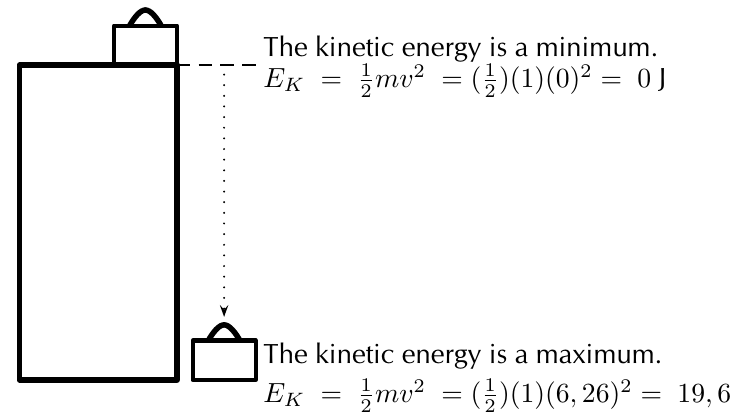
This demonstrates that kinetic energy is minimum when an object is stationary and maximum when it moves fastest.
Worked examples
Example
Worked Example 1: Basic kinetic energy calculation
Question: A 1 kg brick falls from a 4 m high roof. It reaches the ground with a velocity of 8.85 m·s⁻¹. What is the kinetic energy of the brick when it starts to fall and when it reaches the ground?
Solution:
Step 1: Identify the given information
- Mass of brick: kg
- Velocity at bottom: m·s⁻¹
- Both values are in correct units
Step 2: Determine what is being asked
- We need to find the kinetic energy at the top (when stationary) and at the bottom (when moving).
Step 3: Calculate kinetic energy at the top
- Since the brick is not moving at the top, its kinetic energy is zero.
Step 4: Calculate kinetic energy at the bottom
Example
Worked Example 2: Comparing kinetic energies of different objects
Question: A herder is herding sheep into a kraal. A mother sheep and her lamb are both running at 2.7 m·s⁻¹ towards the kraal. The sheep has a mass of 80 kg and the lamb has a mass of 25 kg. Calculate the kinetic energy for each animal.
Solution:
Step 1: Identify given information
- Mass of sheep = 80 kg
- Mass of lamb = 25 kg
- Both animals have velocity = 2.7 m·s⁻¹
Step 2: Calculate the sheep's kinetic energy
Step 3: Calculate the lamb's kinetic energy
Note: Even though both animals move at the same velocity, the sheep has more kinetic energy because it has greater mass.
Example
Worked Example 3: Unit conversion and calculation
Question: A bullet having a mass of 150 g is shot with a muzzle velocity of 960 m·s⁻¹. Calculate its kinetic energy.
Solution:
Step 1: Convert mass to correct units
- Mass in grams ÷ 1000 = Mass in kg
- 150 g ÷ 1000 = 0.150 kg
Step 2: Apply the kinetic energy formula
Checking units
Note
Unit Verification for Kinetic Energy
The unit for kinetic energy should be kg·m²·s⁻². We can prove this equals the joule (the unit for energy):
This confirms that our kinetic energy calculations will always result in joules when using the correct SI units.
Summary
Key Points to Remember:
- Kinetic energy is energy of motion - only moving objects possess it
- The formula is - half mass times velocity squared
- Stationary objects have zero kinetic energy - no motion means no kinetic energy
- Velocity has more impact than mass - because velocity is squared in the formula
- Always check your units - mass in kg, velocity in m·s⁻¹, energy in J