Motion in One Dimension (Grade 10 NSC Matric Physical Sciences): Revision Notes
📚Revision Notes
Equations of Motion
Motion can be described in three different ways: using words, using graphs, and using equations. The equations of motion provide a mathematical approach to solve problems involving objects that move with constant acceleration (also called uniformly accelerated motion).
Note
The equations of motion represent the third and most precise method for analyzing motion, allowing for exact calculations when dealing with constant acceleration scenarios.
Variables and symbols
When working with motion equations, you need to understand the key variables and their symbols:
- vi = initial velocity (m·s⁻¹) at t = 0 s
- vf = final velocity (m·s⁻¹) at time t
- Δx = displacement (m)
- t = time (s)
- Δt = time interval (s)
- a = acceleration (m·s⁻²)
These variables represent the fundamental quantities that describe how objects move when they experience constant acceleration.
The four kinematic equations
There are four main equations that relate the motion variables. Each equation connects different combinations of the five variables, allowing you to solve problems when you know any three quantities and need to find the fourth.
Equation 1:
This equation relates final velocity to initial velocity, acceleration, and time. Use this when you need to find velocity after a certain time period.
Equation 2:
This equation calculates displacement using the average of initial and final velocities multiplied by time. It's particularly useful when you know both velocities.
Equation 3:
This equation finds displacement using initial velocity, time, and acceleration. It's very common in problems where an object starts from rest or has a known initial velocity.
Equation 4:
This equation connects velocities, acceleration, and displacement without involving time. Use this when time is not given or needed.
Problem-solving strategy
Important
Essential Problem-Solving Steps:
Step 1: Read the question carefully to identify the quantities that are given. Write them down clearly.
Step 2: Identify which equation to use. Write it down! Choose the equation that contains the three known quantities and the one unknown quantity you need to find.
Step 3: Ensure all values are in the correct SI units and substitute them into your equation.
Step 4: Calculate the answer and check that your units make sense.
Remember: You need any three known quantities (vi, vf, Δx, t, or a) to calculate the fourth one using the appropriate equation.
Worked example 1: Finding acceleration
Example
Worked Example: Finding Acceleration
Question: A racing car travels north and accelerates uniformly, covering a distance of 725 m in 10 s. If it has an initial velocity of 10 m·s⁻¹, find its acceleration.
Solution:
Step 1 - Identify given information:
- m·s⁻¹
- m
- s
- (unknown)
Step 2 - Choose the appropriate equation:
- Since we know , , and , but need to find , we use Equation 3:
Step 3 - Substitute values and solve:
Step 4 - Final answer: The racing car is accelerating at 12.5 m·s⁻² north.
Worked example 2: Multiple calculations
Example
Worked Example: Multiple Motion Calculations
Question: A motorcycle travelling east starts from rest and moves in a straight line with constant acceleration, covering a distance of 64 m in 4 s. Calculate:
- its acceleration
- its final velocity
- at what time the motorcycle had covered half the total distance
- what distance the motorcycle had covered in half the total time
Solution:
Finding acceleration: Given: m·s⁻¹ (starts from rest), m, s
Using Equation 3:
Finding final velocity:
- Using Equation 1:
Time at half distance (32 m):
- Using Equation 3:
Distance at half time (2 s):
- Using Equation 3:
Real-world applications
The equations of motion have practical applications in road safety, helping us analyse the relationship between speed and stopping distance.
Example
Worked Example: Stopping Distance Analysis
Question: A truck travels at a constant velocity of 10 m·s⁻¹ when the driver sees a child 50 m ahead. The driver's reaction time is 0.5 s, after which the truck brakes with an acceleration of -1.25 m·s⁻². Will the truck hit the child?
Solution:
This problem has two phases: constant velocity during reaction time, then deceleration during braking.
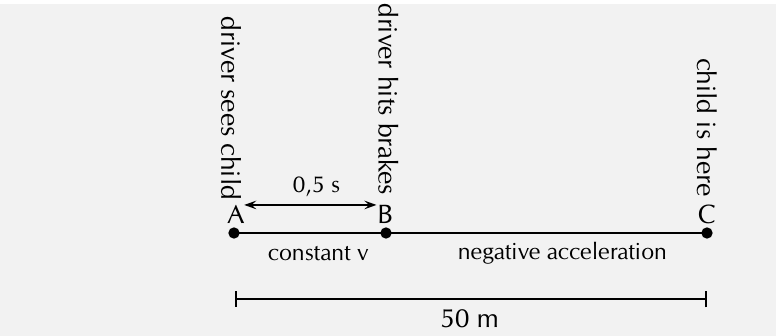
Phase 1 - Constant velocity (reaction time): Distance = velocity × time = m
Phase 2 - Braking (deceleration): Given: m·s⁻¹, m·s⁻¹, m·s⁻²
First, find braking time using Equation 1:
Then find braking distance using Equation 2:
Total stopping distance: m
Since the child is 50 m ahead and the truck stops in 45 m, the truck will not hit the child.
Summary
Key Points to Remember:
- The four kinematic equations work only for motion with constant acceleration
- Always identify your known and unknown variables before choosing an equation
- Ensure all values are in correct SI units before substituting
- Any three known quantities allow you to find the fourth using the appropriate equation
- Draw timeline diagrams for complex problems with multiple phases to visualise the motion clearly
- The problem-solving strategy is your roadmap to success: identify givens, choose the right equation, check units, and verify your answer