Sound Waves (Grade 10 NSC Matric Physical Sciences): Revision Notes
📚Revision Notes
Sound Waves
What are sound waves?
Sound waves are a type of longitudinal wave that travels through matter. When you hear any sound around you, what you're actually detecting are pressure changes in the air that reach your ears.
Sound is created when something causes a disturbance in the air around it. This disturbance creates a pulse that travels away from where it started. When this pulse reaches your ear, it makes your eardrum vibrate, which is how you hear the sound.
Note
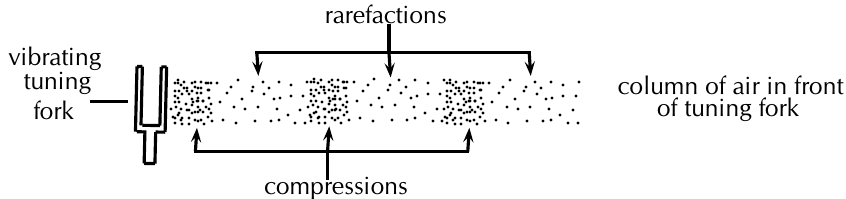
Scientists define sound waves as longitudinal pressure waves. This means the waves are made up of alternating areas of compressions and rarefactions in the air pressure.
How sound waves are created
Let's look at how a tuning fork creates sound waves to understand this process better.
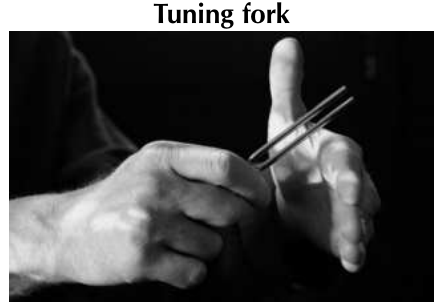
A tuning fork is a special instrument that musicians use to create sound waves of a specific frequency. When you strike a tuning fork, its prongs vibrate back and forth very quickly.
Example
How a Tuning Fork Creates Sound Waves:
Step 1: The vibrating prongs push against the air particles in front of them
Step 2: These air particles get pushed together, creating a compression (high pressure area)
Step 3: The particles behind the compression spread out, creating a rarefaction (low pressure area)
Step 4: As the prongs continue vibrating, this pattern of compressions and rarefactions travels through the air
Properties of sound waves
Sound waves have two main features that make them different from other types of waves:
Compressions and rarefactions
- Compressions: These are regions where air particles are squeezed together, creating areas of high pressure
- Rarefactions: These are regions where air particles are spread apart, creating areas of low pressure
The continuous creation of these alternating high and low pressure areas is what allows sound to travel through the air as a wave.
Need for a medium
Important
Unlike light waves, sound waves must have a medium to travel through. They cannot travel through empty space (vacuum).
The medium can be:
- Air (most common)
- Liquids like water
- Solids like metal or wood
How sound waves travel through different media
Sound waves behave differently depending on what they're travelling through:
Speed in different media:
- Sound travels fastest in solids
- Sound travels at medium speed in liquids
- Sound travels slowest in gases like air
Note
This happens because the particles in solids are closer together than in liquids, and particles in liquids are closer together than in gases. When particles are closer together (denser material), the sound wave can travel faster between them.
Practical investigation: Building a telephone
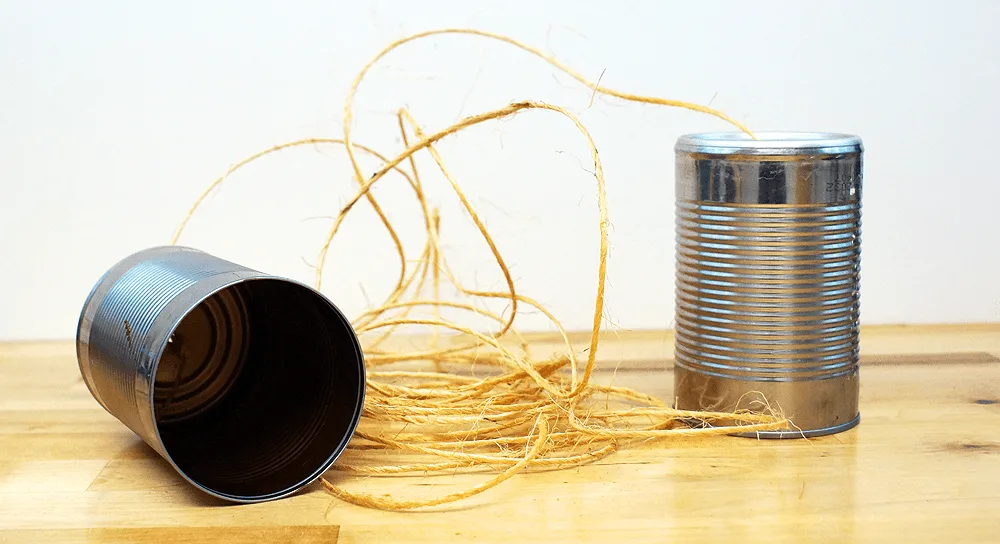
You can demonstrate how sound travels through different media by building your own telephone using simple materials.
Example
Building Your Own Telephone:
Materials needed:
- Two tin cans or paper cups
- String
- Toothpicks or small sticks
Method:
- Tie a toothpick to each end of a long piece of string
- Make a small hole in the bottom of each can or cup
- Push the toothpick through the hole and pull the string tight
- Place one can at each end of the string
- Hold the string tight and talk into one can while someone listens at the other end
Why it works:
- Sound waves travel much faster and further through the tight string than through air alone
- The string must be tight for the sound wave to travel through it effectively
- The cups help to amplify (make louder) the sound at both ends
This experiment shows that sound waves need a medium to travel through, and they travel better through some materials than others.
Remember!
Summary
Key Points to Remember:
- Sound waves are longitudinal pressure waves made up of compressions (high pressure) and rarefactions (low pressure)
- Sound waves need a medium to travel - they cannot travel through empty space
- Vibrations create sound waves by pushing air particles together and apart
- Sound travels fastest in solids, slower in liquids, and slowest in gases because denser materials have particles closer together
- Simple experiments like the tin can telephone can demonstrate how sound travels through different materials