Superposition of Pulses (Grade 10 NSC Matric Physical Sciences): Revision Notes
📚Revision Notes
Superposition of Pulses
What happens when pulses meet?
When two or more pulses travel through the same medium and encounter each other at the same location, they interact to create a new disturbance at that point. This interaction follows a fundamental rule called the principle of superposition. After the pulses pass through each other, each pulse continues along its original path with its original amplitude unchanged.
Important
Key Concept: Pulses do not permanently change each other when they interact. After interference, each pulse maintains its original properties and continues along its path as if the interaction never occurred.
Principle of superposition
Important
Definition: The principle of superposition states that when two disturbances occupy the same space at the same time, the resulting disturbance equals the sum of the two individual disturbances.
This means that when pulses meet, you simply add their amplitudes together at each point where they overlap. The resulting pulse shape depends on whether the amplitudes add positively or negatively.
Types of interference
Constructive interference
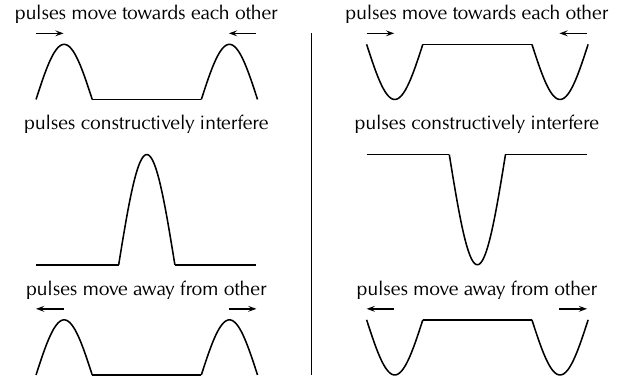
Definition: Constructive interference occurs when two pulses meet, resulting in a bigger pulse.
Constructive interference happens when:
- Two upward pulses (crests) meet each other
- Two downward pulses (troughs) meet each other
- The amplitudes add together to create a larger combined amplitude
For example, if a pulse with amplitude +2 m meets another pulse with amplitude +1 m, the resulting pulse will have amplitude +3 m at the point where they overlap.
Destructive interference
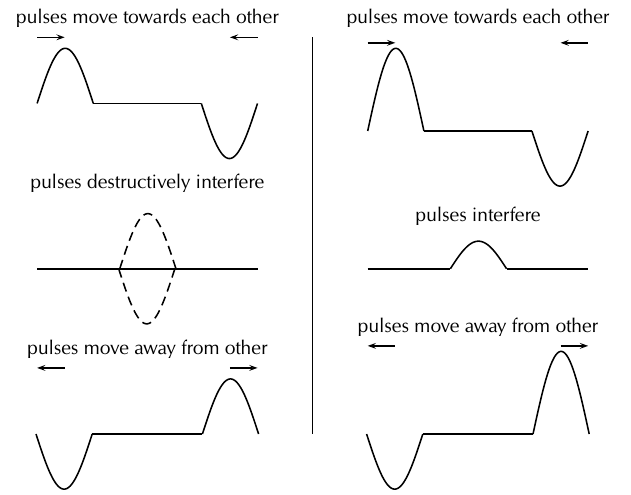
Definition: Destructive interference occurs when two pulses meet, resulting in a smaller pulse.
Destructive interference happens when:
- An upward pulse (crest) meets a downward pulse (trough)
- The amplitudes partially or completely cancel each other out
- One amplitude is positive and the other is negative
For example, if a pulse with amplitude +2 m meets a pulse with amplitude -1 m, the resulting pulse will have amplitude +1 m. If equal but opposite pulses meet, they completely cancel out temporarily.
Worked example: pulse collision
Example
Worked Example: Analyzing Pulse Collision
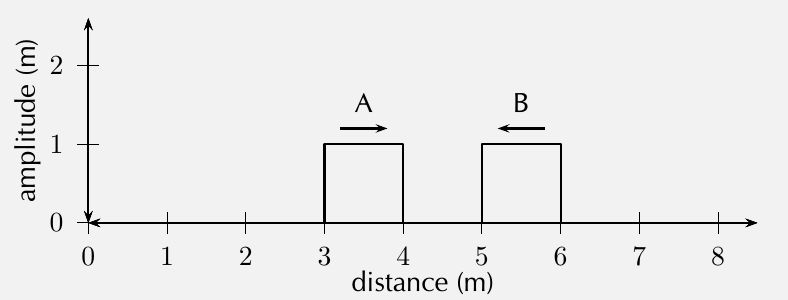
Let's examine what happens when two rectangular pulses approach each other at a speed of 1 m·s⁻¹.
Initial conditions (t = 0 s):
Two identical pulses, each with amplitude 1 m, are positioned at different locations. Pulse A is at 2-3 m moving right, and pulse B is at 6-7 m moving left.
Step 1: After 1 second Each pulse moves 1 m in its respective direction. Pulse A moves to position 3-4 m, and pulse B moves to position 5-6 m.
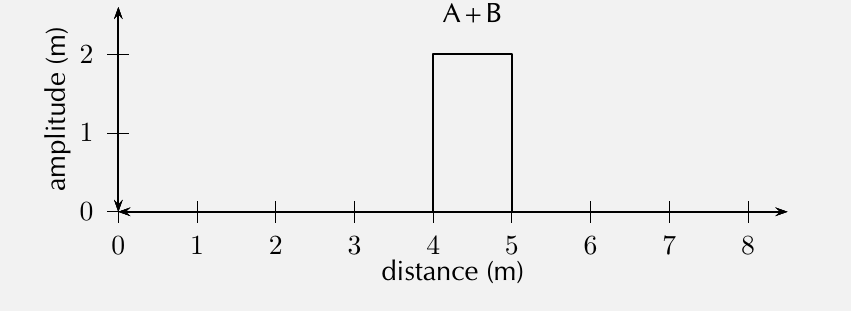
Step 2: After 2 seconds The pulses now overlap completely. Using the principle of superposition, we add their amplitudes: 1 m + 1 m = 2 m. The combined pulse has double the original amplitude.
Step 3: After 5 seconds The pulses have passed through each other completely. Each pulse continues with its original shape and amplitude, but they are now on opposite sides from where they started.
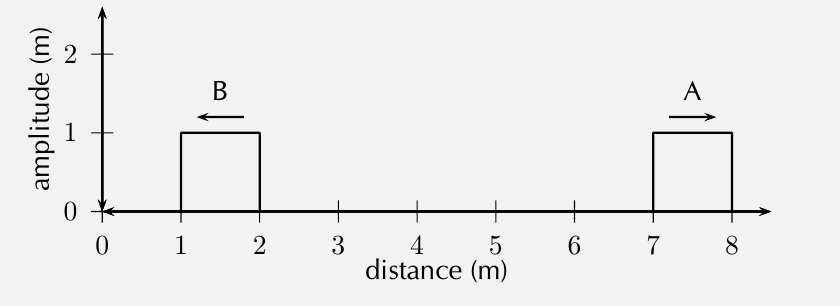
This demonstrates that pulses maintain their individual properties after interference - they don't permanently change each other.
Experimental demonstration
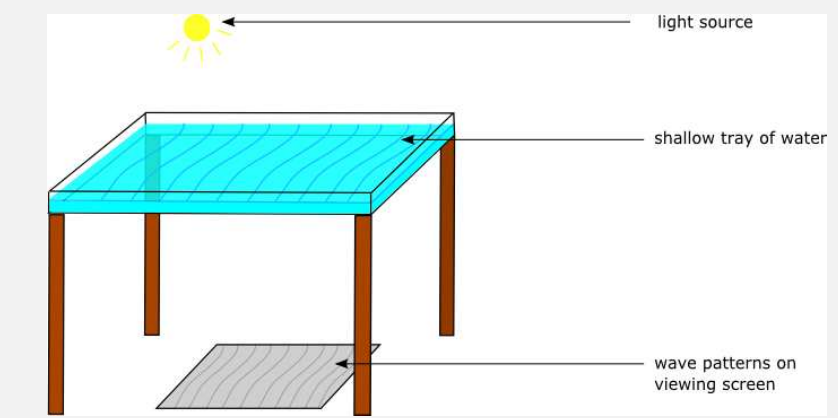
Aim: To observe constructive and destructive interference using a ripple tank
Apparatus: Ripple tank apparatus with light source, shallow water tray, and viewing screen
Note
Method:
- Set up the ripple tank with shallow water
- Create a single pulse and observe its behaviour (you can tap the water surface, drop a small object, or use an electronic vibrator)
- Produce two pulses simultaneously and observe their interaction
- Create two pulses at slightly different times and observe the interference patterns
Expected results: When you produce two pulses simultaneously, you'll see them interfere constructively (creating larger amplitude). When produced at different times, you may observe destructive interference where the pulses partially cancel each other.
Problem-solving approach for pulse superposition
Note
Systematic Problem-Solving Steps:
When analyzing pulse superposition problems:
- Identify the initial conditions - note the position, amplitude, and direction of each pulse
- Calculate pulse positions at different time intervals using: new position = initial position + (speed × time)
- Check for overlap - determine when and where pulses meet
- Apply superposition - add amplitudes algebraically at overlapping regions
- Show the aftermath - demonstrate that pulses continue unchanged after passing through each other
Common exam scenarios
- Equal amplitude pulses: Result in complete constructive or destructive interference
- Unequal amplitude pulses: Create partial interference effects
- Complex pulse shapes: Require point-by-point amplitude addition
- Multiple pulses: Apply superposition principle to all overlapping regions
Key exam tips
Note
Essential Exam Strategy:
- Always remember that pulses return to their original form after interference
- Pay careful attention to pulse directions (shown by arrows)
- When adding amplitudes, consider both positive and negative values
- Draw clear diagrams showing the step-by-step progression
- Check your final answer by ensuring energy conservation
Summary
Key Points to Remember:
- The principle of superposition states that overlapping disturbances add algebraically
- Constructive interference occurs when pulses of the same type meet, creating larger amplitudes
- Destructive interference happens when opposite pulses meet, reducing the overall amplitude
- Pulses maintain their original properties after passing through each other
- Problem-solving requires tracking pulse positions over time and applying superposition when they overlap