What Is a Transverse Wave? (Grade 10 NSC Matric Physical Sciences): Revision Notes
📚Revision Notes
What Is a Transverse Wave?
Understanding waves in nature
Waves are everywhere around us in the natural world. You can observe them in water - whether in the ocean, a dam, or even a bucket. However, waves don't only exist in water. They occur in any type of medium.
Think about earthquakes. These release enormous amounts of energy that create waves powerful enough to travel through solid rock. When your friend speaks to you, sound waves are produced that travel through the air to reach your ears.
What makes all these different examples similar is that a wave is simply a disturbance of a medium caused by moving energy. But how is this different from a single pulse?
Note
Examples of waves in everyday life include:
- Ocean waves and ripples in water
- Sound waves traveling through air
- Seismic waves from earthquakes moving through solid rock
- Light waves (though these don't require a medium)
What is a wave?
Before understanding transverse waves specifically, we need to understand what any wave actually is. Previously, you learned about pulses - these are single disturbances that travel through a medium.
Important
A wave is a periodic, continuous disturbance that consists of a train of pulses.
This means that instead of just one pulse travelling through a medium, a wave is made up of many pulses following one after another in succession. You can think of it like a train - each carriage is a pulse, and the whole train moving together is the wave.
A perfect example is what happens when you create ripples in a pool. Instead of making just one splash (a single pulse), continuous vibrations create wave after wave spreading outward through the water.
Defining transverse waves
Now that you understand what a wave is, let's focus on what makes some waves "transverse."
Important
A transverse wave is a wave where the movement of the particles of the medium is perpendicular (at a right angle) to the direction of propagation of the wave.
This might sound complicated, but it's actually quite simple when you visualise it:
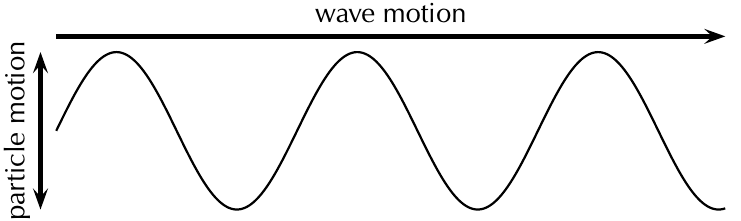
The diagram shows exactly what happens in a transverse wave. The wave itself travels horizontally (shown by the "wave motion" arrow), but the particles of the medium move vertically up and down (shown by the "particle motion" arrow). These two directions are perpendicular to each other - they form a 90-degree angle.
Demonstrating transverse wave motion
You can easily create and observe transverse waves using a simple rope experiment. When you hold one end of a stretched rope and flick it up and down continuously, you create a train of pulses travelling along the rope.
Example
Rope Wave Demonstration:
Step 1: Hold one end of a stretched rope
Step 2: Flick your hand up and down continuously
Step 3: Observe what happens:
- The wave travels horizontally from one end of the rope to the other
- But each part of the rope only moves up and down vertically
- The rope particles never actually travel along the rope's length
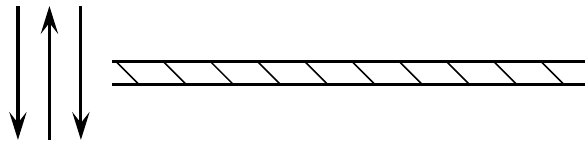
If you tied a ribbon to the middle of the rope, you would see the ribbon moving up and down as the wave passes through, but the ribbon wouldn't travel along with the wave. This demonstrates the key principle: the wave propagates through the medium, but the particles of the medium only oscillate perpendicular to the wave's direction.
Understanding particle motion vs wave motion
This is one of the most important concepts about transverse waves. There are actually two different types of motion happening simultaneously:
Important
Two Types of Motion in Waves:
- The motion of the particles in the medium (up and down)
- The motion of the wave itself (horizontally along the medium)
For waves, there is no net displacement of the particles in the medium. They return to their equilibrium position after the wave passes. However, there is a net displacement of the wave itself as energy travels through the medium.
Crests and troughs
All transverse waves have characteristic features that help us identify and describe them.
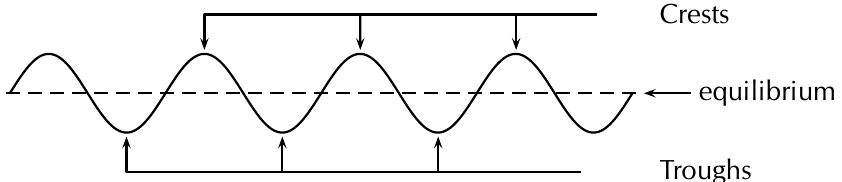
Waves have moving crests (or peaks) and troughs.
- A crest is the highest point the medium rises to
- A trough is the lowest point the medium sinks to
The horizontal dashed line in the diagram shows the equilibrium position - this is where the medium would be if no wave was passing through it.
Important
Formal Definitions: A crest is a point on the wave where the displacement of the medium is at a maximum. A point on the wave is a trough if the displacement of the medium at that point is at a minimum.
This means crests represent the maximum upward displacement from equilibrium, while troughs represent the maximum downward displacement from equilibrium.
Remember!
Summary
Key Points to Remember:
-
A wave is a periodic, continuous disturbance consisting of a train of pulses
-
In transverse waves, particles move perpendicular (at 90°) to the wave's direction of travel
-
Wave motion and particle motion are two different things - waves carry energy horizontally while particles oscillate vertically
-
Crests are the highest points (maximum displacement) and troughs are the lowest points (minimum displacement)
-
Particles return to their equilibrium position after a wave passes - they don't travel with the wave