Vectors and Scalars (Grade 10 NSC Matric Physical Sciences): Revision Notes
📚Revision Notes
Properties of Vectors
Introduction to vector properties
Vectors are special mathematical quantities that have both magnitude (size) and direction. Understanding their mathematical properties is essential for solving physics problems involving forces, displacement, velocity, and acceleration.
Note
Unlike scalar quantities that only have size, vectors require us to consider both how big they are and which way they point. This dual nature makes vector mathematics more complex but also more powerful for describing physical phenomena.
Equality of vectors
When comparing vectors, we need to check two important characteristics before we can say they are equal.
Important
Definition: Equality of vectors
Two vectors are equal if they have the same magnitude and the same direction.
For example, if we have two forces, N in the upward direction and N in the upward direction, then we can say that . Both vectors must match exactly in both size and direction.
Negative vectors
Just like scalar quantities can be positive or negative, vectors can also have positive or negative values. The sign tells us about the direction relative to a chosen reference.
Important
Definition: Negative vector
A negative vector is a vector that has the opposite direction to the reference positive direction.
When solving problems, we choose a reference positive direction first. For example, if we define upward as positive, then a force of 30 N downwards would be written as N. The negative sign shows us that the vector points in the opposite direction to our chosen positive reference.
Addition and subtraction of vectors
Adding vectors
When we add vectors together, we must consider both their magnitudes and their directions. This makes vector addition different from simple arithmetic.

Let's understand this through a practical example. Imagine you and a friend are trying to move a heavy box. You stand behind it and push forwards with a force , while your friend stands in front and pulls towards them with a force . Since both forces act in the same direction (forwards), the total force is:
The concept becomes clearer when we think about displacement vectors. Displacement describes the change in an object's position - it points from the initial position to the final position.
Example
Practical Activity: Understanding Vector Addition
Materials: Masking tape
Method:
-
Task 1: Take 2 steps forward and mark your position as A. Then take 3 more steps forward and mark your final position as B. Notice that taking 2 steps plus 3 steps gives you a total displacement of 5 steps forward.
-
Task 2: Return to your starting point. Now take 3 steps forward and mark this as B, then take 2 more steps forward and mark your final position as A.
Key observation: The final position is the same regardless of the order! This shows that vector addition is commutative - the order doesn't matter.

When we add vectors graphically, we place the second vector at the end of the first vector. The resultant vector goes from the starting point (tail of the first vector) to the end point (head of the second vector).
Subtracting vectors
Vector subtraction occurs when forces or displacements act in opposite directions. Let's return to our box example, but this time imagine you're not communicating properly. You stand behind the box and pull it towards you with force , while your friend stands at the front and pulls it towards them with force . Now the forces act in opposite directions.
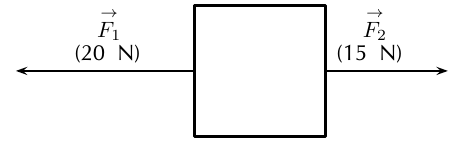
When vectors act in opposite directions, we define one direction as positive and treat the opposite direction as negative. The total force becomes:
Note
Key insight: Subtracting a vector is the same as adding a vector in the opposite direction.
The resultant vector
When we combine multiple vectors, we get a single vector that has the same overall effect.
Important
Definition: Resultant vector
The resultant vector is the single vector whose effect is the same as the individual vectors acting together.
We can understand this concept through two scenarios:
Example
Scenario 1: Forces in the same direction
- N (rightward)
- N (rightward)
- N to the right
Scenario 2: Forces in opposite directions
- N (leftward)
- N (rightward)
- N N N N to the left

The resultant force in each case produces the same effect as the original individual forces combined.
Equilibrant
There's a special vector related to the resultant that's important in physics problems.
Important
Definition: Equilibrant
The equilibrant is the vector which has the same magnitude but opposite direction to the resultant vector.

The equilibrant is useful because when you add the resultant vector and the equilibrant together, they cancel each other out (the answer is always zero). This concept is important in equilibrium problems where forces balance out.
For our previous examples:
- When N to the right, the equilibrant N to the left
- When N to the left, the equilibrant N to the right
Techniques of vector addition
There are two main approaches to adding vectors: graphical techniques and algebraic techniques. Understanding both methods helps you solve different types of problems effectively.
Graphical techniques
Graphical methods involve drawing accurate scale diagrams to represent individual vectors and find their resultants. The most common graphical method is the head-to-tail method.
Note
In this method:
- Draw the first vector to scale
- Place the tail of the second vector at the head of the first vector
- The resultant vector goes from the tail of the first vector to the head of the second vector
- This can be extended for multiple vectors by continuing the chain
This visual approach helps you understand how vectors combine and is particularly useful when working with vectors that aren't along the same line.
Summary
Key Points to Remember:
- Vector equality: Two vectors are equal only if they have both the same magnitude and the same direction
- Negative vectors: Show direction opposite to the chosen positive reference direction
- Vector addition: Must account for both magnitude and direction - use the head-to-tail method for graphical addition
- Resultant vector: The single vector that replaces all individual vectors with the same overall effect
- Equilibrant: Has the same magnitude as the resultant but opposite direction - when added to the resultant, they cancel out