Overview of Gaseous Exchange (Grade 11 NSC Matric Life Sciences): Revision Notes
📚Revision Notes
Overview of Gaseous Exchange
What is gaseous exchange?
Gaseous exchange is one of the most important processes that keeps all living things alive. To understand it properly, you need to know how it differs from two other related processes: breathing and cellular respiration.
Important
Understanding the Three Key Respiratory Processes
These three processes are often confused but serve completely different functions:
Breathing is the mechanical action of moving air in and out of your lungs. Think of it like a pump - your muscles work to expand and contract your chest, which draws air into your lungs and pushes it back out again.
Gaseous exchange is the physical process where oxygen and carbon dioxide are swapped between the air in your lungs and your blood. This happens at special surfaces in your body that are perfectly designed for this job.
Cellular respiration is the chemical process that happens inside your cells. Here, glucose (sugar) is broken down using oxygen to release energy that your body can use, producing carbon dioxide and water as waste products.
All three processes work together in perfect coordination - breathing brings fresh air to your lungs, gaseous exchange gets oxygen into your blood and removes carbon dioxide, and cellular respiration uses that oxygen to create energy for your body's activities.
Why is gaseous exchange so important?
Every living thing, from the tiniest bacteria to the largest whale, needs oxygen to survive. Gaseous exchange allows organisms to:
- Get oxygen from their environment into their bodies for cellular respiration
- Remove carbon dioxide, which is a toxic waste product that must be expelled
- Maintain proper gas levels in their blood and tissues
- Support energy production for all life processes
Note
When gaseous exchange doesn't work properly due to disease or poor lifestyle choices, it can seriously affect an organism's health and survival. This is why understanding this process is so crucial for maintaining good health.
Requirements for efficient gaseous exchange surfaces
For gaseous exchange to work effectively, the surfaces where it happens must have six important features. These requirements apply to all living organisms, whether they live on land or in water.
Important
The Six Essential Requirements for Effective Gas Exchange
All gas exchange surfaces, regardless of the organism, must have these critical features:
- Large surface area - relative to the organism's volume
- Thin and permeable walls - to allow rapid diffusion
- Moist conditions - gases can only dissolve in water
- Protection from damage - preventing injury and desiccation
- Good ventilation - maintaining concentration gradients
- Efficient transport system - moving gases to and from tissues
Let's explore each requirement and understand why it matters:
Large surface area creates enough space for sufficient oxygen and carbon dioxide to move across. Smaller organisms naturally have a better surface area to volume ratio than larger ones.
Thin and permeable walls allow faster gas passage. Thick barriers slow down the diffusion process, making gas exchange less efficient.
Moist conditions are essential because gases like oxygen and carbon dioxide can only dissolve and move across surfaces when water is present. Dry surfaces cannot support effective gaseous exchange.
Protection from damage is crucial since exchange surfaces are usually delicate and must be protected from physical injury and drying out, which would stop them working properly.
Good ventilation ensures that fresh oxygen-rich air or water constantly flows over the exchange surface to maintain concentration gradients for diffusion.
Efficient transport system is needed because once gases cross the exchange surface, they must be quickly transported to where they're needed in the body, and waste gases need to be carried away efficiently.
How different organisms achieve efficient gas exchange
Different types of organisms have evolved amazing adaptations to meet these six requirements. The diversity of solutions shows the incredible creativity of evolution in solving the same fundamental challenge.
Example
Example: Plant Gas Exchange Adaptations
Plants use their leaves as their main gas exchange surface. The flat shape of leaves creates a large surface area, while tiny pores called stomata allow gases to enter and exit. The spongy mesophyll cells inside leaves have thin walls and are kept moist by water vapour. Air moves around the leaf surface naturally, and simple diffusion transports gases where they're needed.
Example
Example: Earthworm Skin Breathing
Earthworms breathe through their skin, which must always stay moist and slimy. Their elongated, cylindrical body shape provides a good surface area to volume ratio. Special mucous glands keep the skin wet, and gas exchange happens directly through the thin skin surface. The worm doesn't need special protection since it lives underground in moist soil.
Example
Example: Insect Tracheal System
Insects have developed a unique tracheal system - a network of tubes that brings air directly to their tissues. These tubes branch extensively to create a large surface area, and they're lined with a thin, moist membrane. The insect's hard exoskeleton protects this system, while rhythmic body movements help pump air through the tubes.
Example
Example: Fish Gill Efficiency
Fish use gills to extract oxygen from water. Their gills have many branched filaments that create an enormous surface area packed into a small space. The gill membranes are extremely thin, and water constantly flows over them. The gills are protected by hard bony covers called opercula, and the fish's heart and blood vessels efficiently transport dissolved gases around the body.
Example
Example: Mammalian Lung Design
Mammals have lungs filled with millions of tiny air sacs called alveoli. These create a massive surface area within a protected chest cavity. The alveolar walls are incredibly thin and are kept moist by a thin layer of fluid. Breathing movements ensure fresh air reaches the alveoli, while the circulatory system rapidly transports gases throughout the body.
Basic human respiratory system
The human gas exchange system is beautifully designed with three main components working together seamlessly:
- Air passages that carry air to and from the lungs
- Lungs containing the actual gas exchange surfaces
- Breathing muscles that create the movements needed for ventilation
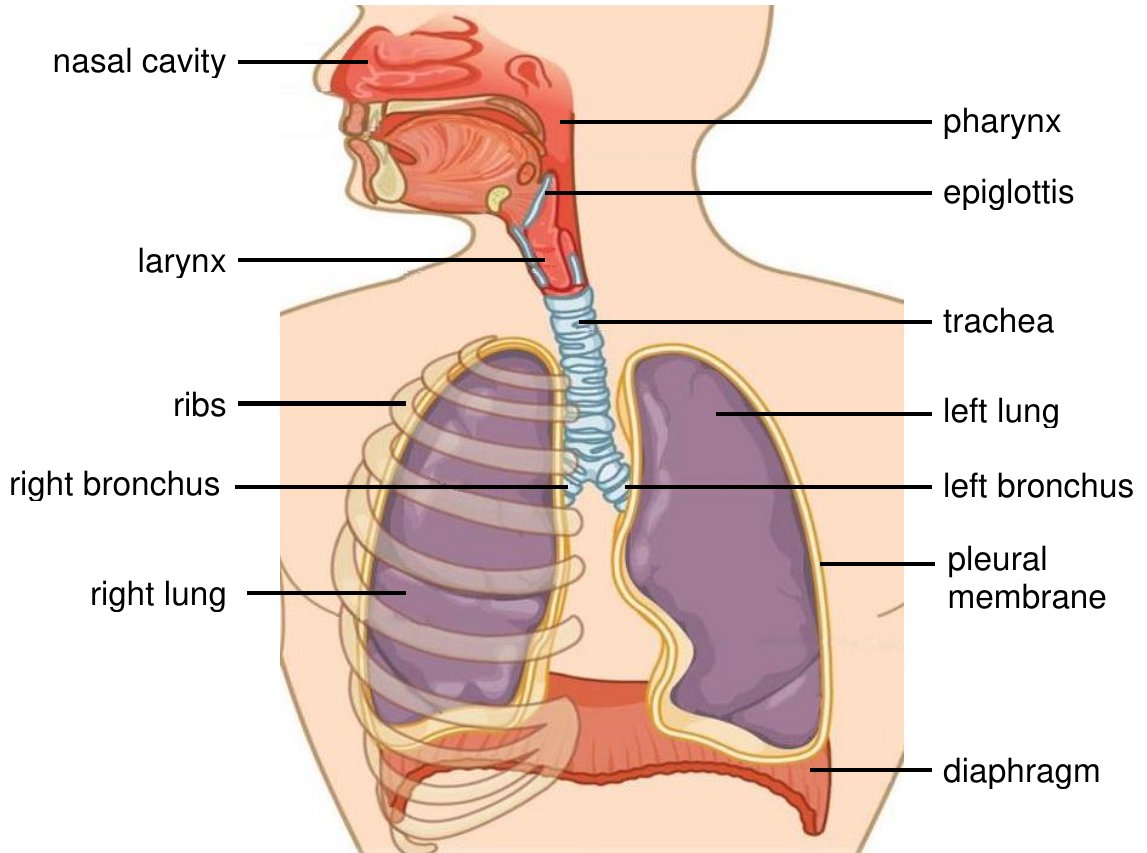
The journey of air through your respiratory system follows this precise pathway:
- Nasal cavity - air enters and is warmed, moistened, and filtered
- Pharynx and larynx - air passes through the throat area
- Trachea - the main airway leading to the lungs
- Bronchi - the trachea splits into left and right branches
- Lungs - where the actual gas exchange takes place
- Diaphragm - the main breathing muscle that helps move air in and out
Note
The Remarkable Design of Human Lungs
The lungs themselves are specially adapted for efficient gaseous exchange. The bronchi divide into smaller and smaller tubes, eventually ending in microscopic alveoli. These tiny air sacs have extremely thin walls made of squamous epithelium, are kept moist by a thin fluid layer, and are surrounded by dense networks of blood capillaries. This design perfectly meets all six requirements for efficient gas exchange.
Key terminology
Understanding these important terms will help you master the topic of gaseous exchange:
Diffusion - The natural movement of molecules from areas where they're highly concentrated to areas where they're less concentrated, until the concentrations become equal.
Aerobic - Any process that needs oxygen to work properly, like aerobic cellular respiration.
Anaerobic - Processes that can happen without oxygen being present, though these are usually less efficient.
Terrestrial organisms - Living things that spend their lives primarily on land, like most plants, mammals, birds, and insects.
Aquatic organisms - Living things that live in water environments, such as fish, aquatic plants, and marine animals.
Cellular respiration - The process inside cells where glucose is broken down (with or without oxygen) to release usable energy in the form of ATP, producing carbon dioxide and water as waste products.
Breathing or ventilation - The mechanical process of moving air into and out of the respiratory organs through inhalation and exhalation movements.
Summary
Key Points to Remember:
-
Three key processes work together: breathing (mechanical), gaseous exchange (physical), and cellular respiration (chemical) - each has a different role but they depend on each other.
-
All gas exchange surfaces need six things: to be large, thin and permeable, moist, protected, well-ventilated, and connected to a good transport system.
-
Different organisms have evolved clever solutions: plants use leaves, earthworms use skin, insects use tracheal tubes, fish use gills, and mammals use lungs - but all follow the same basic principles.
-
Surface area to volume ratio matters: smaller organisms have an advantage because they have more surface area relative to their size, making gas exchange more efficient.
-
Gaseous exchange is essential for life: without it, organisms cannot get the oxygen they need for energy production or remove the toxic carbon dioxide waste from cellular respiration.