Composition, Features, and Explanations of Business Cycles (Grade 12 NSC Matric Economics): Revision Notes
📚Revision Notes
Composition, Features, and Explanations of Business Cycles
Understanding business cycles
A business cycle represents the natural rhythm of any modern economy. Think of it like the beating of a heart - there are regular patterns of expansion and contraction that repeat over time, though never in exactly the same way. These cycles show us how economic activity rises and falls in predictable patterns that economists can study and understand.
Note
The heart analogy is particularly useful for understanding business cycles - just as a heartbeat has regular patterns but can vary in response to different conditions, business cycles follow recognisable patterns while remaining unique in their specific characteristics.
Business cycles are important because they affect everyone's daily lives. When the economy is expanding, jobs are easier to find, businesses grow, and people generally feel more optimistic about the future. During contractions, unemployment rises, businesses struggle, and economic uncertainty increases.
Key concepts and definitions
Understanding business cycles requires familiarity with essential terminology. These terms help economists and policymakers communicate clearly about economic conditions.
| Term | Definition |
|---|---|
| Business cycle | Successive periods of growth and decline in economic activities |
| Depression | Economic activity is at its lowest. Deepening of the recession |
| Economic indicator | Used to measure trends in the economy, e.g. GDP |
| Peak | Point where the economic expansion is at its highest |
| Phillips curve | Illustrates the relationship between unemployment and inflation |
| Recession | A negative economic growth for at least two successive quarters |
| Trough | Point where the economic contraction is at its lowest |
These definitions form the foundation for understanding how economists measure and describe economic fluctuations in countries like South Africa.
Nature and features of business cycles
Business cycles have several distinctive characteristics that make them both predictable and unpredictable at the same time. Understanding these features helps explain why managing an economy is such a complex task.
Recurring but unique patterns
Economic fluctuations follow patterns that repeat over time, but each cycle is unique in its duration and intensity. This happens because different circumstances and expectations influence how consumers and producers respond to economic conditions.
Example
Real-World Example: Different Recession Causes
A recession caused by a global financial crisis will look different from one caused by rising oil prices. The 2008 financial crisis led to banking sector problems and credit shortages, while oil price shocks in the 1970s created inflation and energy costs issues. Both caused recessions, but required different policy responses.
Recognisable structure
Every business cycle contains the same basic elements:
- Two periods: contraction and expansion phases
- Two turning points: the peak (highest point) and trough (lowest point)
- Four phases: recovery, prosperity/boom, recession, and depression
This structure provides a framework for understanding where an economy currently stands and what might come next.
Phases and measurement of business cycles
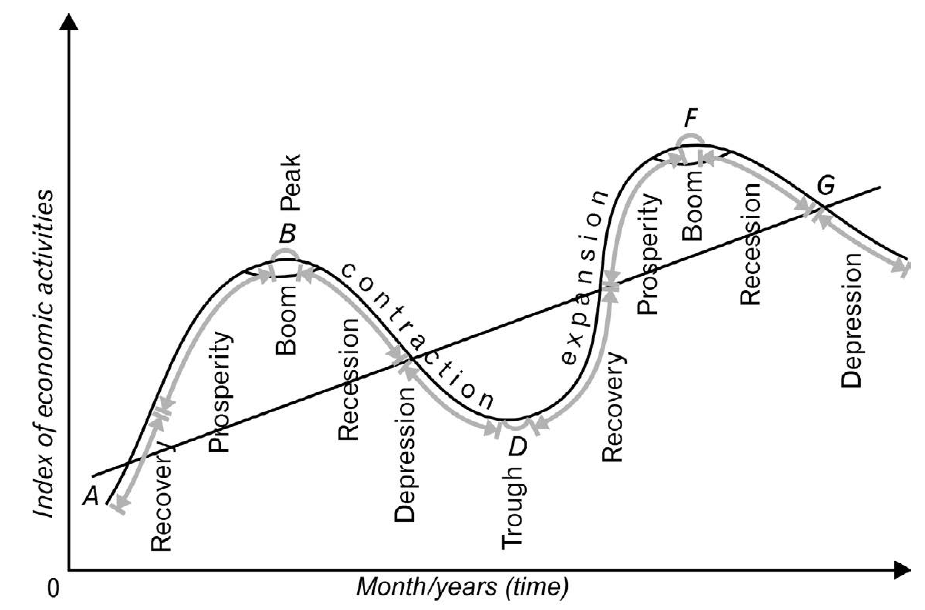
The business cycle diagram shows how economic activity moves through different phases over time. Each phase has distinct characteristics that affect employment, investment, and consumer spending.
The four main phases
Important
Understanding these four phases is crucial for recognising where an economy stands in its cycle and predicting what changes might occur next.
Recovery (Point A to B): The economy begins to improve after hitting bottom. Businesses start hiring again, consumer confidence returns, and investment gradually increases. This phase represents hope and gradual improvement.
Prosperity/Boom (Point B to C): Economic activity reaches high levels. Employment is strong, businesses are profitable, and consumers are spending freely. However, this phase can lead to overconfidence and excessive risk-taking.
Recession (Point C to D): Economic activity begins to decline. This officially starts when GDP falls for two consecutive quarters. Unemployment rises, business profits fall, and consumers become more cautious with spending.
Depression (Point D onwards): If a recession becomes severe and prolonged, it may turn into a depression. This represents the most challenging economic conditions, with very high unemployment and widespread business failures.
Measuring cycles
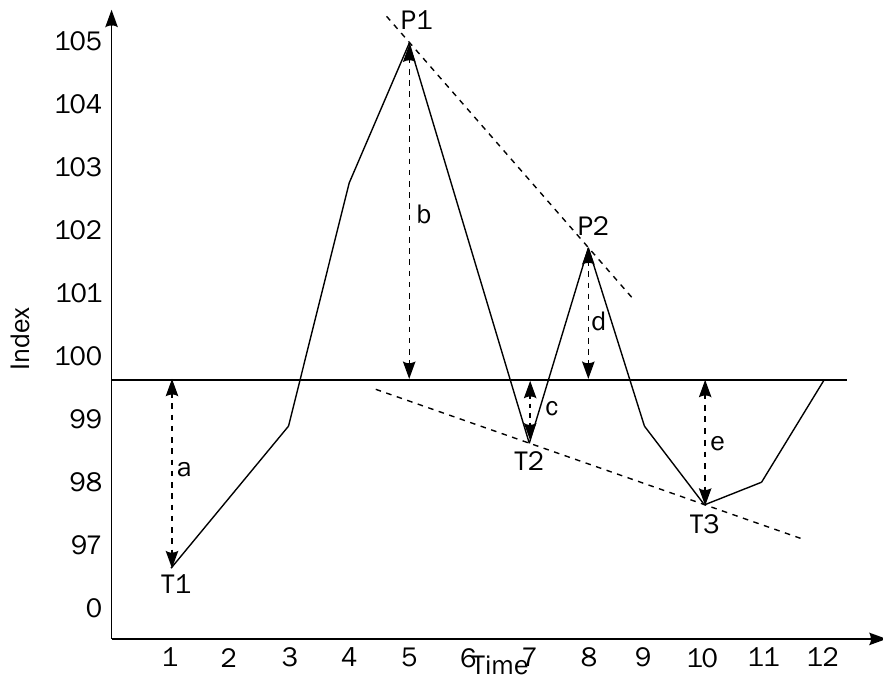
Economists measure business cycles in several important ways:
- Duration: The length of a complete cycle, measured from peak to peak or trough to trough
- Amplitude: The distance between peaks and troughs, which shows how severe the fluctuations are
- Trend line: The long-term average path of economic growth, around which the cycle oscillates
Note
These measurements help policymakers determine when intervention might be necessary and how severe current economic conditions are compared to historical patterns.
Explanations for business cycles
Economists have developed two main theories to explain why business cycles occur. These competing explanations have important implications for how governments should respond to economic fluctuations.
The exogenous explanation
The exogenous approach suggests that business cycles result from external factors that operate independently of the economic system itself. This view, often associated with monetarist economists, sees the economy as naturally stable.
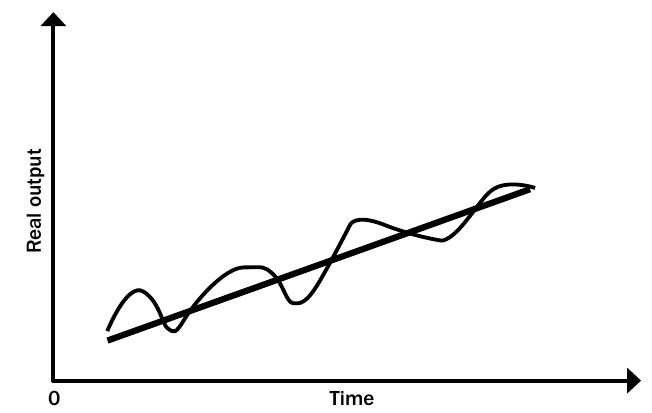
Key features of exogenous explanations include:
- Market stability: Monetarists believe markets naturally tend towards equilibrium and full employment
- External disruptions: Cycles result from outside shocks like weather conditions, wars, technological changes, or government policy mistakes
- Minimal intervention: Since markets are inherently stable, government intervention should be limited
- Examples: The Sunspot Theory suggests that solar radiation affects weather patterns, which influence agricultural production and create economic fluctuations
Note
This approach suggests that if governments avoid inappropriate policies (especially monetary policy mistakes), business cycles would be less severe and markets would return to stability more quickly.
The endogenous explanation
The endogenous approach, closely associated with Keynesian economics, argues that business cycles arise from factors within the economic system itself. This view sees instability as a natural feature of market economies.
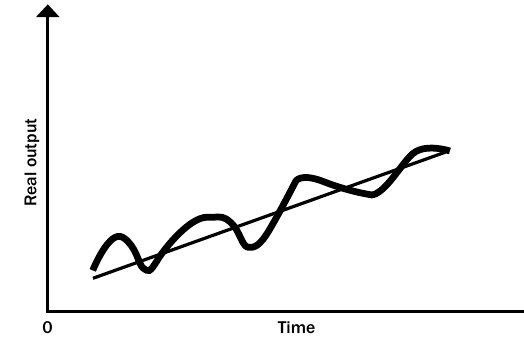
Key features of endogenous explanations include:
- Market instability: Keynesian economists believe markets are inherently unstable and rarely achieve full employment naturally
- Internal contradictions: Price mechanisms fail to coordinate demand and supply effectively, leading to regular imbalances
- Need for intervention: Government action is necessary to stabilise the economy and maintain full employment
- Structural problems: Issues like inflexible wages and mismatches between saving and investment create ongoing instability
Important
This approach supports active government intervention through fiscal and monetary policies to smooth out business cycle fluctuations and maintain economic stability.
Types of business cycles
Economists have identified several different types of cycles that operate over various time periods. Understanding these different cycles helps explain why economic forecasting is challenging and why multiple factors influence economic performance simultaneously.
Short to medium-term cycles
Kitchen cycles last between 3 to 5 years and result from businesses adjusting their inventory levels. When demand changes, companies either build up stock or reduce it, creating short-term fluctuations in production and employment.
Jugler cycles operate over 7 to 11 years and connect to changes in business and government investment patterns. These cycles reflect longer-term decisions about building factories, infrastructure, and expanding productive capacity.
Long-term cycles
Kuznets cycles span 15 to 20 years and relate to major changes in construction and building activity. These cycles often connect to demographic changes, urbanisation patterns, and major infrastructure development projects.
Kondratieff cycles last longer than 50 years and result from fundamental technological innovations, major wars, and discoveries of new resource deposits.
Example
Historical Examples of Kondratieff Cycles
Examples include the Industrial Revolution, the development of railways, and the computer age. Each of these represented fundamental changes in how economies operated and created long-lasting effects on business patterns.
Government policy responses
Governments can use various tools to influence business cycles and attempt to reduce their negative effects on society. This process is sometimes called "fine tuning" the economy.
Monetary policy instruments
Monetary policy involves controlling the money supply and interest rates to influence economic activity. In South Africa, the South African Reserve Bank (SARB) and Monetary Policy Committee (MPC) make these decisions.
The quantity theory of money () explains how changes in money supply affect the economy:
- M = Total stock of money in circulation
- V = Velocity of money (how quickly money changes hands)
- P = Price level of goods and services
- T = Total quantity of goods and services produced
Important
When the money stock increases faster than production can respond, prices tend to rise, creating inflation.
The money multiplier effect () shows how new bank deposits create additional money in the economic system:
- = Total new money created
- = Initial new deposit
- = Required reserve ratio that banks must keep
Understanding these relationships helps central banks make informed decisions about interest rates and money supply to influence business cycles.
Summary
Key Points to Remember:
- Business cycles are natural patterns of economic expansion and contraction that occur in all market economies, but each cycle is unique in timing and severity
- Four key phases exist: recovery, prosperity/boom, recession, and depression, with peaks and troughs marking the turning points between expansion and contraction
- Two main explanations compete: exogenous theories blame external factors and favour minimal government intervention, while endogenous theories identify internal market failures and support active government stabilisation policies
- Multiple cycle types operate simultaneously: from short Kitchen cycles (3-5 years) to long Kondratieff cycles (50+ years), creating complex patterns in real economic data
- Government tools can help: monetary policy instruments like interest rates and money supply management allow policymakers to influence the severity and duration of business cycle fluctuations