Anabatic and Katabatic Winds (Grade 12 NSC Matric Geography): Revision Notes
📚Revision Notes
Anabatic and Katabatic Winds
Introduction to valley climate
Valley climates develop on a local scale and typically last for just a few hours. These unique weather patterns are created by the specific topography of valleys and how they respond to daily heating and cooling cycles. One of the most important features of valley climates is the formation of anabatic and katabatic winds.
Note
Valley climates are localised weather phenomena that demonstrate how topography can create distinct microclimates within small geographical areas. Unlike regional weather patterns that affect large areas, these local climates can vary dramatically over distances of just a few kilometres.
Understanding anabatic and katabatic winds
The terms "anabatic" and "katabatic" describe the direction of air movement along valley slopes. Anabatic refers to air moving upward along slopes, while katabatic describes air flowing downhill.
Note
Key Definitions:
- Anabatic: Means "moving upward" - air flows up valley slopes
- Katabatic: Means "going downhill" - air flows down valley slopes
These terms come from Greek origins, where "ana" means up and "kata" means down, making them easy to remember.
These wind patterns occur because of the way valley structures respond to heating during the day and cooling at night. The shape of a valley and the daily temperature changes create a natural circulation system that alternates between these two types of winds.
Formation of anabatic winds (daytime)
During daylight hours, the sun heats the slopes and the air directly above them. This heating process causes the air to become warmer and less dense than the surrounding air. As warm air is lighter, it begins to rise up the valley sides, creating anabatic winds.

Example
Worked Example: Daytime Anabatic Wind Formation
Step 1: Solar radiation heats the valley slopes
- Sun's energy warms the slope surfaces throughout the morning
Step 2: Air in contact with heated slopes becomes warm and less dense
- Heated air expands and becomes lighter than surrounding air
Step 3: Warm, buoyant air rises along the slopes
- Density differences cause the warm air to move upward
Step 4: Upward movement creates anabatic winds
- Continuous flow develops from valley floor towards higher elevations
Formation of katabatic winds (nighttime)
At night, the situation reverses completely. Without solar heating, the valley slopes begin to cool through radiation. The air in contact with these cooled surfaces becomes cold and dense, causing it to flow downhill under the influence of gravity.
Example
Worked Example: Nighttime Katabatic Wind Formation
Step 1: Valley slopes lose heat through radiation cooling
- Slopes radiate heat away to the clear night sky
Step 2: Air near the cooled slopes becomes cold and dense
- Cooling air contracts and becomes heavier
Step 3: Gravity causes heavy, cold air to sink down valley sides
- Dense air flows downward like water flowing downhill
Step 4: Downward flow creates katabatic winds
- Cold air moves from higher elevations to accumulate at the valley floor
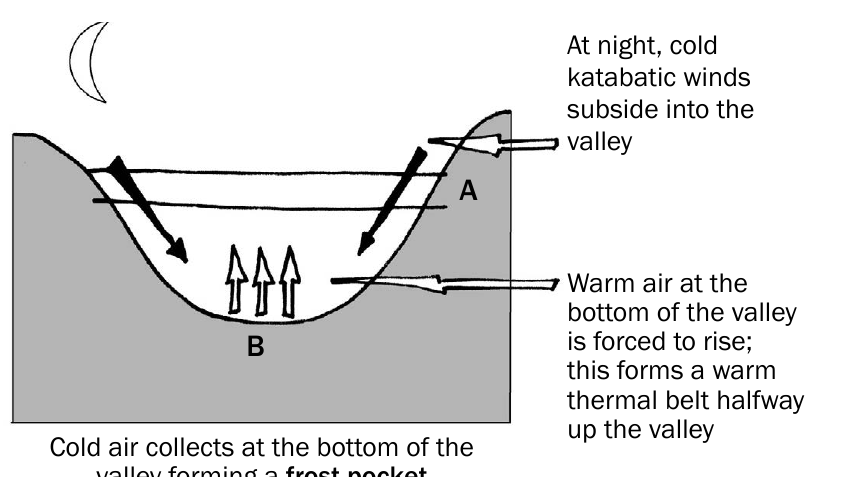
Temperature zones created by katabatic winds
The movement of cold air downhill during nighttime creates distinct temperature zones within the valley. As cold air accumulates at the bottom of the valley, warmer air is pushed upward, forming what is known as a thermal belt partway up the valley slopes.
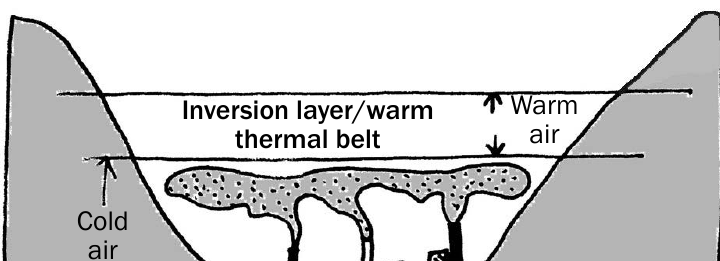
Important
The formation of thermal belts and frost pockets is a critical concept for understanding settlement patterns and agricultural practices in valleys. These temperature zones can have differences of several degrees Celsius over very short distances.
This process creates two important zones:
Thermal belt: This is a zone of warmer temperatures located partway up the valley slopes. It forms when cold katabatic winds push the warmer air that was originally at the valley bottom upward to an intermediate level.
Frost pocket: This is an area of very cold temperatures that develops at the valley floor where the dense, cold katabatic winds accumulate. These areas are prone to frost formation due to the pooling of cold air.
Effects on human settlements
The formation of anabatic and katabatic winds has significant implications for where people choose to live and how they use the land.
Benefits of anabatic winds
Anabatic winds help remove pollution from valleys during the day. As these winds flow upward, they carry pollutants away from settled areas, improving air quality in the valley bottom where most human activities occur.
Challenges from katabatic winds
Katabatic winds create several challenges for settlements:
- They trap pollution in the valley at night, as the downward-flowing cold air prevents pollutants from dispersing upward
- They bring very cold temperatures to the valley floor, making these areas less comfortable for human habitation
- The cold air accumulation can create harsh microclimates in valley bottoms
Important
Settlement planners must carefully consider these wind patterns when developing valleys. Areas that seem pleasant during daytime site visits may experience severe pollution trapping and temperature drops at night due to katabatic winds.
Agricultural implications
The temperature zones created by these wind patterns strongly influence farming practices in valleys.
Thermal belt advantages
The thermal belt becomes an ideal location for:
- Growing crops that require warm, frost-free conditions
- Establishing settlements, as temperatures remain more moderate
- Cultivating temperature-sensitive crops like certain fruits or sugar cane
Note
Agricultural Benefits of Thermal Belts: Farmers have recognised for centuries that the thermal belt zone offers the best compromise between accessibility and favourable growing conditions. This zone avoids both the frost-prone valley floor and the exposed, windswept mountain tops.
Frost pocket considerations
The frost-prone valley bottoms are better suited for:
- Crops that can tolerate cold conditions and occasional frost
- Root vegetables like potatoes that can withstand cooler temperatures
- Grazing areas for livestock rather than sensitive crop production
Pollution and air quality impacts
The alternating wind patterns create a daily cycle that affects air quality in valleys. During the day, anabatic winds help clear pollutants by carrying them upward and out of populated areas. However, at night, katabatic winds reverse this process.
The formation of temperature inversions, where warm air sits above cold air, traps pollution close to the ground. This creates a layer that acts like a lid, preventing pollutants from dispersing and leading to poor air quality in valley settlements during nighttime and early morning hours.
Important
Temperature Inversion Warning: Temperature inversions created by katabatic winds can lead to dangerous pollution accumulation in valleys. Cities located in valleys often experience their worst air quality during early morning hours when the inversion is strongest, particularly in winter months.
Summary
Key Points to Remember:
-
Anabatic winds occur during the day when heated slopes cause warm air to rise upward along valley sides, helping to remove pollution from settled areas
-
Katabatic winds develop at night when cooled slopes cause cold, dense air to flow downhill, creating frost pockets at valley bottoms and thermal belts on slopes
-
Thermal belts are ideal for settlements and sensitive crops because they maintain warmer temperatures and avoid both the cold valley floor and exposed mountain tops
-
Frost pockets limit agricultural options to cold-tolerant crops and create challenging conditions for human settlement due to very low nighttime temperatures
-
These wind patterns significantly impact air quality by dispersing pollution during the day but trapping it near the ground at night through temperature inversions