Mutations (Grade 12 NSC Matric Life Sciences): Revision Notes
📚Revision Notes
Mutations
What are mutations?
A mutation occurs when there is a permanent change to the DNA within a cell. Think of DNA as the instruction manual for life - when these instructions get altered, it can have different effects on the organism. Mutations are actually quite common and can be categorised into three main types based on their impact: harmless, harmful, or useful.
Understanding mutations is crucial because they play a fundamental role in genetics, inheritance, and evolution. They can occur in individual genes or affect entire chromosomes, leading to various outcomes for the organism.
Note
Mutations are not rare events - they occur naturally in all living organisms as part of normal biological processes. What makes them significant is their potential impact on survival, reproduction, and evolution.
Types of mutations by effect
Harmless mutations
Most mutations that occur in living organisms are actually harmless. These mutations typically affect the non-coding regions of DNA, which make up approximately 98.5% of our genetic material. Since these regions don't contain instructions for making proteins, changes here generally don't affect how the cell or organism functions.
Note
The vast majority of our DNA doesn't actually code for proteins. This "non-coding DNA" was once called "junk DNA," but we now know it plays important regulatory roles, even though mutations in these regions are usually harmless.
These harmless mutations don't impact the structure or normal functioning of cells and organisms. Common examples include genetic variations that lead to freckles, natural blonde hair colour, or pattern baldness. While these traits might seem significant to us, they don't actually affect survival or health in any meaningful way.
Harmful mutations
Harmful mutations are more concerning because they alter the DNA sequences responsible for producing specific proteins. When the genetic instructions for making a protein are changed, the resulting protein may be incorrect or defective. This can lead to changes in an organism's physical appearance or how their body functions.
Important
Harmful mutations can result in genetic disorders that significantly impact quality of life or survival. The severity depends on which protein is affected and how critical that protein is for normal body functions.
These mutations can result in genetic disorders that affect quality of life or survival. The severity depends on which protein is affected and how important that protein is for normal body functions. Some harmful mutations cause mild effects, while others can lead to serious medical conditions.
Useful mutations
While it might seem contradictory, some mutations actually provide advantages to organisms. Useful mutations also change the DNA responsible for protein production, but in this case, the altered protein gives the organism a better chance of survival in its environment.
When useful mutations occur, they contribute to genetic variation within populations. This genetic variation is essential for natural selection - the process where organisms with advantageous traits are more likely to survive and reproduce. Over time, these beneficial mutations can spread through populations and drive evolutionary change.
Gene mutations
Gene mutations occur during DNA replication when individual base pairs (the building blocks of DNA) are added, removed, or duplicated incorrectly. This changes the sequence of bases in the DNA, which can alter the instructions for making specific proteins.
Several important genetic conditions result from gene mutations:
Sex-linked gene mutations occur on the X chromosome and include conditions like haemophilia and colour blindness. These conditions are more common in males because they only have one X chromosome, so a single faulty gene can cause the condition.
Example
Example: Sex-linked Inheritance
Males have XY chromosomes, while females have XX chromosomes. If a male inherits an X chromosome with a faulty gene for colour vision, he will be colour blind because he has no second X chromosome to compensate. Females need faulty genes on both X chromosomes to be affected, making these conditions much rarer in females.
Autosomal gene mutations affect chromosomes other than the sex chromosomes. A significant example is sickle cell anaemia, which is particularly common in Central Africa, India, and South America. This condition results from a gene mutation that produces faulty haemoglobin molecules. The resulting red blood cells become sickle-shaped (curved like a half-moon), which causes multiple problems: they can't carry oxygen efficiently (leading to anaemia), and their unusual shape causes them to stick together and block small blood vessels, damaging organs like the brain and kidneys.
Example
Example: Sickle Cell Anaemia
Normal red blood cells are round and flexible, allowing them to move easily through blood vessels. In sickle cell anaemia:
- A single base change in the DNA alters the haemoglobin protein
- This causes red blood cells to become rigid and sickle-shaped
- These abnormal cells block blood flow and break down quickly
- Result: pain, organ damage, and anaemia
Albinism represents another type of gene mutation that prevents the normal production of melanin, the pigment responsible for colour in skin, hair, and eyes. This recessive gene mutation results in very pale skin, light-coloured hair, and light-sensitive eyes.
Important
People with albinism often face discrimination and prejudice, despite being completely normal in all other respects. They do require extra protection from sun exposure due to their increased risk of skin cancer.
Chromosome aberrations
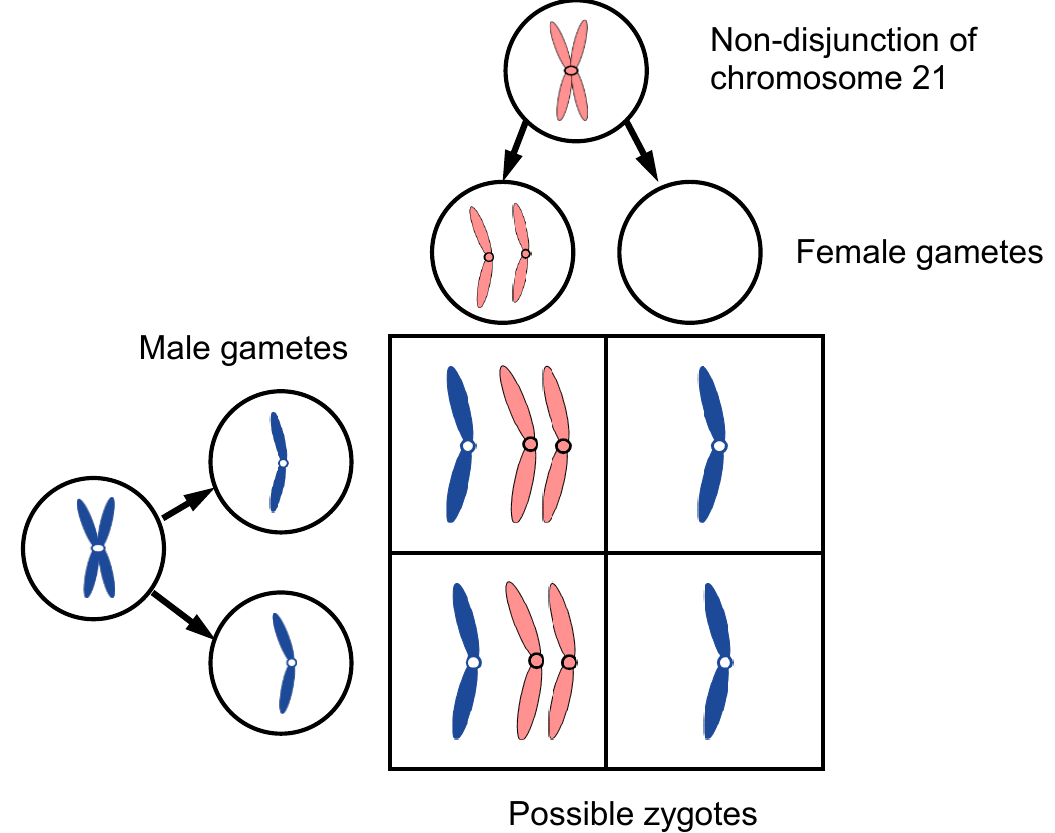
Chromosome aberrations involve changes to entire chromosomes rather than individual genes. These mutations occur during meiosis (the process that produces sex cells) when chromosomes fail to separate properly during anaphase I. This is called non-disjunction, where both chromosomes from a pair go to the same cell instead of separating.
Down syndrome is the most well-known example of a chromosome aberration. It results from having three copies of chromosome 21 (called trisomy 21) instead of the normal two copies. This occurs when chromosome 21 fails to separate properly during meiosis, creating gametes with an extra chromosome.
Example
Example: Down Syndrome Formation
- During meiosis, chromosome 21 should separate so each gamete gets one copy
- Non-disjunction occurs - both chromosomes go to one gamete
- This creates gametes with either 2 copies or 0 copies of chromosome 21
- When a gamete with 2 copies fertilises a normal gamete (1 copy), the result is trisomy 21
- The extra genetic material affects development throughout the body
When a gamete with an extra chromosome 21 fuses with a normal gamete during fertilisation, the resulting zygote has three copies of chromosome 21. This additional genetic material affects development and leads to the characteristic features and challenges associated with Down syndrome.
The bigger picture
Mutations play a crucial role in the story of life on Earth. While harmful mutations can cause genetic disorders, useful mutations provide the raw material for evolution. Natural selection acts on this genetic variation, allowing organisms with advantageous traits to thrive and pass their genes to future generations.
Note
Evolution would be impossible without mutations. They provide the genetic diversity that allows species to adapt to changing environments over thousands and millions of years.
This process has been ongoing for billions of years, driving the incredible diversity of life we see today. Without mutations, all organisms would be genetically identical, and evolution would be impossible.
Summary
Key Points to Remember:
- Mutations are permanent changes to DNA that can be harmless, harmful, or useful depending on their effects
- Most mutations are harmless because they occur in non-coding DNA regions that don't affect protein production
- Gene mutations happen during DNA replication and can cause conditions like sickle cell anaemia, albinism, and colour blindness
- Chromosome aberrations occur during meiosis when chromosomes don't separate properly, leading to conditions like Down syndrome
- Useful mutations drive evolution by providing genetic variation that natural selection can act upon