Evidence Supporting Common Ancestors of Living Hominids (Grade 12 NSC Matric Life Sciences): Revision Notes
📚Revision Notes
Evidence Supporting Common Ancestors of Living Hominids
Introduction to fossil evidence for human evolution
The study of human evolution relies heavily on fossil evidence that demonstrates how modern humans share common ancestors with other primates. Through careful examination of fossilised remains, scientists have traced the progressive development from ape-like beings to modern humans over millions of years.
Note
Three main sources of evolutionary evidence:
- Fossil records - preserved remains showing anatomical changes over time
- Genetic analysis - DNA comparisons revealing relationships between species
- Cultural artifacts - tools and evidence of behavioural evolution
The fossil record shows a gradual transition in key characteristics that distinguish humans from other primates. These changes include the development of bipedalism (walking on two legs), increased brain size, changes in jaw structure, and modifications to dental features. Understanding this evidence requires familiarity with specific scientific terminology used in human evolutionary studies.
Essential terminology for understanding hominin classification
Scientists use precise terminology to classify and name early human species. Understanding these terms is crucial for studying human evolution effectively.
Important
Key Definitions for Human Evolution:
- Hominin: The group consisting of modern and early humans
- Genus: Biological classification ranking between family and species, consisting of structurally or phylogenetically related species
- Species: A group of organisms that are genetically similar, can interbreed and produce fertile offspring
- Pithecus: Greek word for 'ape'
The classification system organises early human species into three main groups: Ardipithecus, Australopithecus, and Homo. The naming system follows a pattern where the first name indicates the genus, while the second name specifies the species. For example, Australopithecus afarensis means "southern ape from the Afar region" of Ethiopia, whilst Homo sapiens translates to "wise human."
Timeline of hominin evolution
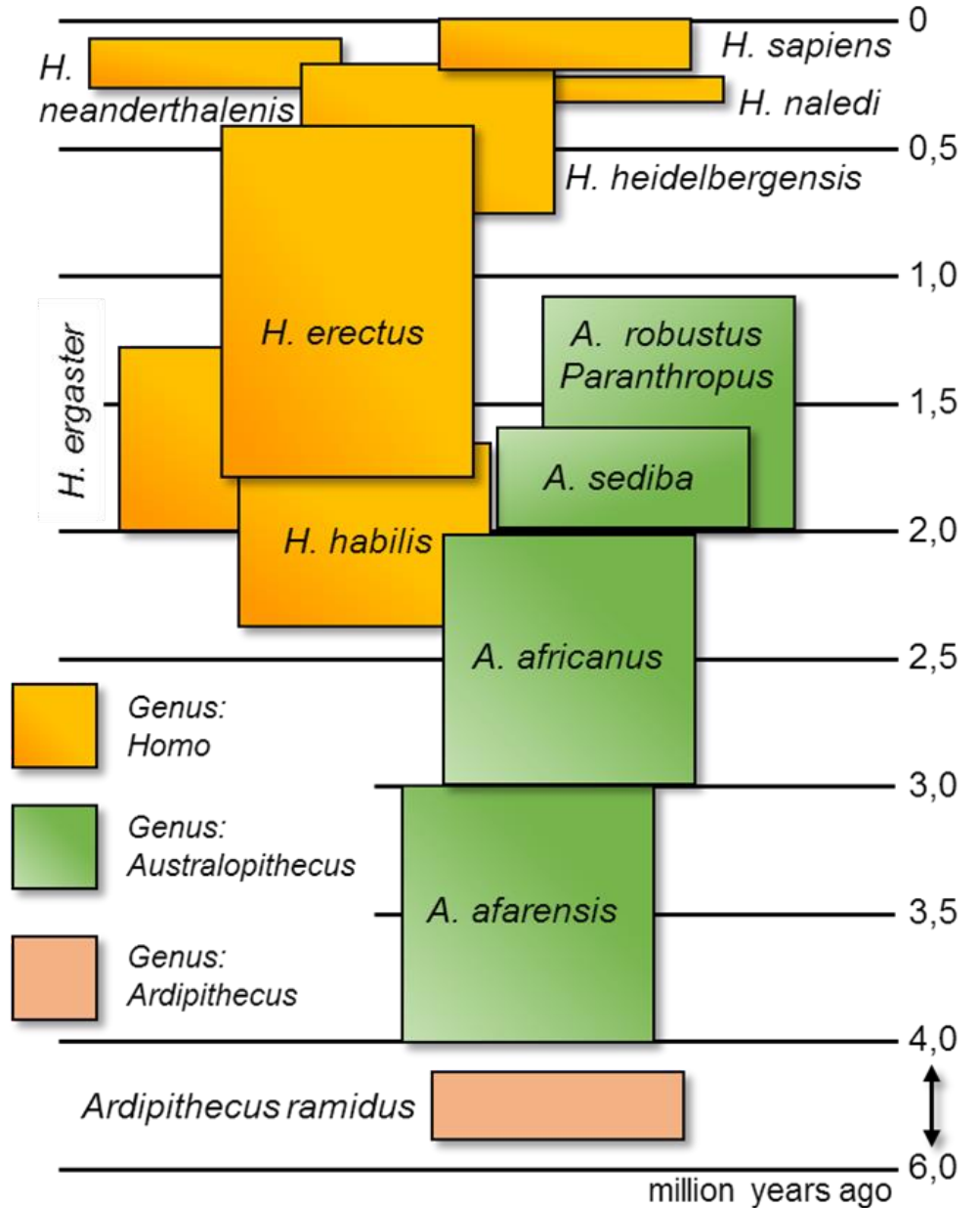
Human evolution spans approximately 6 million years, showing a complex branching pattern rather than a simple linear progression. Climate change served as a major driving force in this evolution, as organisms needed to adapt to changing environments and resource availability.
Note
The Three Major Evolutionary Phases:
- Early hominins ( million years ago): Represented by Ardipithecus species
- Intermediate forms ( million years ago): Various Australopithecus species
- Modern human lineage ( million years ago-present): Homo species
Key evolutionary advantages that allowed hominins to survive and flourish included the ability to walk upright, increased brain capacity for communication and problem-solving, and the development of tool-making skills.
Ardipithecus: the earliest hominins
Ardipithecus ramidus characteristics
Ardipithecus ramidus represents one of the earliest known hominin species, existing between million years ago. These early hominins served as an important intermediate form between apes and humans.

Ardipithecus ramidus individuals were relatively small, standing about metres tall and weighing approximately kilogrammes. Their brain size ( mL) remained similar to that of modern chimpanzees, indicating that significant brain expansion had not yet occurred in human evolution.
Example
Transitional Anatomical Features in Ardipithecus:
Evidence of early bipedalism:
- The foramen magnum (opening where the spinal cord connects to the brain) showed forwards position, suggesting adaptation for upright walking
Retained ape-like characteristics:
- Heavy brow ridges and very protruding jaws
- Brain size similar to chimpanzees ( mL)
Intermediate features:
- Smaller canine teeth than chimpanzees, beginning human-like dental trends
- Adapted pelvis for both bipedal walking and tree climbing
This combination of features supports the idea that Ardipithecus ramidus represents a crucial evolutionary link between our ape ancestors and later hominin species.
Australopithecus: intermediate evolutionary forms
The Australopithecus genus includes several species that lived between million years ago, primarily in Africa along the Rift Valley. These hominins show more advanced human-like characteristics than Ardipithecus while retaining some ape-like features.
Important Australopithecus species
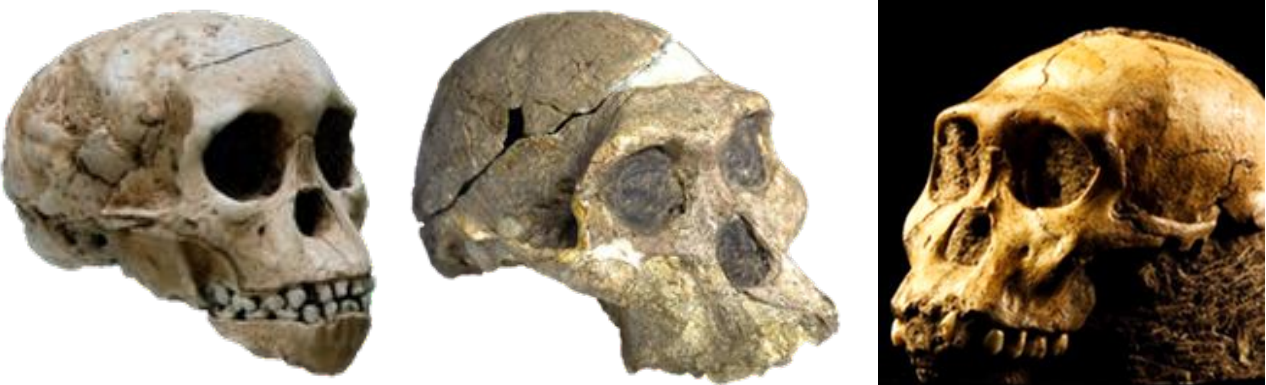
Australopithecus afarensis ( million years ago) includes the famous fossil "Lucy," discovered in 1974. This species was well-adapted for tree-dwelling but had developed the ability to walk upright with proper bipedalism. The Laetoli footprints, discovered by Mary Leakey in 1976, provide clear evidence of bipedal locomotion in this species.
Australopithecus africanus ( million years ago) includes significant discoveries like the Taung child (discovered in 1924 by Raymond Dart), Mrs Ples (found at Sterkfontein caves), and Little Foot (a nearly complete skeleton found in 1997).
Australopithecus sediba ( million years ago) represents the most recent Australopithecus species, with the famous "Karabo" specimen discovered by Lee Berger possibly serving as an ancestor to the genus Homo.
Evolutionary progression in Australopithecus
The three main Australopithecus species show a clear evolutionary progression towards more human-like characteristics over time.
Example
Physical Development Trends in Australopithecus:
Consistent features:
- Height remained relatively stable ( cm range)
- Foramen magnum maintained forwards positioning, confirming bipedal locomotion
Progressive changes:
- Brain size gradually increased: mL (A. afarensis) → mL (A. africanus)
- Brow ridges became progressively smaller
- Jaw prognathism (forwards projection) decreased over time
- Canine teeth became less pointed and smaller
- Pelvic adaptations evolved from intermediate bipedal/tree-climbing to fully adapted bipedal walking
This progression demonstrates how Australopithecus species served as crucial evolutionary stepping stones between the earliest hominins and the Homo genus.
Homo: the human lineage
The genus Homo represents the direct lineage leading to modern humans, beginning approximately million years ago. This genus includes our own species (Homo sapiens) plus extinct species.
Important
Key Distinguishing Feature of Homo Genus: The most significant difference from Australopithecus is dramatically increased brain size - approximately 30% larger than their predecessors.
Major Homo species
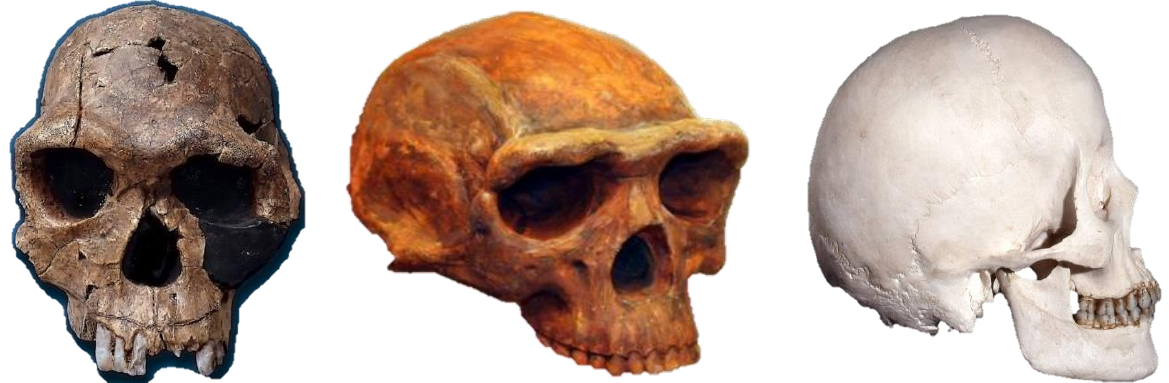
Homo habilis ( million years ago), discovered at Olduvai Gorge in Tanzania, represents the earliest Homo species:
- Height: cm
- Brain size: mL
- Present but less pronounced brow ridges
- Less protruding jaws compared to Australopithecus
- Fully adapted pelvis for bipedal walking
Homo erectus ( million years ago) shows continued evolutionary development:
- Increased height: cm
- Larger brain: mL
- Small but distinct brow ridges
- Further reduction in jaw prognathism
- Fully bipedal locomotion
Homo sapiens ( million years ago-present) represents modern humans:
- Modern height: cm
- Largest brain size: mL
- No prominent brow ridges
- Non-protruding jaws
- Small canine teeth
- Fully adapted bipedal pelvis
This progression clearly demonstrates the evolutionary trend towards larger brains, reduced facial prognathism, and increasingly sophisticated adaptations for bipedal locomotion.
Understanding phylogenetic relationships
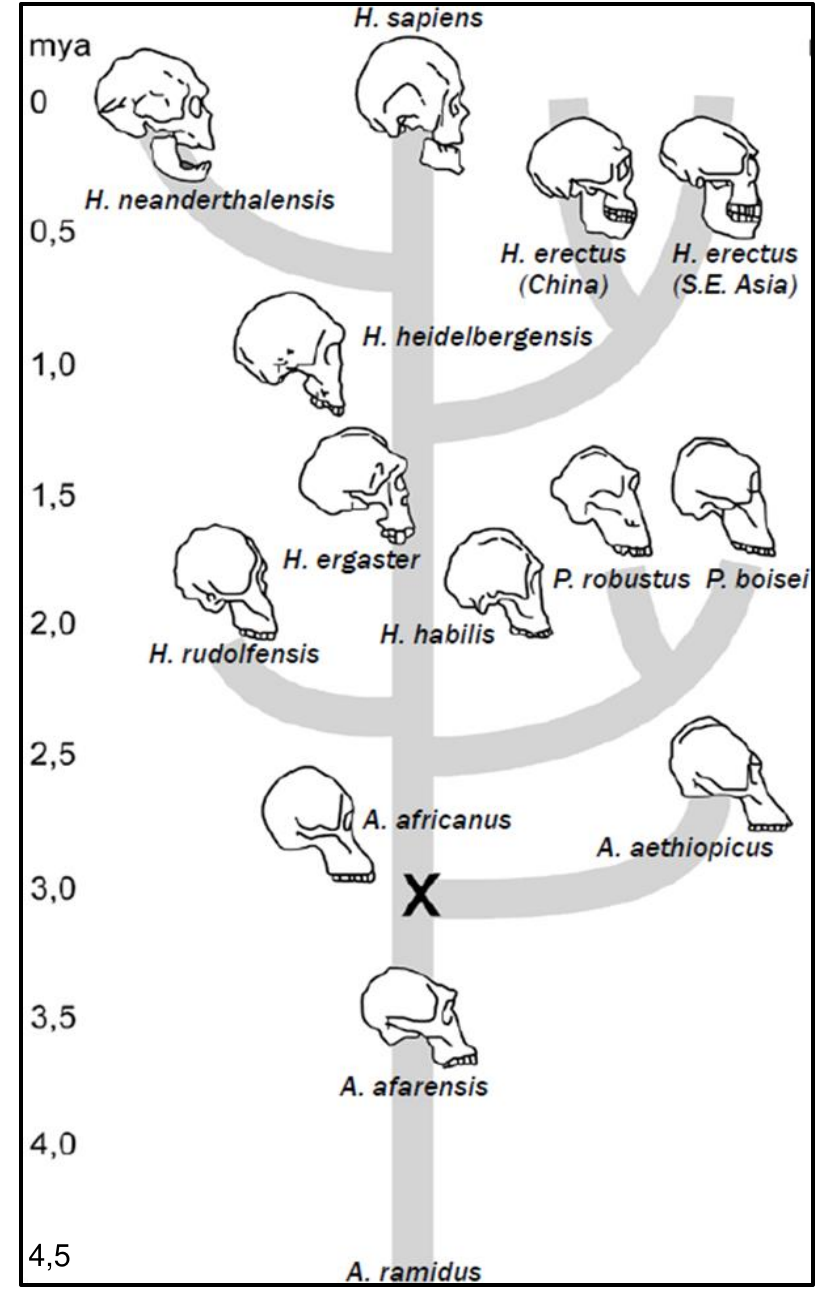
Phylogenetic trees help scientists visualise the evolutionary relationships between different hominin species over time. These diagrams show how species branched from common ancestors rather than following a simple linear progression.
Important
Key Concepts About Human Evolution:
Branching evolution: Rather than a straight line from apes to humans, evolution follows a "bush-like" pattern with multiple branches. Many evolutionary lineages became extinct, including species like H. rudolfensis and P. robustus.
Common ancestry: All hominin species can trace their lineage back to common ancestors, with major branching points occurring around million years ago.
Non-linear progression: Evolution doesn't follow a predetermined path from "primitive" to "advanced." Instead, it represents organisms adapting to environmental pressures and opportunities over time.
Extinction patterns: The diagram shows that numerous hominin species coexisted at various times, but most evolutionary branches eventually became extinct, leaving only Homo sapiens as the surviving hominin species.
As evolutionary biologist Stephen J. Gould noted, "evolution is a bush, not a ladder," emphasising that evolutionary development involves complex branching relationships rather than simple linear advancement.
Summary
Key Points to Remember:
-
Fossil evidence supports common ancestry - Progressive anatomical changes in hominin fossils demonstrate evolutionary relationships between apes and humans over million years
-
Three main genera show evolutionary progression - Ardipithecus ( mya), Australopithecus ( mya), and Homo ( mya-present) display increasingly human-like characteristics
-
Brain size evolution is key evidence - Brain capacity increased dramatically from mL in Ardipithecus to mL in Homo sapiens, showing cognitive advancement
-
Bipedalism developed early - Forwards positioning of the foramen magnum and pelvic adaptations show that upright walking evolved before significant brain expansion
-
Evolution follows branching patterns - Phylogenetic trees reveal that human evolution involved multiple species and extinct lineages rather than a simple linear progression from apes to humans