DNA Sequence (Grade 12 NSC Matric Life Sciences): Revision Notes
📚Revision Notes
DNA Sequence

What is DNA sequence and why does it matter?
DNA sequence refers to the specific order of nitrogenous bases (A, T, G, C) along a DNA strand. This sequence acts like a blueprint that contains all the instructions needed to build and maintain living organisms. Think of it as a recipe book where the order of ingredients (bases) determines what final product (protein) you'll create.
Note
The sequence is incredibly important because even small changes can have significant effects on the proteins that are produced, which in turn affects how organisms function and develop.
Understanding mutations and their impact on protein structure
When we talk about mutations, we're referring to alterations that occur in the specific arrangement of nitrogen-containing bases within a DNA molecule or gene. These changes might seem small, but they can have far-reaching consequences for protein formation.
Here's how mutations affect protein structure through a step-by-step process:
The mutation cascade effect
When a mutation occurs in DNA, it sets off a chain reaction that can alter the final protein product. Since messenger RNA (mRNA) is created by copying the DNA sequence during transcription, any change in the original DNA will be reflected in the mRNA copy.
This change in mRNA means that the codons (three-base sequences that specify amino acids) will also be different. As a result, different transfer RNA (tRNA) molecules carrying different amino acids will be recruited during protein synthesis. This leads to a change in the amino acid sequence, ultimately resulting in the formation of a different protein with potentially altered function.
Note
However, it's worth noting that not all mutations cause changes in protein structure. Due to the redundancy in the genetic code, some mutations may still code for the same amino acid, meaning the final protein remains unchanged.
The relationship between base triplets, codons, and anti-codons
Understanding the difference between these three key concepts is crucial for grasping how DNA sequence translates into proteins:
- Base triplets: These are three-base sequences found in DNA
- Codons: These are three-base sequences found in mRNA that specify which amino acid should be added during protein synthesis
- Anti-codons: These are complementary three-base sequences found in tRNA that pair with codons during translation
Important
Don't confuse these three terms! Remember that base triplets are in DNA, codons are in mRNA, and anti-codons are in tRNA. Each plays a different role in the process of protein synthesis.
Codons and their corresponding amino acids
The genetic code operates like a translation dictionary, where each three-letter "word" (codon) in mRNA corresponds to a specific amino acid. This relationship is universal across most living organisms, demonstrating the fundamental unity of life.
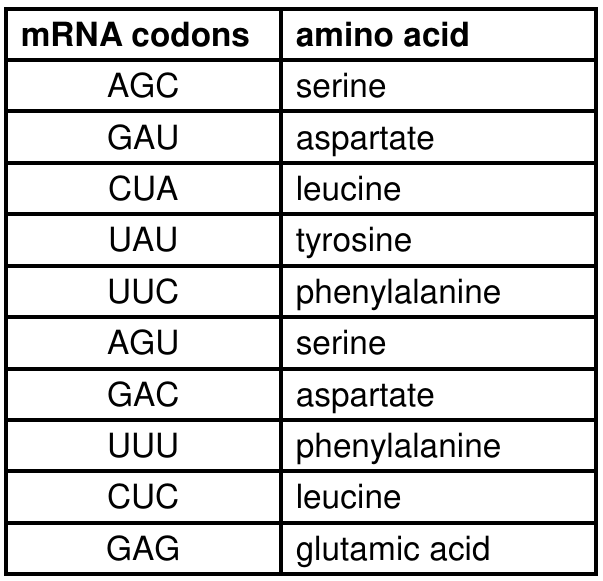
From this codon table, we can see several important patterns:
- Multiple codons can code for the same amino acid (for example, both UUC and UUU code for phenylalanine)
- This redundancy provides protection against some mutations
- The genetic code is read in groups of three bases, starting from a specific start point
Working with DNA sequences
When analysing DNA sequences, remember that you need to work through the central dogma pathway: DNA → RNA → Protein.
Example
Worked Example: Reading an mRNA Sequence
If you have an mRNA sequence like GAU CUC GAC AGC AUG ACC, you would:
Step 1: Divide it into codons GAU | CUC | GAC | AGC | AUG | ACC
Step 2: Use the codon table to find the corresponding amino acids
- GAU = Aspartic acid (Asp)
- CUC = Leucine (Leu)
- GAC = Aspartic acid (Asp)
- AGC = Serine (Ser)
- AUG = Methionine (Met) - Start codon
- ACC = Threonine (Thr)
Step 3: Determine the amino acid sequence The resulting protein sequence would be: Asp-Leu-Asp-Ser-Met-Thr
Common misconceptions and exam tips
Important
Common misconception: Students often confuse DNA base triplets with mRNA codons. Remember that DNA contains thymine (T) while RNA contains uracil (U).
Important
Exam tip: When given a DNA sequence, first transcribe it to mRNA (remembering that T becomes U), then use the codon table to find amino acids.
Exam tip: Pay attention to reading direction - sequences are typically read from left to right, and you need to identify the correct reading frame.
Real-world applications
Understanding DNA sequences has revolutionised medicine and biotechnology in South Africa and globally. Applications include:
- Genetic testing for inherited diseases
- Development of personalised medicines
- Agricultural improvements in crops
- Conservation efforts for endangered species
Note
These applications demonstrate how understanding the fundamental relationship between DNA sequence and protein structure has practical benefits that directly impact human health, food security, and environmental conservation.
Summary
Key Points to Remember:
- DNA sequence determines protein structure: The order of bases in DNA ultimately determines which proteins are made and how they function
- Mutations can alter protein function: Changes in DNA sequence may lead to different amino acid sequences and altered protein structure
- The genetic code is universal: The same codons code for the same amino acids in nearly all living organisms
- Not all mutations matter: Some changes in DNA don't affect the final protein due to the redundancy of the genetic code
- Reading frame is crucial: DNA and RNA must be read in the correct groups of three bases to produce the right protein