Reflex Action and Reflex Arc (Grade 12 NSC Matric Life Sciences): Revision Notes
📚Revision Notes
Reflex Action and Reflex Arc
What is a reflex action?
A reflex action is a rapid, involuntary reaction that occurs in response to a stimulus without conscious thought. These automatic responses happen so quickly that your brain doesn't have time to process what's happening before your body reacts.
Note
Reflex actions are one of the body's most important protective mechanisms, allowing us to respond to danger in milliseconds rather than the seconds it would take for conscious thought to process the situation.
Common examples of reflex actions include:
- Knee-jerk reflex when a doctor taps below your kneecap
- Sneezing when dust enters your nose
- Blinking when something moves quickly towards your eye
- Pulling your hand away from a hot surface
What is a reflex arc?
A reflex arc refers to the complete neural pathway that nerve impulses follow during a reflex action. Think of it as the "route" that the message takes from detecting the stimulus to producing the response. This pathway allows the body to react swiftly to potentially harmful situations.
Why are reflex actions important?
Reflex actions serve a crucial protective function for your body. They enable you to respond immediately to dangerous situations without having to think about it first. This split-second response time can prevent serious injury - for example, automatically pulling your hand away from a hot stove before you consciously realise it's burning you.
The pathway of a reflex arc
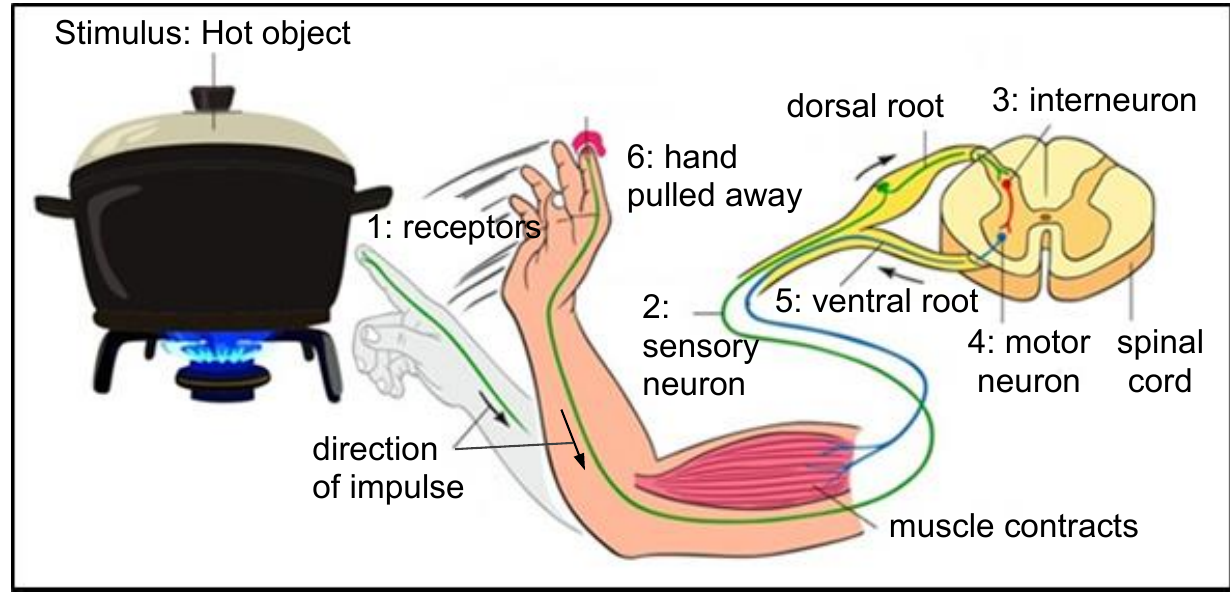
Let's examine how a reflex works using the example of touching a hot pot. The diagram below shows the complete reflex arc pathway.
Example
Worked Example: The Hot Pot Reflex Arc
Let's trace the complete pathway of what happens when you accidentally touch a hot pot:
Step 1: Stimulus detection When your hand touches the hot pot, specialised receptors in your skin detect the heat stimulus. These receptors immediately convert the physical stimulus into electrical nerve impulses.
Step 2: Sensory transmission The nerve impulse travels along a sensory neuron through the dorsal root into the spinal cord. This sensory neuron carries the "danger" message towards your central nervous system.
Step 3: Processing in the spinal cord Inside the spinal cord, the impulse passes from the sensory neuron to an interneuron. This interneuron acts like a relay station, connecting the incoming sensory information to the outgoing motor response.
Step 4: Motor transmission The interneuron passes the impulse to a motor neuron within the spinal cord. The motor neuron will carry the response message back to your muscles.
Step 5: Impulse to effector The impulse travels along the motor neuron's axon, exiting the spinal cord through the ventral root. It continues until it reaches the effector organs - in this case, the muscles in your arm and hand.
Step 6: Response occurs The muscles receive the nerve impulse and contract immediately, causing your hand to pull away from the hot pot quickly and automatically.
Key characteristics of reflex actions
Speed is essential: The entire reflex arc process happens in milliseconds, much faster than if your brain had to process the information first.
Brain involvement comes later: Importantly, your brain is not initially involved in the reflex action. The response occurs at the spinal cord level. Only after the reflex arc is complete do impulses reach your brain, which is when you actually feel the pain and become consciously aware of what happened.
Note
This is why you often pull your hand away from something hot before you even feel the pain - the reflex happens first, then the pain sensation reaches your brain!
Involuntary nature: You cannot consciously control or stop a reflex action once it has begun - your body automatically responds to protect itself.
Consistent pathway: Every reflex follows the same basic pathway: stimulus → receptor → sensory neuron → interneuron → motor neuron → effector → response.
Common misconception
Important
Common Mistake to Avoid
Many students think the brain controls reflex actions, but this is incorrect. Reflex actions bypass the brain entirely and are processed in the spinal cord. This is why they're so much faster than voluntary actions that require brain processing.
Remember: Brain involvement comes AFTER the reflex has already occurred!
Exam tips
Note
Exam Success Tips
- Remember the sequence: Stimulus → Receptor → Sensory neuron → Interneuron → Motor neuron → Effector → Response
- Be able to explain why reflexes don't involve the brain initially
- Know that receptors detect stimuli and convert them to nerve impulses
- Understand that effectors (usually muscles) produce the final response
- Practice labelling reflex arc diagrams with the correct components
Summary
Key Points to Remember:
- Reflex actions are rapid, automatic responses that protect the body from harm
- The reflex arc is the neural pathway that impulses follow during a reflex
- Six main components make up the reflex arc: stimulus, receptors, sensory neuron, interneuron, motor neuron, and effector organs
- The brain is not initially involved - reflexes are processed in the spinal cord for maximum speed
- Examples include pulling away from hot objects, knee-jerk responses, and protective blinking