Acids and Bases (Grade 12 NSC Matric Physical Sciences): Revision Notes
📚Revision Notes
Acids and Bases
What are acids and bases?
Acids and bases are substances we encounter regularly in our daily lives. Many common household items contain these important chemical compounds.
Note
Understanding acids and bases is fundamental to chemistry because these substances play crucial roles in biological processes, industrial applications, and everyday chemical reactions around us.
Acids typically have a sour taste and are found in various foods and products. Examples include:
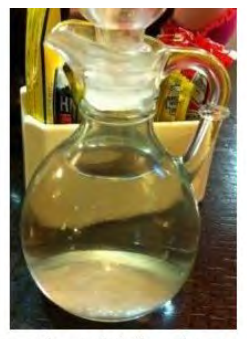
- Vinegar (contains acetic acid)
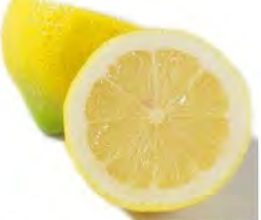
- Lemon juice (contains citric acid)
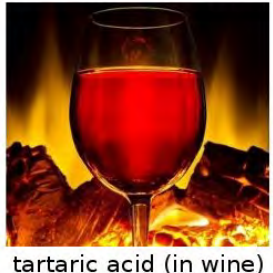
- Wine (contains tartaric acid)
Bases usually have a bitter taste and feel slippery to touch. Common examples include:
- Sodium hydroxide (found in cleaning products)
- Ammonia (household cleaner)
- Magnesium hydroxide (antacid tablets)
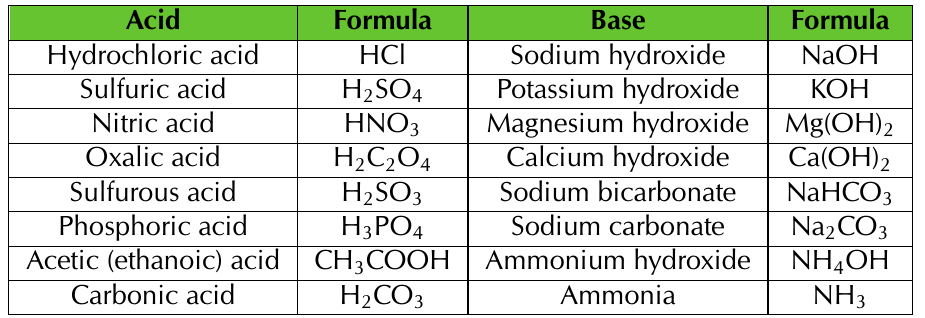
Some acids like hydrochloric acid, sulfuric acid, and nitric acid are primarily used in laboratories and industry rather than in household products.
Models for acids and bases
Scientists have developed different models to define and understand acids and bases. These models help us predict how these substances will behave in chemical reactions.
Arrhenius model
The Arrhenius model was one of the earliest definitions for acids and bases. This model focuses specifically on what happens when acids and bases dissolve in water.

Arrhenius acid: A substance that increases the concentration of hydronium ions () when dissolved in water.
Arrhenius base: A substance that increases the concentration of hydroxide ions () when dissolved in water.
For example, when hydrochloric acid dissolves in water:
When sodium hydroxide dissolves in water:
Important
The Arrhenius definition has significant limitations because it only applies to reactions occurring in water. Many acid-base reactions happen in other solvents or without water present, which this model cannot explain.
Brønsted-Lowry model
The Brønsted-Lowry model provides a broader definition that applies to reactions beyond those in water. This model focuses on the transfer of protons (hydrogen ions, ).

Brønsted-Lowry acid: A substance that donates protons () in a reaction. We call this a proton donor.
Brønsted-Lowry base: A substance that accepts protons () in a reaction. We call this a proton acceptor.
Let's examine some examples to understand how this works:
In the reaction:
- HCl donates a proton, so it acts as the acid
- NH₃ accepts a proton, so it acts as the base
In the reaction:
- CH₃COOH donates a proton, so it acts as the acid
- H₂O accepts a proton, so it acts as the base
Amphoteric substances
Some substances can act as either acids or bases depending on the reaction conditions. We call these amphoteric substances.
Amphoteric substance: A substance that can act as an acid in one reaction or as a base in another reaction.
Note
Water is a perfect example of an amphoteric substance:
- In reaction with NH₃: H₂O donates a proton (acts as acid)
- In reaction with CH₃COOH: H₂O accepts a proton (acts as base)
Other examples of amphoteric substances include ammonia (NH₃), zinc oxide (ZnO), and beryllium hydroxide (Be(OH)₂).
Conjugate acid-base pairs
The Brønsted-Lowry model introduces an important concept called conjugate acid-base pairs. Understanding these pairs helps us track proton transfer in reactions.
Conjugate acid-base pair: Two compounds that differ only by one hydrogen ion () and a charge of +1.
When an acid donates a proton, it forms its conjugate base. When a base accepts a proton, it forms its conjugate acid.
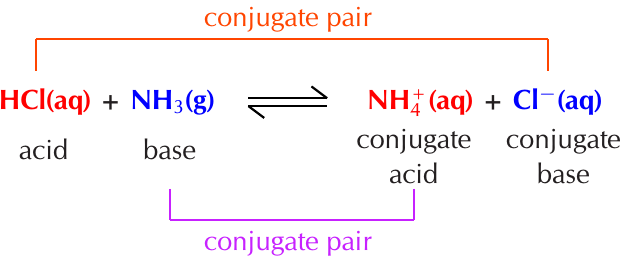
In the reaction above:
- HCl (acid) and Cl⁻ (conjugate base) form one conjugate pair
- NH₃ (base) and NH₄⁺ (conjugate acid) form another conjugate pair

Another example shows water acting as an acid:
- H₂O (acid) and OH⁻ (conjugate base) form one conjugate pair
- NH₃ (base) and NH₄⁺ (conjugate acid) form another conjugate pair
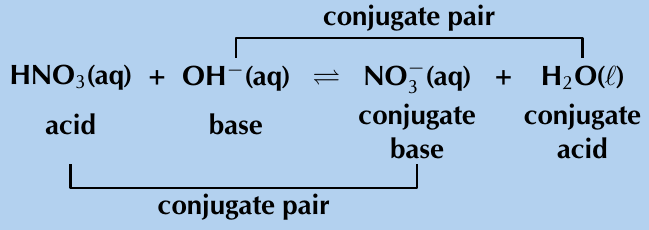
Example
Worked Example: Identifying Conjugate Pairs
Question: Determine the conjugate acid-base pairs for the reaction:
Solution: Step 1: Identify which reactant is the acid and which is the base
- HNO₃ is nitric acid. It donates a proton, so it's the acid
- OH⁻ accepts a proton, so it's the base
Step 2: Identify the conjugate base of the acid
- HNO₃ donates a proton to become NO₃⁻
- Therefore NO₃⁻ is the conjugate base of HNO₃
Step 3: Identify the conjugate acid of the base
- OH⁻ accepts a proton to become H₂O
- Therefore H₂O is the conjugate acid of OH⁻
Step 4: Label the conjugate pairs
- HNO₃/NO₃⁻ form one conjugate acid-base pair
- OH⁻/H₂O form another conjugate acid-base pair
Important
Remember that conjugate acid-base pairs must differ by exactly one H⁺ ion and have charges that differ by exactly +1.
Strong and weak acids and bases
Not all acids and bases behave the same way in solution. We classify them based on how completely they ionise or dissociate.
Strong acids and bases
Strong acid: An acid that almost completely dissociates to form ions in solution.
Strong base: A base that almost completely dissociates to form ions in solution.
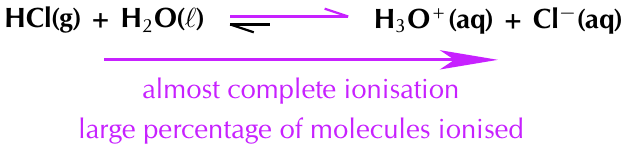
When we say "almost completely," we mean that a large percentage of the molecules break apart into ions. For example, if we add 100,000 molecules of HCl to water, about 99,000 might form ions.
The unequal arrows show that the equilibrium strongly favours ion formation.
Note
Common strong acids include:
- Hydrochloric acid (HCl)
- Nitric acid (HNO₃)
- Sulfuric acid (H₂SO₄)
Common strong bases include:
- Sodium hydroxide (NaOH)
- Potassium hydroxide (KOH)
Weak acids and bases
Weak acid: An acid where only a small percentage of molecules dissociate to form ions in solution.
Weak base: A base where only a small percentage of molecules dissociate to form ions in solution.
For weak acids and bases, only a small fraction of molecules form ions. For example, if we add 100,000 molecules of HF to water, only about 100 might form ions.
The unequal arrows show that the equilibrium does not favour ion formation.
An example of a weak base is Mg(OH)₂, which only partially dissociates into Mg²⁺ and OH⁻ ions.
Dilute and concentrated solutions
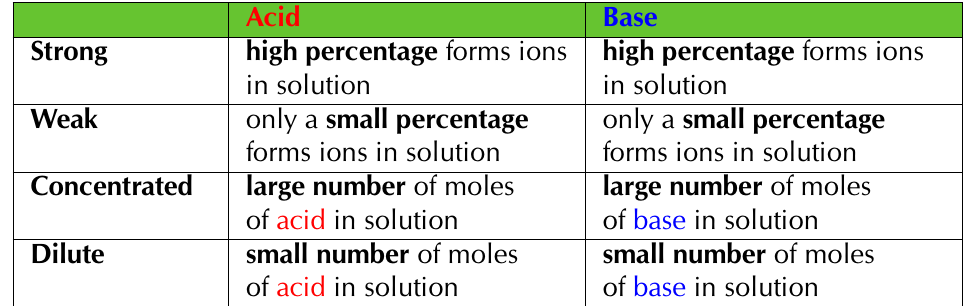
It's important not to confuse strong/weak with concentrated/dilute. These terms describe different properties of solutions.
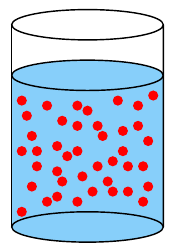
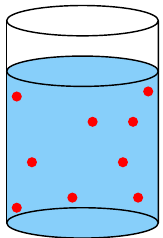
Concentrated solution: A solution with a high ratio of dissolved substance (acid or base) to solvent.
Dilute solution: A solution with a low ratio of dissolved substance to solvent.
Important
Critical Distinction:
- Strong/weak refers to the extent of ionisation (a property of the compound)
- Concentrated/dilute refers to the amount of substance present (a property of the solution)
These are completely independent properties!
You can have:
- A concentrated solution of a weak acid (lots of weak acid molecules, few ions)
- A dilute solution of a strong acid (few strong acid molecules, but most form ions)
- Any other combination
The electrical conductivity of a solution depends on the concentration of mobile ions present. A concentrated solution of a strong acid or base will have high electrical conductivity, while a dilute solution of a weak acid or base will have low electrical conductivity.
Example
Worked Example: Strong/weak and concentrated/dilute
Question: Solution 1 contains 100 dm³ of HCl added to 10 dm³ of water. Almost all HCl molecules ionise. Solution 2 contains 0.01 g of Mg(OH)₂ added to 1000 dm³ of water. Only a small percentage of Mg(OH)₂ molecules dissociate.
Classify these solutions as strong/weak and concentrated/dilute.
Solution: Step 1: Identify the compounds
- HCl is hydrochloric acid (an acid)
- Mg(OH)₂ is magnesium hydroxide (a base)
Step 2: Determine if they are strong or weak
- Almost all HCl molecules ionise → HCl is a strong acid
- Only small percentage of Mg(OH)₂ dissociates → Mg(OH)₂ is a weak base
Step 3: Determine if solutions are concentrated or dilute
- 100 dm³ of HCl in 10 dm³ of water = high ratio → concentrated
- 0.01 g of Mg(OH)₂ in 1000 dm³ of water = low ratio → dilute
Step 4: Final classification
- Solution 1: concentrated solution of a strong acid
- Solution 2: dilute solution of a weak base
Example
Worked Example: Calculating Concentration
Question: 16.4 g of KOH is added to 12.9 cm³ of water. Calculate the concentration of the solution.
Solution: Step 1: List known information
- Mass = 16.4 g
- Volume = 12.9 cm³ = 0.0129 dm³
Step 2: Calculate molar mass of KOH
Step 3: Calculate number of moles
Step 4: Calculate concentration
Ka and Kb equilibrium constants
The equilibrium constants Ka (for acids) and Kb (for bases) provide a quantitative way to measure the strength of acids and bases.
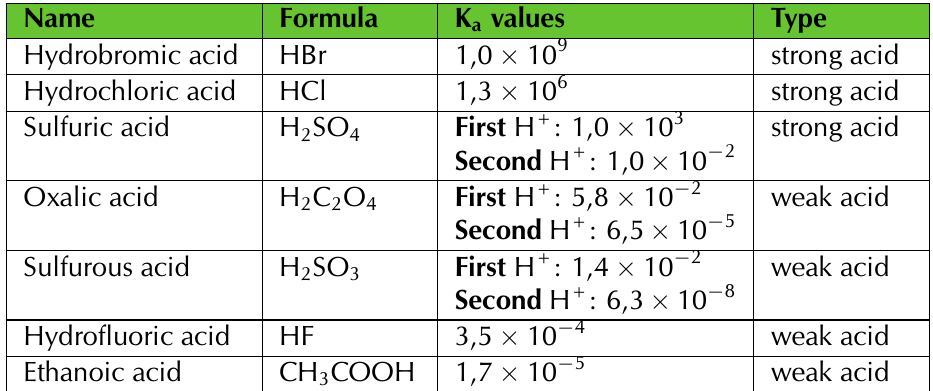
For acids, we use the general expression:
Strong acids
Strong acids have very large Ka values (typically greater than ). This indicates that the equilibrium lies far to the right, meaning almost complete ionisation occurs.
For hydrobromic acid:
The very large Ka value (approximately ) confirms that HBr is a strong acid.
Weak acids
Weak acids have much smaller Ka values (typically less than 1). This indicates that only a small fraction of molecules ionise.
For ethanoic acid:
The small Ka value () confirms that ethanoic acid is weak.
Bases and Kb values
For bases, we use similar principles. Strong bases like NaOH have very large Kb values and dissociate almost completely:
Weak bases like NH₃ have small Kb values and only partially ionise:
Example
Worked Example: Ka Calculations
Question: Calculate the equilibrium constant for hydrochloric acid added to 1.38 dm³ of water:
- n(HCl) in solution = 0.005 mol
- n(Cl⁻) in solution = 87.3 mol
Solution: Step 1: Calculate concentrations
- (1:1 ratio with Cl⁻)
Step 2: Apply Ka expression
This large Ka value confirms that HCl is a strong acid.
Summary
Key Points to Remember:
- Arrhenius acids increase H₃O⁺ concentration; Arrhenius bases increase OH⁻ concentration
- Brønsted-Lowry acids donate protons; Brønsted-Lowry bases accept protons
- Conjugate pairs differ by exactly one H⁺ ion and one unit of charge
- Strong acids/bases almost completely ionise; weak acids/bases only partially ionise
- Concentrated/dilute refers to amount of substance, not degree of ionisation
- Large Ka values indicate strong acids; small Ka values indicate weak acids