pH (Grade 12 NSC Matric Physical Sciences): Revision Notes
📚Revision Notes
pH
What is pH?
pH is a measurement that tells us how acidic or basic (alkaline) a solution is. The term pH stands for "power of hydrogen" and was first introduced by Danish biochemist Søren Peter Lauritz Sørensen in 1909.
Important
Definition: pH is a measure of the acidity or alkalinity of a solution.
The pH scale ranges from 0 to 14 and works as follows:
- pH < 7: The solution is acidic
- pH = 7: The solution is neutral (pure water)
- pH > 7: The solution is basic or alkaline
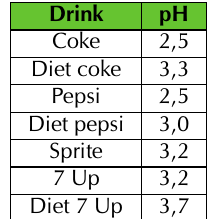
Many everyday items have specific pH values. For example, popular soft drinks are quite acidic, with pH values between 2.5 and 3.7. This explains why these drinks can be harmful to tooth enamel over time.
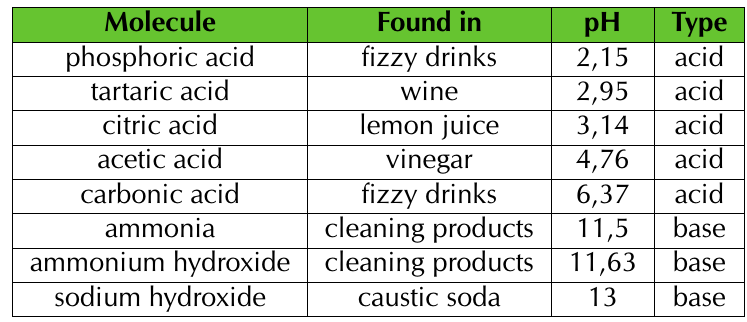
Understanding pH helps us make sense of the world around us. From the citric acid in lemon juice (pH 3.14) to the sodium hydroxide in caustic soda (pH 13), pH measurements help us classify and understand different substances.
pH calculations
The pH of a solution can be calculated using logarithmic equations. The concentration of hydrogen ions [H⁺] and hydronium ions [H₃O⁺] can be used interchangeably in these calculations.
Key formula:
The brackets [ ] represent concentration in mol.dm⁻³.
Note
Important tip: The pH scale is a logarithmic scale, which means each unit represents a tenfold change in acidity. A solution with pH 2 is ten times more acidic than a solution with pH 3.

This table shows the relationship between pH values and ion concentrations. Notice how as pH increases (becomes more basic), the hydrogen ion concentration [H⁺] decreases while the hydroxide ion concentration [OH⁻] increases.
Example
Worked Example 1: Basic pH calculation
Question: Calculate the pH of a solution where the concentration of hydrogen ions is 1 × 10⁻⁷ mol.dm⁻³.
Solution: Step 1: Identify the hydrogen ion concentration: [H⁺] = 1 × 10⁻⁷ mol.dm⁻³
Step 2: Apply the pH formula:
This solution has a pH of 7, making it neutral.
Example
Worked Example 2: More complex pH calculation
Question: In a 162 cm³ solution of ethanoic acid, 0.001 mol of H₃O⁺ ions are formed. Calculate the pH of the solution.
Solution: Step 1: Calculate the concentration of hydronium ions: Concentration = n(mol) ÷ V(dm³) Volume = 162 cm³ = 0.162 dm³ [H₃O⁺] = 0.001 mol ÷ 0.162 dm³ = 0.0062 mol.dm⁻³
Step 2: Calculate the pH:
This solution is acidic with a pH of 2.21.
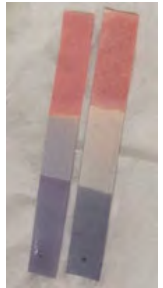
pH indicator strips like these are practical tools for quickly measuring pH in laboratories and everyday situations.
Water ionisation and Kw
Water can act as both an acid and a base through a process called auto-protolysis or auto-ionisation. This means water molecules can transfer protons between themselves.
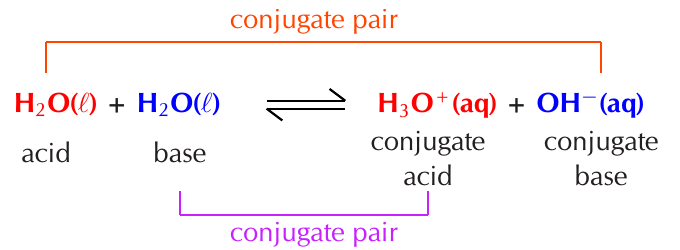
The equation for water ionisation is:
In this reaction:
- One water molecule acts as an acid (proton donor)
- Another water molecule acts as a base (proton acceptor)
- Conjugate pairs are formed: H₂O/OH⁻ and H₂O/H₃O⁺
Important
Definition: Auto-protolysis is the transfer of a proton between two identical molecules. The auto-ionisation of water is one example of auto-protolysis.
The equilibrium constant for this process is called Kw:
- At 25°C:
This relationship is crucial for understanding pH calculations and the behaviour of aqueous solutions.
Salt hydrolysis
When salts dissolve in water, they can affect the pH of the solution. The final pH depends on the strength of the original acid and base that formed the salt.
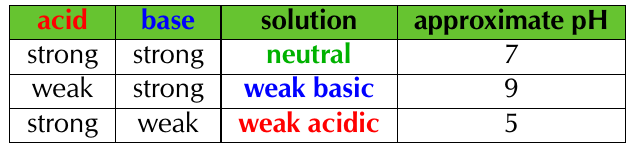
The general rules for salt hydrolysis are:
Strong acid + strong base
- Result: Neutral solution (pH ≈ 7)
- Example: HCl + NaOH → NaCl + H₂O
- The salt does not significantly affect water's pH
Weak acid + strong base
- Result: Basic solution (pH ≈ 9)
- Example: CH₃COOH + NaOH → CH₃COONa + H₂O
- The salt makes the solution slightly basic
Strong acid + weak base
- Result: Acidic solution (pH ≈ 5)
- Example: HCl + NH₃ → NH₄Cl + H₂O
- The salt makes the solution slightly acidic
Important
Important note: Neutralisation does not always result in a pH of 7. The pH depends on the strength of the reactants involved.
Indicators
Indicators are chemical compounds that change colour depending on the pH of the solution they're in. They are essential tools for determining when chemical reactions reach completion, especially in titrations.
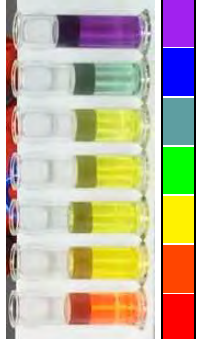
Different indicators work best at different pH ranges and show distinct colour changes:
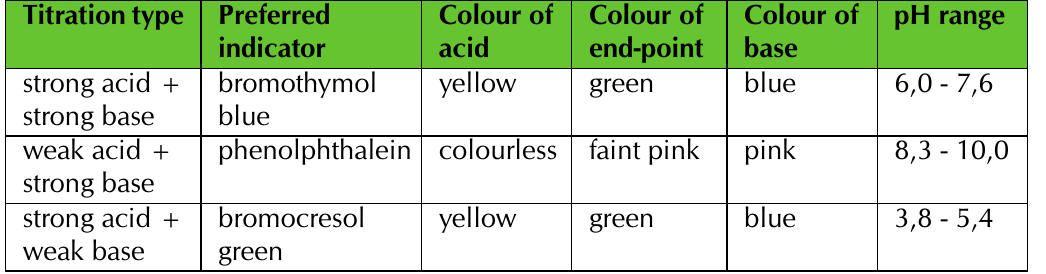
Common indicators and their uses:
Bromothymol blue:
- pH range: 6.0 - 7.6
- Colours: Yellow (acidic) → Green (neutral) → Blue (basic)
- Best for: Strong acid + strong base titrations
Phenolphthalein:
- pH range: 8.3 - 10.0
- Colours: Colourless (acidic) → Faint pink (neutral) → Pink (basic)
- Best for: Weak acid + strong base titrations
Bromocresol green:
- pH range: 3.8 - 5.4
- Colours: Yellow (acidic) → Green (neutral) → Blue (basic)
- Best for: Strong acid + weak base titrations
Note
The colour change occurs because indicators are weak acids or bases themselves. When the pH changes, the equilibrium between their molecular and ionic forms shifts, causing different colours to appear.
Summary
Key Points to Remember:
-
pH measures acidity/alkalinity on a scale from 0-14, where pH < 7 is acidic, pH = 7 is neutral, and pH > 7 is basic
-
pH calculations use logarithms: , and the pH scale is logarithmic (each unit = 10× change)
-
Water ionises to form conjugate pairs: , with at 25°C
-
Salt solutions' pH depends on parent acid/base strength: strong + strong = neutral (pH 7), weak + strong = depends on which is weak
-
Indicators change colour at specific pH ranges and must be chosen to match the expected equivalence point pH in titrations