Titrations (Grade 12 NSC Matric Physical Sciences): Revision Notes
📚Revision Notes
Titrations
What are titrations?
Titration is a fundamental analytical technique used in chemistry to determine the concentration of an unknown solution. The process involves adding a solution of known concentration (called a standard solution) to a solution of unknown concentration until the reaction between them is complete.
The neutralisation reaction between an acid and a base forms the basis of most titrations. During this process, you carefully measure the volume of standard solution needed to completely react with the unknown solution. The point where the reaction is complete is called the end-point, and this occurs when stoichiometrically equivalent amounts of acid and base have reacted with each other.
Note
Another name for titration is volumetric analysis, which describes how you use precise volume measurements to determine concentration.
Titration indicators
Indicators are essential chemicals that help you identify when the end-point has been reached. These substances change colour within specific pH ranges, allowing you to see when neutralisation is complete.
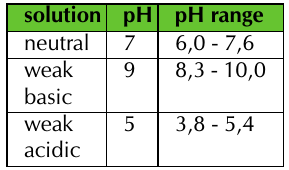
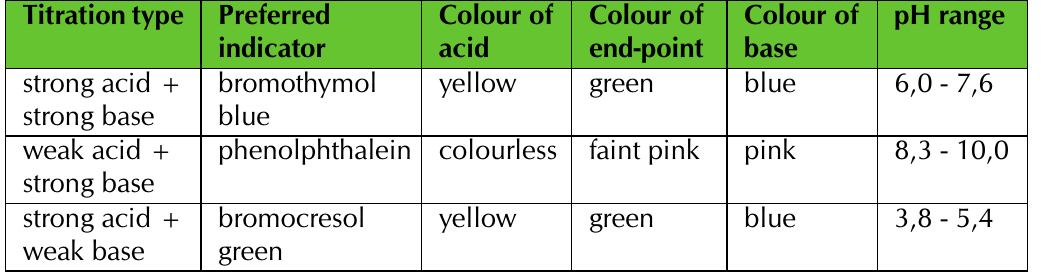
The choice of indicator depends on the type of titration you are performing:
Important
Indicator Selection Guide:
Strong acid + Strong base titrations:
- Use bromothymol blue
- pH range: 6.0 - 7.6
- Colour change: Yellow (acid) → Green (end-point) → Blue (base)
Weak acid + Strong base titrations:
- Use phenolphthalein
- pH range: 8.3 - 10.0
- Colour change: Colourless (acid) → Faint pink (end-point) → Pink (base)
Strong acid + Weak base titrations:
- Use bromocresol green
- pH range: 3.8 - 5.4
- Colour change: Yellow (acid) → Green (end-point) → Blue (base)
The indicator changes colour according to Le Chatelier's principle. When acid is added, the equilibrium shifts to produce more of the acidic form, and when base is added, it shifts to produce more of the basic form.
Titration procedure
The titration process requires careful setup and precise measurements to obtain accurate results.
Essential equipment:
- Burette (for adding standard solution drop by drop)
- Pipette (for measuring exact volumes)
- Conical flask (for holding the unknown solution)
- White tile (to better observe colour changes)
- Standard solution of known concentration
Step-by-step method:
-
Prepare the solution: Place a carefully measured volume of the unknown solution into a conical flask using a pipette.
-
Add indicator: Add a few drops of suitable indicator to the unknown solution.
-
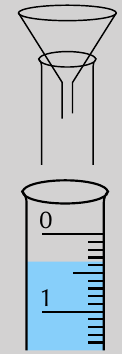
Set up equipment: Place the conical flask on a white tile. Fill the burette with standard solution and record the initial volume reading.
-
Rough titration: Add standard solution quickly while swirling the flask until you see the colour change. Record the volume used.
-
Accurate titrations: Perform at least three careful titrations, adding the standard solution drop by drop near the end-point. Stop when the colour change persists after swirling.
-
Record measurements: Note the final burette reading and calculate the volume of standard solution used for each titration.
-
Calculate average: Use the volumes from your accurate titrations (ignore the rough titration) to calculate an average volume.
Important
Safety Considerations:
- Always wear safety glasses and gloves when handling concentrated acids and bases
- Handle all chemicals with care as they can cause serious burns
- Work in a well-ventilated area
Titration calculations
Understanding the mathematical relationships is crucial for determining unknown concentrations from titration data.
Note
Key unit conversions:
- 1 dm³ = 1 litre = 1000 ml = 1000 cm³
- Always convert cm³ to dm³ by dividing by 1000
Important
Essential formulas:
- Concentration = moles ÷ volume
- Moles = concentration × volume
Calculation steps:
- Balance the chemical equation to understand the mole ratio between reactants
- Convert all volumes from cm³ to dm³
- Calculate moles of the known substance using
- Use stoichiometry to find moles of the unknown substance
- Calculate concentration of unknown using
Example
Worked Example 1: Basic Acid-Base Titration
25 cm³ of sodium hydroxide solution was titrated with 0.2 mol.dm⁻³ hydrochloric acid. 15 cm³ of acid was needed to neutralise the base.
Solution:
Step 1: (balanced equation)
Step 2: Convert volumes:
- NaOH:
- HCl: ,
Step 3: Calculate moles of HCl:
Step 4: Use stoicheiometry (1:1 ratio):
Step 5: Calculate concentration of NaOH:
Example
Worked Example 2: Diprotic Acid Titration
10 g of sodium hydroxide dissolved in 500 cm³ water. 20 cm³ of this solution neutralised 10 cm³ of sulfuric acid.
Solution:
Step 1:
Step 2: Calculate concentration of NaOH solution:
Step 3: Calculate moles of NaOH used in titration:
Step 4: Use stoicheiometry (2:1 ratio NaOH
₂SO₄):Step 5: Calculate concentration of H₂SO₄:
Preparing standard solutions
Standard solutions are essential for accurate titrations. These solutions have precisely known concentrations and are prepared using specific procedures.
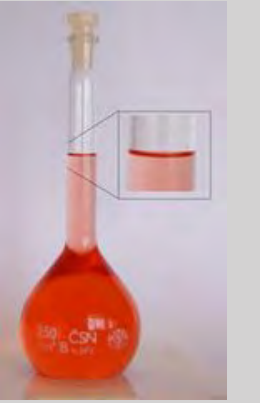
Equipment needed:
- Volumetric flask (for precise volume measurement)
- Weighing scale and spatula
- Beaker and funnel
- Plastic dropper
Method for preparing standard solution:
- Weigh the solute: Use an accurate balance to measure the required mass of solid
- Initial dissolution: Dissolve the solid in a small amount of distilled water in a beaker
- Transfer to volumetric flask: Use a funnel to transfer the solution without spilling
- Rinse and add more water: Rinse the beaker and funnel, adding the washings to the flask
- Fill to near the mark: Add distilled water until the liquid level approaches the graduation mark
- Final adjustment: Use a dropper to add water drop by drop until the meniscus aligns exactly with the mark
- Mix thoroughly: Cap the flask and invert several times to ensure complete mixing
Important
Safety Warnings:
- Concentrated bases can cause serious burns
- Always wear gloves and safety glasses
- Handle all chemicals with care
When recording your titration results, use a systematic approach with multiple trials to ensure accuracy and precision. Calculate the average of your accurate titrations (excluding the rough titration) for your final calculations.
Summary
Key Points to Remember:
-
Titration determines unknown concentrations by measuring the volume of standard solution needed for complete neutralisation
-
Choose the correct indicator based on your titration type - bromothymol blue for strong acid/strong base, phenolphthalein for weak acid/strong base
-
Always perform multiple accurate titrations after an initial rough titration to ensure reliable results
-
Unit conversions are essential - always convert cm³ to dm³ by dividing by 1000 before calculations
-
Use stoicheiometry from balanced equations to relate moles of known and unknown substances in your calculations