Le Chatelier’s Principle (Grade 12 NSC Matric Physical Sciences): Revision Notes
📚Revision Notes
Le Chatelier's Principle
What is Le Chatelier's principle?
Le Chatelier's Principle is a fundamental concept that helps us predict how chemical equilibrium systems respond when disturbed. This principle was developed by French chemist Henry Louis Le Chatelier in the late 1800s.
Note
Definition: When an external stress (change in pressure, temperature or concentration) is applied to a system in chemical equilibrium, the equilibrium will change in such a way as to reduce the effect of the stress.
This principle is crucial in industrial applications where yields must be accurately predicted and maximised. The key factors that can change the equilibrium position are:
- Concentration changes
- Temperature changes
- Pressure changes (for gaseous reactants)
Le Chatelier's principle essentially tells us that equilibrium systems "fight back" against changes by shifting to counteract the disturbance.
The effect of concentration on equilibrium
When the concentration of any substance in an equilibrium is changed, the equilibrium will shift to minimise the effect of that change.
Important
Key rules for concentration changes:
-
If concentration of a reactant is increased: The equilibrium shifts in the direction that uses the reactants, so the forwards reaction is favoured
-
If concentration of a product is decreased: More product is formed, so the forwards reaction is favoured
-
If concentration of a reactant is decreased: The equilibrium shifts to produce more reactants, so the reverse reaction is favoured
-
If concentration of a product is increased: Product is used up, so the reverse reaction is favoured
Example
Worked Example: Concentration Effects
For the reaction:
If or concentration is increased:
- Le Chatelier's principle predicts equilibrium will shift to decrease reactant concentration
- Forwards reaction rate increases
- Some sulphur dioxide or oxygen is used to produce sulphur trioxide
- Equilibrium shifts to the right
- When new equilibrium is reached, there will be more product than before
If decreases:
- Le Chatelier's principle predicts equilibrium will shift to increase product concentration
- Forwards reaction rate increases to produce more products
- Some sulphur dioxide or oxygen is used to produce sulphur trioxide
- Equilibrium shifts to the right
Common-ion effect
The common-ion effect occurs when a substance releases ions that are already present in the equilibrium reaction.
For example, if solid sodium chloride is added to a solution containing:
The added ion interferes with the equilibrium by raising the concentration of . According to Le Chatelier's principle, the reverse reaction speeds up to reduce the effect of the added , causing the equilibrium position to shift to the left.
The effect of temperature on equilibrium
When the temperature of a reaction mixture is changed, the equilibrium will shift to minimise that change.
Important
Key rules for temperature changes:
-
If temperature is increased: The equilibrium shifts to favour the reaction which will reduce the temperature → The endothermic reaction is favoured
-
If temperature is decreased: The equilibrium shifts to favour the reaction which will increase the temperature → The exothermic reaction is favoured
Example
Worked Example: Temperature Effects
kJ
This forwards reaction is exothermic (shown by negative ΔH), meaning the forwards reaction gives off heat and the reverse reaction takes in heat (endothermic).
An increase in temperature:
- Favours the endothermic reaction because it takes in energy (cools the container)
- The reverse reaction is endothermic, so the reverse reaction is favoured
- The yield of ammonia (NH₃) will decrease
A decrease in temperature:
- Favours the exothermic reaction because it releases energy (warms the container)
- The forwards reaction is exothermic, so the forwards reaction is favoured
- The yield of NH₃ will increase
Cobalt equilibrium demonstration
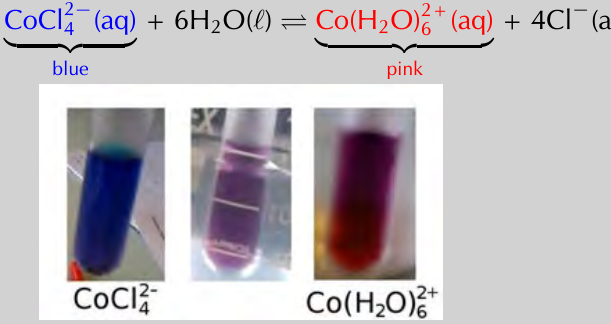
The cobalt chloride equilibrium provides an excellent visual demonstration: (blue) (pink)
Note
This reaction shows clear colour changes when temperature or concentration is altered, making it easy to observe Le Chatelier's principle in action.
The effect of pressure on equilibrium
When the pressure of a gaseous reaction mixture is changed, the equilibrium will shift to minimise that change.
Important
Key rules for pressure changes:
-
If pressure is increased: The equilibrium shifts to favour a decrease in pressure → favours the side with fewer gas molecules
-
If pressure is decreased: The equilibrium shifts to favour an increase in pressure → favours the side with more gas molecules
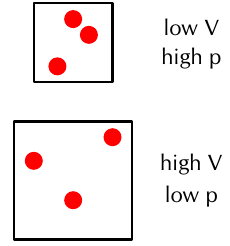
To predict pressure effects, you need to count the number of gas molecules in the balanced equation.
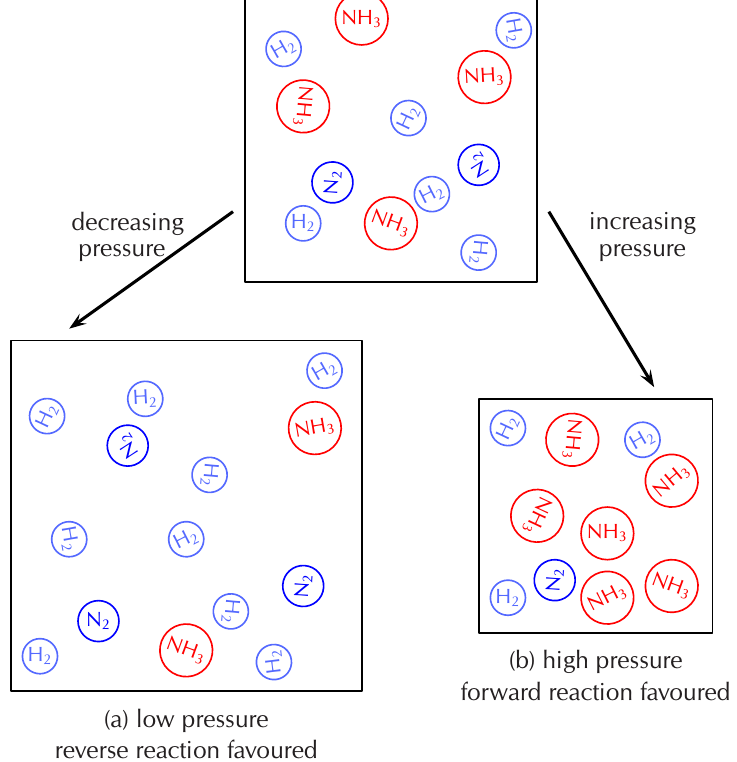
Example
Worked Example: Pressure Effects
The balanced equation ratio is 1:3:2. For every 1 molecule of gas, there are 3 molecules of gas and 2 molecules of gas. Therefore:
- 4 molecules of reactant gas to 2 molecules of product gas
An increase in pressure:
- Favours the reaction that decreases the number of gas molecules
- There are fewer molecules of product gas than reactant gas, so the forwards reaction is favoured
- The equilibrium will shift to the right and the yield of NH₃ will increase
A decrease in pressure:
- Favours the reaction that increases the number of gas molecules
- There are more molecules of reactant gas, so the reverse reaction is favoured
- The equilibrium will shift to the left and the yield of NH₃ will decrease
The effect of a catalyst on equilibrium
If a catalyst is added to a reaction, both the forwards and reverse reaction rates will be increased. Since both rates are increased, the concentrations of reactants and products will remain the same. This means that a catalyst has no effect on the equilibrium position.
Note
However, a catalyst will affect how quickly equilibrium is reached. This is very important in industry where the longer a process takes, the more money it costs. If a catalyst reduces the time needed to form specific products, it also reduces the cost of production.
Factors that influence the value of Kc
Concentration, pressure, and temperature all affect the equilibrium position of a reaction, and a catalyst affects reaction rates. However, only temperature affects the value of Kc.
Important
Effects on Kc:
-
Changing concentration: Results in one reaction being favoured, which minimises the effect of the change and restores the concentration ratio between reactants and products. Kc will remain the same
-
Changing pressure: The equilibrium shifts to minimise the pressure change and restores the ratio between reactant and product concentrations. Kc will remain the same
-
Adding a catalyst: Both forwards and reverse reaction rates are increased, so the ratio between reactant and product concentrations remains the same. Kc will remain the same
-
Changing temperature: This will favour either the endothermic or exothermic reaction, changing the ratio between reactant and product concentrations. Kc will change
Important exam tip: When comparing Kc values for different reactions, ensure the different reactions took place at the same temperature.
Using Le Chatelier's principle - step-by-step method
When a system is in chemical equilibrium and there has been a change in conditions, follow these steps:
Note
Step 1: Identify the disturbance or stress on the system
- For example, there is an increase in the concentration of reactant
Step 2: Use Le Chatelier's principle to decide how the system will respond
- Le Chatelier predicts a shift to decrease the concentration of reactant
Step 3: Look at the given equation and decide whether the rate of the forwards reaction or the rate of the reverse reaction is increased. State the shift in equilibrium
- The forwards reaction will be favoured. The equilibrium will shift to the right
Step 4: Where appropriate, link equilibrium shift to any observed change in the system
- This might result in a colour change
Worked examples
Example
Worked Example 1: Using Le Chatelier's principle
Question: Table salt is added to the (purple) solution in equilibrium: (blue) (pink)
- Use Le Chatelier's principle to predict the change in equilibrium position
- What would be observed?
Solution:
Step 1: Identify the disturbance or stress on the system Adding NaCl produces ions and ions as the salt dissolves. Looking at the equilibrium, is in the equation and the disturbance is the increase in concentration of the Cl⁻ ion.
Step 2: Use Le Chatelier's principle to decide how the system will respond By Le Chatelier's principle, the equilibrium position will shift to reduce the concentration of Cl⁻ ions.
Step 3: Decide whether the rate of the forwards reaction or the rate of the reverse reaction is increased and state the resulting shift in equilibrium The reverse reaction uses ions and hence the rate of the reverse reaction will increase. The reverse reaction is favoured and the equilibrium will shift to the left.
Step 4: What would the colour change be due to this equilibrium shift? The solution will appear more blue as more blue ions are formed.
Example
Worked Example 2: Rate-time graphs
Question: For the reaction , kJ What stress has occurred in this system?
Solution:
Step 1: Check the axes so you know what the variables are on this graph The axes are labelled rate and time. Therefore this is a rate-time graph.
Step 2: Are both rates affected equally? No, the forwards rate is increased more than the reverse rate. Therefore the stress must be a change in temperature (a catalyst would increase both rates equally).
Step 3: Was the temperature increased or decreased? The forwards reaction is endothermic (ΔH is positive). An increase in temperature will favour the reaction that cools the reaction vessel (the endothermic reaction). Therefore the stress must have been an increase in temperature.
Graphs and Le Chatelier's principle
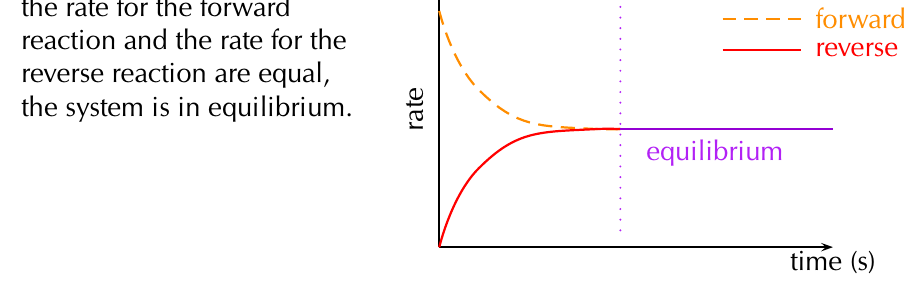
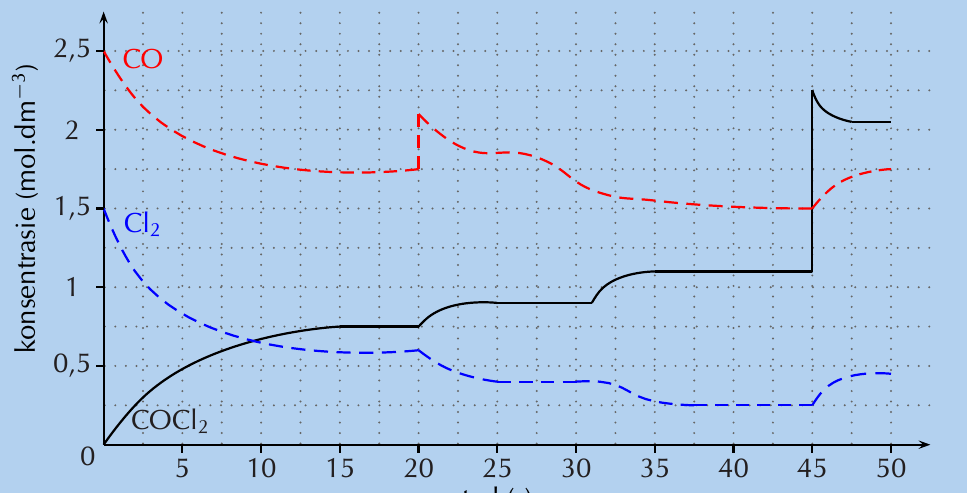
Graphs can be used to represent data about equilibrium reactions. Understanding how to interpret these graphs is essential for exam success.
Rate-time graphs
Note
Key points for rate-time graphs:
-
Identify the type of graph by looking at the y-axis label (rate vs time)
-
When forwards and reverse reaction rates are equal, the system is in equilibrium
-
For concentration-time graphs: Equilibrium occurs where the concentration of reactants and products are constant (but not necessarily equal)
Effects of changes on rate-time graphs:
-
Change in concentration: Sharp increase in one reaction rate, sharp decrease in the other rate, then gradual return to equal rates
-
Change in pressure: Sharp increase or decrease in all reactants and products, with same effect as concentration change
-
Change in temperature: Both rates affected, but unequally - endothermic reaction favoured by temperature increase, exothermic reaction favoured by temperature decrease
-
Addition of catalyst: Both forwards and reverse reactions favoured by same amount
Concentration-time graphs
Key features:
- Shows how concentrations of reactants and products change over time
- Equilibrium reached when all concentrations become constant
- Sharp changes indicate external disturbances to the system
Example
Worked Example 3: Concentration-time graphs
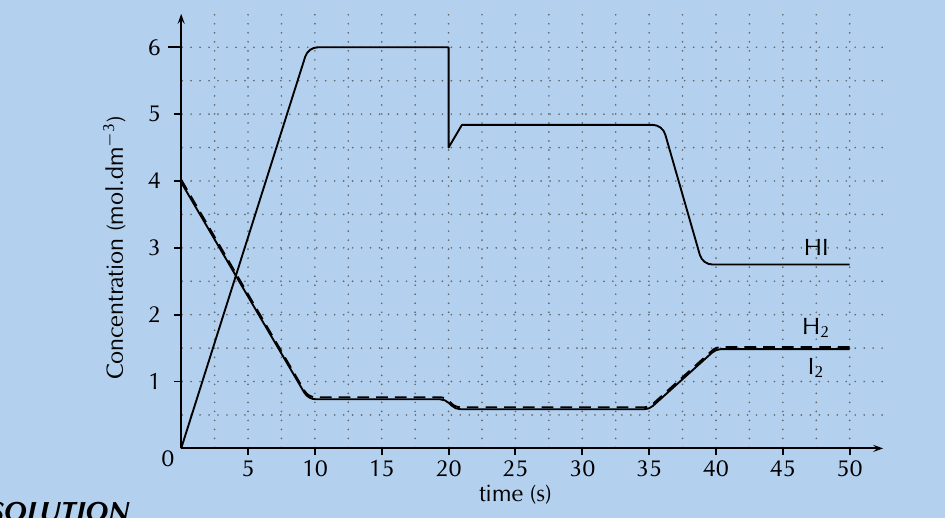
Question: Consider the equilibrium:
- After how many seconds does the system reach equilibrium?
- Calculate the value of the equilibrium constant
- What happens at t = 20 s?
- If the change at t = 35 s is due to an increase in temperature, is the reaction exothermic or endothermic?
Solution:
Step 1: Check axes - this is a concentration-time graph
Step 2: System reaches equilibrium when all concentrations become constant at t = 10 s
Step 3: At t = 10 s, 25 s, and 45 s:
- mol.dm⁻³
- mol.dm⁻³
- mol.dm⁻³
Step 4:
Step 5: At t = 20 s, HI concentration decreases sharply - HI must have been removed from the system
Step 6: The different at 45 s means the event at t = 35 s was a temperature change. Since the reverse reaction was favoured (more reactants, less product), and temperature increased, the reverse reaction must be endothermic, making the forwards reaction exothermic.
Summary
Key Points to Remember:
-
Le Chatelier's Principle: When a system in equilibrium is disturbed, it shifts to counteract the change and reduce the stress
-
Concentration changes: Adding reactants or removing products shifts equilibrium forwards; removing reactants or adding products shifts equilibrium backwards
-
Temperature changes: Increasing temperature favours the endothermic reaction; decreasing temperature favours the exothermic reaction
-
Pressure changes: Increasing pressure favours the side with fewer gas molecules; decreasing pressure favours the side with more gas molecules
-
Only temperature changes affect Kc - concentration, pressure, and catalysts do not change the equilibrium constant value