The Equilibrium Constant (Grade 12 NSC Matric Physical Sciences): Revision Notes
📚Revision Notes
The Equilibrium Constant
What is the equilibrium constant?
The equilibrium constant is a fundamental concept in chemistry that helps us understand how far a chemical reaction proceeds before reaching equilibrium. When a chemical reaction reaches dynamic equilibrium, both forwards and reverse reactions continue to occur, but their rates become equal, resulting in no net change in the concentrations of reactants and products.
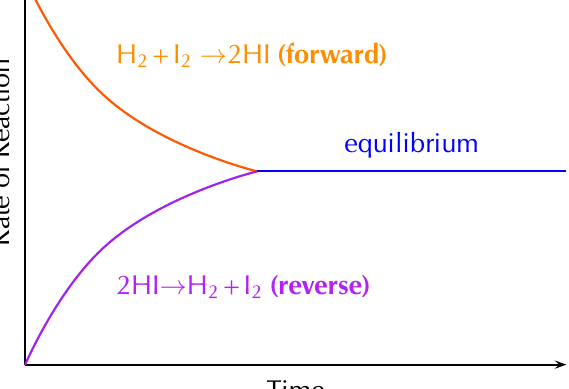
At equilibrium, although individual molecules continue to react in both directions, the overall concentrations remain constant. This is what we call dynamic equilibrium - the system appears static on a large scale, but molecular activity continues.
Note
Think of dynamic equilibrium like a busy two-way street where the number of cars travelling in each direction is equal. Even though individual cars are constantly moving, the overall traffic density in each direction stays the same.
Definition: The equilibrium constant (Kc) is the ratio between the concentration of products and reactants in a chemical reaction at equilibrium.
The equilibrium constant formula
For any general reversible reaction:
The equilibrium constant expression is:
Where:
- Square brackets [ ] represent molar concentrations (mol·dm⁻³)
- Letters a, b, c, d are the coefficients from the balanced equation
- These coefficients become the powers in the Kc expression
Important rules for writing Kc expressions
Important
Essential Rules for Kc Expressions:
- Products go on top of the fraction, reactants go on bottom
- Coefficients from the balanced equation become powers in the expression
- Only include gases and aqueous solutions - pure liquids and solids are omitted
- Concentrations must be at equilibrium - not initial or changing values
Example of writing Kc expressions
For the reaction:
The Kc expression becomes:
Notice how the coefficient 2 becomes the power 2 for each species.
Calculating equilibrium constants
When calculating Kc values, you need equilibrium concentrations of all species involved. Here's a systematic approach:
Example
Worked Example 1: Direct Calculation
Question: For the reaction , if Kc = 6 and [SO₃] = 3 mol·dm⁻³ at equilibrium, calculate [O₂].
Solution:
- Write the Kc expression:
- Rearrange to solve for [O₂]:
- Substitute values:
RICE tables for complex calculations
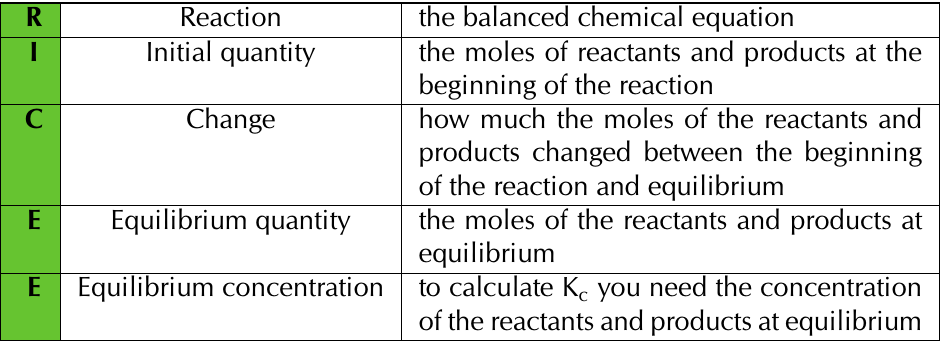
For more complicated equilibrium problems, we use RICE tables - a systematic method for organising information:
Note
RICE stands for:
- Reaction: Write the balanced chemical equation
- Initial: Record initial quantities/concentrations
- Change: Express changes using algebra (usually involving x)
- Equilibrium: Calculate equilibrium quantities/concentrations
How to use RICE tables
The RICE methodology provides a systematic approach to solving complex equilibrium problems. This method ensures you don't miss any important information and helps organise your calculations logically.
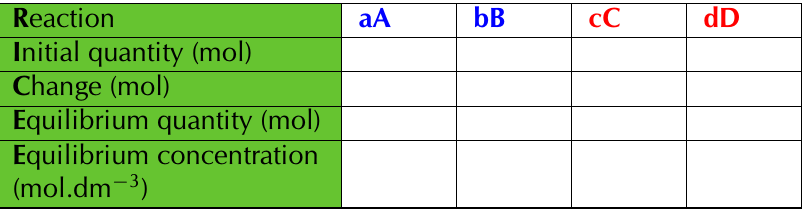
Step-by-step process:
- Fill in the balanced equation across the top
- Record initial molar quantities in the second row
- Express changes algebraically using the stoichiometric ratios
- Calculate equilibrium quantities by combining initial + change
- Convert to concentrations if needed using
Example
Worked Example 2: Complete RICE Calculation
Question: 1.4 moles of NH₃(g) decomposes in a 2.0 dm³ container at 600K: At equilibrium, [NH₃] = 0.3 mol·dm⁻³. Calculate Kc.
Solution:
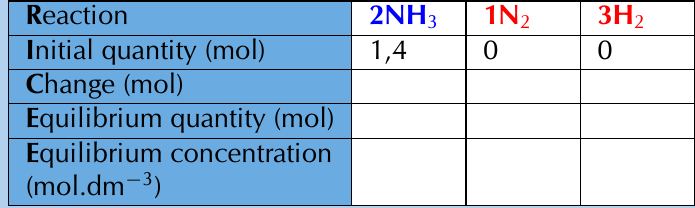
Step 1: Set up RICE table with initial conditions
- Initial: 1.4 mol NH₃, 0 mol N₂, 0 mol H₂
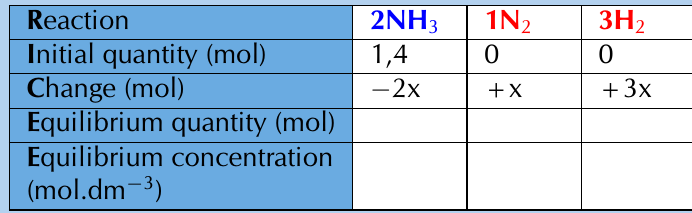
Step 2: Express changes using stoicheiometry
- For every 2 mol NH₃ decomposed, 1 mol N₂ and 3 mol H₂ form
- Change: -2x, +x, +3x
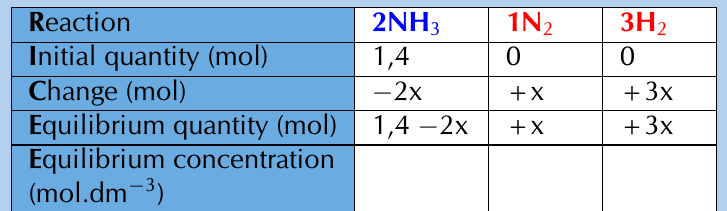
Step 3: Calculate equilibrium quantities
- NH₃: 1.4 - 2x mol
- N₂: x mol
- H₂: 3x mol
Step 4: Find x using given equilibrium concentration
- Solving: 0.6 = 1.4 - 2x, so x = 0.4 mol
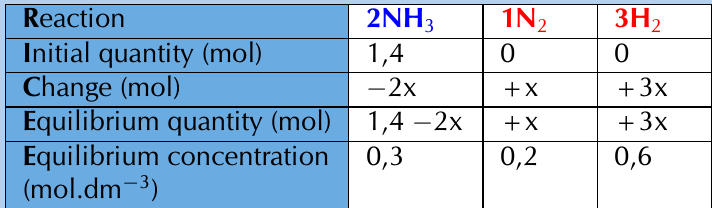
Step 5: Complete the table and calculate Kc
- Equilibrium concentrations: [NH₃] = 0.3, [N₂] = 0.2, [H₂] = 0.6 mol·dm⁻³
Example
Worked Example 3: Another Complete Calculation
Question: Starting with 0.496 mol H₂ and 0.181 mol I₂ in 1 dm³, equilibrium contains 0.00749 mol I₂. Calculate Kc.
Solution:
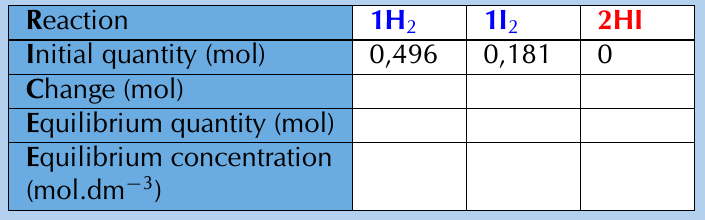
Using RICE methodology:
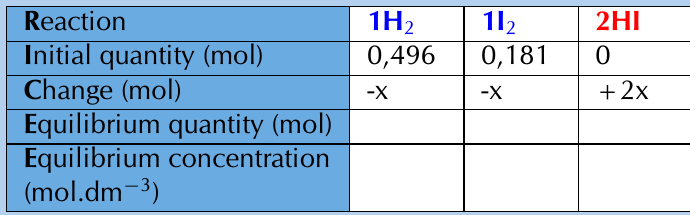
- Initial quantities: 0.496 mol H₂, 0.181 mol I₂, 0 mol HI
- Changes: -x, -x, +2x (following stoicheiometry)
- At equilibrium: I₂ = 0.181 - x = 0.00749 mol
- Solving: x = 0.181 - 0.00749 = 0.1735 mol
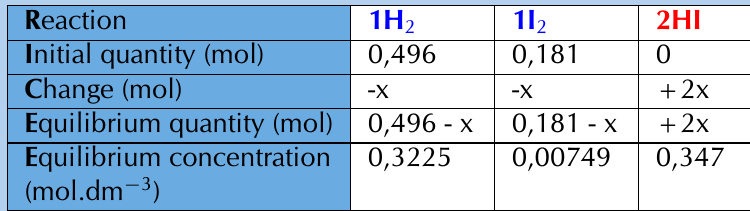
-
Final equilibrium concentrations:
- [H₂] = 0.3225 mol·dm⁻³
- [I₂] = 0.00749 mol·dm⁻³
- [HI] = 0.347 mol·dm⁻³
-
Interpreting Kc values
The value of Kc tells us important information about the reaction direction and yield:

What Kc values mean:
When Kc > 1:
- Equilibrium lies to the right
- More products than reactants at equilibrium
- High yield of products
- Forwards reaction is favoured
When 0 < Kc < 1:
- Equilibrium lies to the left
- More reactants than products at equilibrium
- Low yield of products
- Reverse reaction is favoured
Important
Extreme Kc Values:
When Kc >> 1 (much greater than 1):
- Reaction goes almost to completion
- Very high product yield
When Kc << 1 (much less than 1):
- Very little reaction occurs
- Reactants remain mostly unchanged
Exam tips for equilibrium constants
Mastering equilibrium constant problems requires systematic thinking and careful attention to detail. Here are key strategies for exam success:
Note
Essential Exam Strategies:
-
Always read the question carefully - make sure you understand what's being asked
-
Check equilibrium concentrations - Kc expressions only use concentrations at equilibrium, not initial or changing values
-
Use RICE tables for complex problems - they help organise information systematically
-
Remember the rules:
- Products on top, reactants on bottom
- Coefficients become powers
- Only include gases and aqueous solutions
- Square brackets mean molar concentration
-
Check your answer - does the Kc value make sense given the equilibrium position?
-
Watch units - Kc may have units depending on the reaction, or may be dimensionless
Summary
Key Points to Remember:
-
The equilibrium constant is the ratio of product concentrations to reactant concentrations, each raised to the power of their stoichiometric coefficients
-
Dynamic equilibrium means reaction rates are equal in both directions, but concentrations remain constant
-
RICE tables provide a systematic approach to complex equilibrium calculations: Reaction, Initial, Change, Equilibrium
-
means the equilibrium favours products; means it favours reactants
-
Only gases and aqueous solutions are included in expressions - pure liquids and solids are omitted