Applications of Electrochemistry (Grade 12 NSC Matric Physical Sciences): Revision Notes
📚Revision Notes
Applications of Electrochemistry
Introduction to electrochemical applications
Electrochemistry has many different uses, particularly in industry. The principles of electrochemical cells are used to create electrical batteries. A battery is a device that stores chemical energy and makes it available in electrical form. Batteries are made of electrochemical devices such as one or more galvanic cells or fuel cells.
Fuel cells convert the chemical potential energy produced by the oxidation of fuels (such as hydrogen gas, hydrocarbons, or alcohols) into electrical energy. This makes them an important clean energy technology.
Note
Fuel cells represent a significant advancement in clean energy technology because they produce electricity through chemical reactions without combustion, resulting in minimal environmental impact compared to traditional energy sources.
Batteries have many practical applications including:
- Torches
- Electrical appliances such as cellphones (long-life alkaline batteries)
- Digital cameras (lithium batteries)
- Hearing aids (silver-oxide batteries)
- Digital watches (mercury/silver-oxide batteries)
- Military applications (thermal batteries)
Electroplating
The electrolytic cell can be used for electroplating.
Note
Definition: Electroplating
The process of coating an electrically conductive object with a thin layer of metal using an electrical current.
Electroplating occurs when an electrically conductive object is coated with a layer of metal using electrical current. Sometimes electroplating is used to give a metal particular properties or for aesthetic reasons. The main uses of electroplating include:
- Corrosion protection - protecting metals from rust and degradation
- Abrasion and wear resistance - making surfaces harder and more durable
- The production of jewellery - giving objects an attractive metallic appearance
Copper refining (electrowinning)
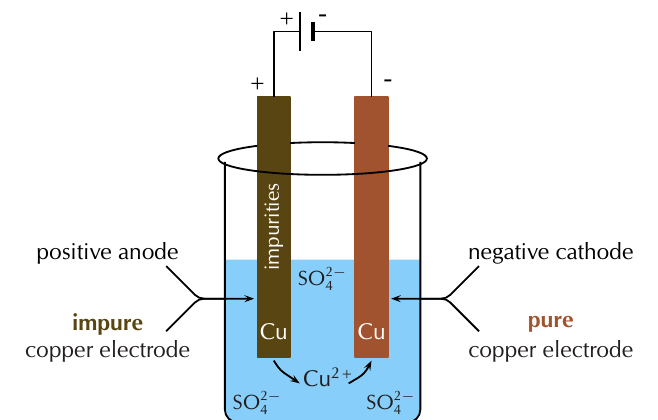
Electro-refining (also called electrowinning) is electroplating on a large scale. Copper plays a major role in the electrical industry as it is very conductive and is used in electric cables. However, copper must be pure to be an effective current carrier.
One method used to purify copper is electrowinning, where copper ore is processed into impure blister copper, which is then deposited as pure copper through electroplating.
Example
Worked Example: Copper Electrowinning Process
The copper electrowinning process works as follows:
Step 1: Setup
- A bar of impure copper containing other metallic impurities acts as the anode
- The cathode is made of pure copper with few impurities
- The electrolyte is a solution of aqueous CuSO₄ and H₂SO₄
Step 2: Electrolysis reactions When current passes through the cell, electrolysis takes place:
At the anode (impure copper):
- The impure copper anode oxidises to form Cu²⁺ ions in solution
- The anode decreases in mass
At the cathode (pure copper):
- Reduction of positive copper ions takes place to produce pure copper metal
- The cathode increases in mass
- (>99% purity)
Step 3: Waste removal Other metal impurities do not dissolve (Au, Ag) and form a solid sludge at the bottom of the tank, or remain in solution (Zn, Fe, Pb) in the electrolyte.
The chloralkali industry
The chlorine-alkali (chloralkali) industry is an important part of the chemical industry, which produces chlorine and sodium hydroxide through the electrolysis of brine.
Note
Definition: Brine
A saturated aqueous solution of sodium chloride.
Brine is obtained from natural salt deposits, and the products of the chloralkali industry have many important uses.
Uses of chloralkali products
Chlorine is used:
- To purify water
- As a disinfectant
- In the production of:
- Hypochlorous acid (used to kill bacteria in drinking water)
- Paper and food products
- Antiseptics, insecticides, medicines, textiles, laboratory chemicals
- Paints, petroleum products, solvents, plastics (such as polyvinyl chloride)
Sodium hydroxide (also known as 'caustic soda') is used to:
- Make soap and other cleaning agents
- Purify bauxite (the ore of aluminium)
- Make paper
- Make rayon (artificial silk)
The separation problem
Important
The Separation Challenge
One major problem in producing chlorine and sodium hydroxide is that when they are produced together, the chlorine combines with the sodium hydroxide to form chlorate (ClO⁻) and chloride (Cl⁻) ions. This leads to the production of sodium chlorate, NaClO, a component of household bleach.
To overcome this problem, the chlorine and sodium hydroxide must be separated so they don't react.
There are three industrial processes designed to overcome this problem. All three methods involve electrolytic cells.
1. The mercury cell
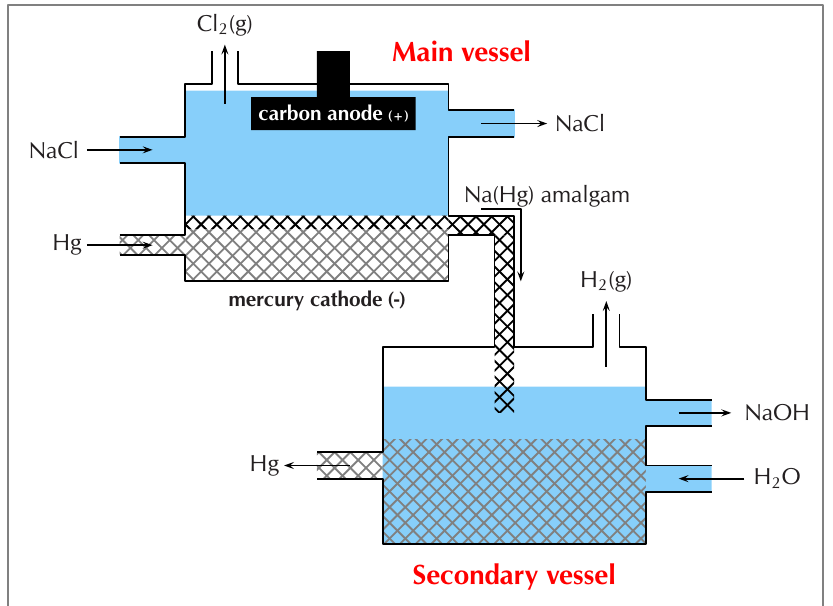
In the mercury cell:
- The anode is a carbon electrode suspended from the top of a chamber
- The cathode is liquid mercury that flows along the floor of this chamber
- The electrolyte is brine (NaCl solution) that is passed through the chamber
- When an electric current is applied, chloride ions in the electrolyte are oxidised at the anode to form chlorine gas
Anode reaction:
- Sodium ions are reduced at the cathode to solid sodium, which dissolves in the mercury making a sodium/mercury amalgam
Cathode reaction:
- The amalgam is poured into a separate vessel, where it decomposes into sodium and mercury
- The sodium reacts with water in the vessel and produces sodium hydroxide and hydrogen gas, while the mercury returns to the electrolytic cell to be used again
Secondary reaction:
Important
Disadvantages of the mercury cell:
- Mercury is expensive and toxic
- Some mercury always escapes with the brine that has been used
- Mercury reacts with the brine to form mercury(II) chloride
- The mercury cell requires a lot of electricity
- Although the chlorine gas produced is very pure, mercury has to be removed from the sodium hydroxide and hydrogen gas mixture
2. The diaphragm cell
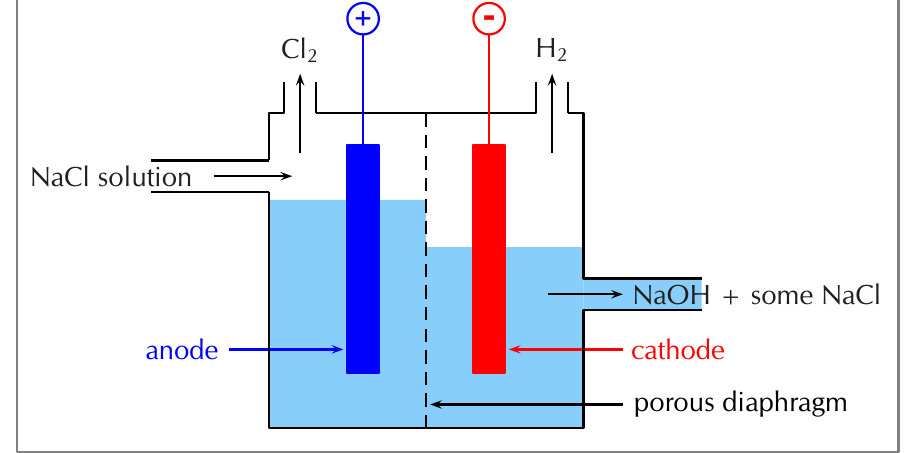
In the diaphragm cell:
- A porous diaphragm divides the electrolytic cell into an anode compartment and a cathode compartment
- Brine is introduced into the anode compartment and flows through the diaphragm into the cathode compartment
- An electric current is passed through the brine causing the salt's chloride ions and sodium ions to move to the electrodes
Reactions:
-
At the anode: Chlorine gas is produced
-
At the cathode: Sodium ions react with water forming caustic soda (NaOH) and hydrogen gas
-
Some NaCl salt remains in the solution with the caustic soda and can be removed at a later stage
Note
Advantages of the diaphragm cell:
- Uses less energy than the mercury cell
- Does not contain toxic mercury
Disadvantages:
- The sodium hydroxide is much less concentrated and not as pure
- The chlorine gas often contains oxygen gas as well
- The process is less cost-effective as the sodium hydroxide solution needs to be concentrated and purified before it can be used
3. The membrane cell
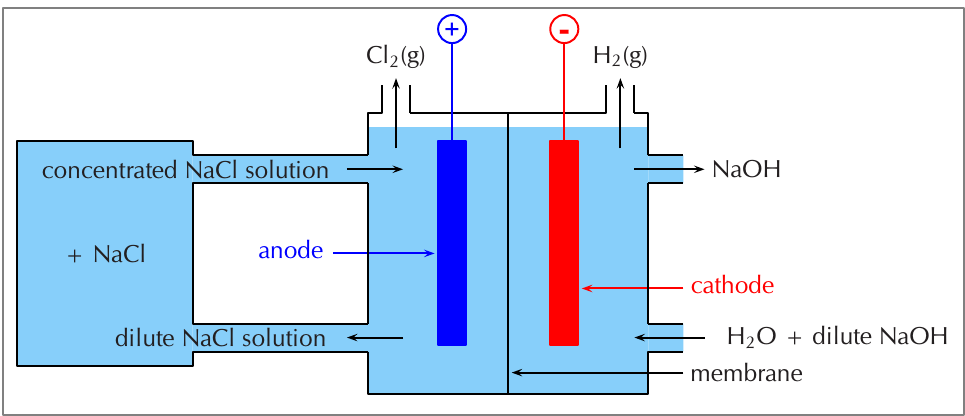
The membrane cell is very similar to the diaphragm cell, with the same reactions occurring. The main differences are:
- The two electrodes are separated by an ion-selective membrane, rather than by a diaphragm
- The membrane structure allows cations to pass through it between compartments of the cell but does not allow anions to pass through (this has nothing to do with the size of the pores, but rather with the charge on the ions)
- Brine is pumped into the anode compartment, and only the positively charged sodium ions pass into the cathode compartment, which contains pure water
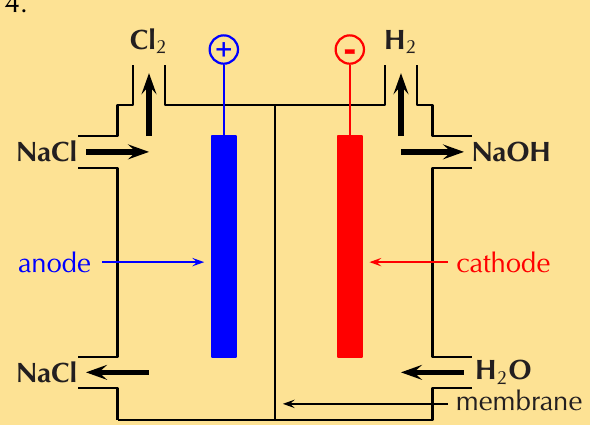
Reactions in the membrane cell:
-
At the positively charged anode: Cl⁻ ions from the brine are oxidised to Cl₂ gas
-
At the negatively charged cathode: Hydrogen ions in the water are reduced to hydrogen gas
-
The Na⁺ ions flow through the membrane to the cathode compartment and react with the remaining hydroxide (OH⁻) ions from the water to form sodium hydroxide (NaOH)
-
The chloride ions cannot pass through the membrane, so the chlorine does not come into contact with the sodium hydroxide in the cathode compartment
Overall equation:
Note
Advantages of using the membrane cell:
- The sodium hydroxide produced is very pure because it is kept separate from the sodium chloride solution
- The sodium hydroxide has a relatively high concentration
- This process uses the least electricity of all three cells
- The cell is cheaper to operate than the other two cells
- The cell does not contain toxic mercury or asbestos
The extraction of aluminium
Aluminium is a commonly used metal in industry, where its properties of being both light and strong can be utilised. It is used in the manufacture of products such as aeroplanes and motor cars. The metal is present in deposits of bauxite, which is a mixture of silicas, iron oxides and hydrated alumina (Al₂O₃·xH₂O).
Electrolysis can be used to extract aluminium from bauxite. The process produces 99% pure aluminium:
Example
Worked Example: Aluminium Extraction Process
Step 1: Preparation Aluminium is melted along with cryolite (Na₃AlF₆) which acts as the electrolyte. Cryolite helps to lower the melting point and dissolve the ore.
Step 2: Anode reactions The carbon rod anode provides a site for the oxidation of O²⁻ and F⁻ ions. Oxygen and fluorine gas are given off at the anode and also result in anode consumption.
Anode reactions:
Step 3: Cathode reaction At the cathode cell lining, the Al³⁺ ions are reduced and metal aluminium deposits on the lining.
Cathode reaction: (99% purity)
Step 4: Electrolyte stability The AlF₆³⁻ electrolyte is stable and remains in its molten state.
Overall reaction:
Important
The only problem with this process is that the reaction is endothermic and large amounts of electricity are needed to drive the reaction. The process is therefore very expensive.
Summary
Key Points to Remember:
-
Electroplating uses electrical current to coat objects with a thin layer of metal for protection, decoration or improved properties
-
The chloralkali industry produces chlorine and sodium hydroxide from brine using three main methods: mercury cell, diaphragm cell, and membrane cell
-
Membrane cells are the most efficient and environmentally friendly method for chloralkali production, producing the purest sodium hydroxide
-
Aluminium extraction from bauxite requires large amounts of electricity, making it an expensive process
-
All these applications demonstrate how electrochemical principles can be used to transform raw materials into valuable industrial products