Standard Electrode Potentials (Grade 12 NSC Matric Physical Sciences): Revision Notes
📚Revision Notes
Standard Electrode Potentials
What are standard electrode potentials?
Standard electrode potentials are measurements that show how easily different substances gain or lose electrons in chemical reactions. These values help us predict which reactions will happen spontaneously and calculate the voltage that electrochemical cells can produce.
The position of equilibrium in electrochemical reactions can change based on conditions like concentration, temperature, and pressure. To make fair comparisons between different substances, we use standard conditions:
- Pressure: 101.3 kPa (1 atmosphere)
- Temperature: 298 K (25°C)
- Concentration: 1 mol.dm⁻³
Note
Using these standard conditions ensures that electrode potential values can be compared directly and used to calculate potential differences between electrodes without constructing specific cells each time.
The standard hydrogen electrode
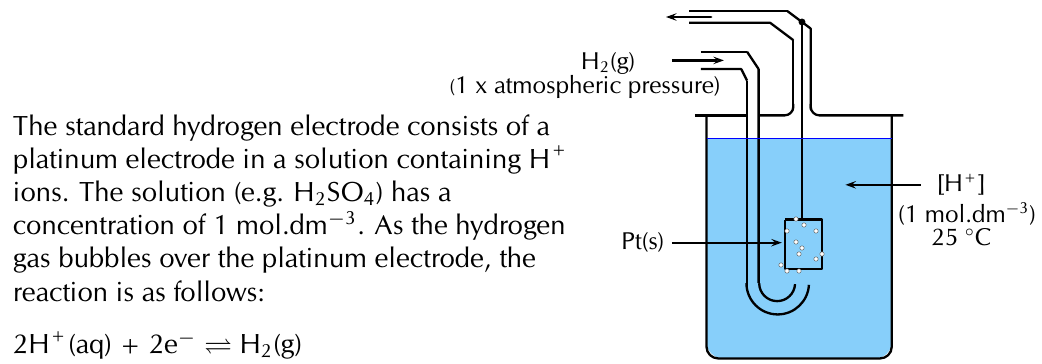
To measure electrode potentials, we need a reference point. The standard hydrogen electrode (SHE) serves as this reference and is assigned a potential of exactly 0.00 V.
Important
Definition: Standard hydrogen electrode
The standard hydrogen electrode is a redox electrode which forms the basis of the scale of oxidation-reduction potentials.
The standard hydrogen electrode consists of a platinum electrode in a solution containing 1 mol.dm⁻³ H⁺ ions at 25°C. Hydrogen gas at 1 atmospheric pressure bubbles over the platinum electrode. The reaction occurring is:
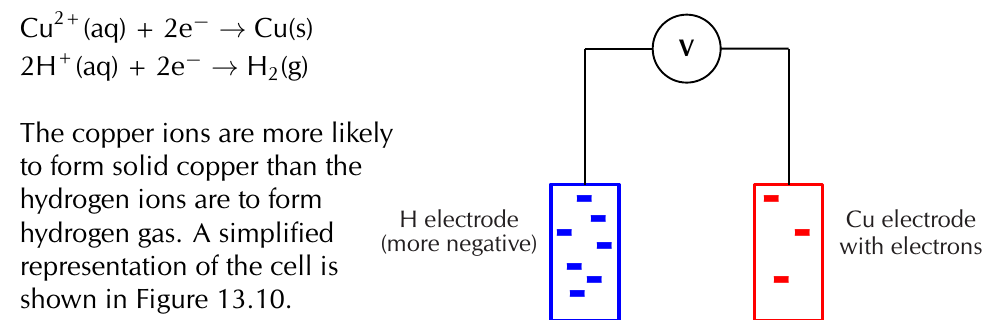
When other electrodes are connected to the standard hydrogen electrode, we can measure their relative electrode potentials. For example:
- If zinc is connected to the SHE, the reading is -0.76 V (zinc is more negative)
- If copper is connected to the SHE, the reading is +0.34 V (copper is more positive)
Understanding the standard electrode potential table
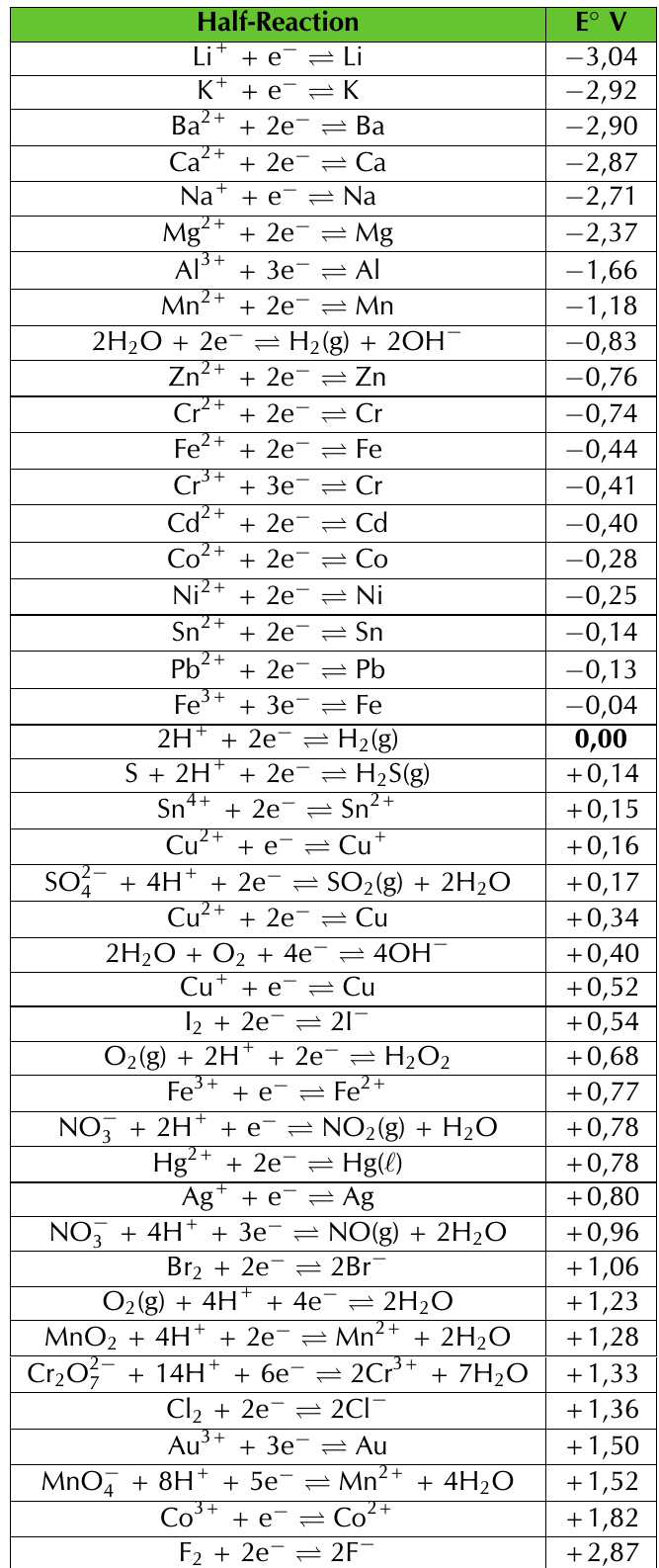
The standard electrode potential table lists reduction half-reactions arranged from most negative to most positive E° values. This arrangement tells us about the relative strengths of reducing and oxidising agents.
Key patterns in the table:
Large negative values (e.g. , E° = -3.04 V):
- The element or compound ionises easily
- It releases electrons easily
- The substance is easily oxidised
- It acts as a good reducing agent
Large positive values (e.g. , E° = +1.50 V):
- The element or compound gains electrons easily
- The substance is easily reduced
- It acts as a good oxidising agent
Note
Important trends:
- Reducing ability decreases as you move down the table (from negative to positive values)
- Oxidising ability increases as you move down the table (from negative to positive values)
Using electrode potentials to predict reactions
The electrode potential values help us predict which reactions will occur. The substance with the higher (more positive) electrode potential will be reduced, while the substance with the lower (more negative) electrode potential will be oxidised.
Example
Worked Example: Predicting reactions
Question: In a cell containing and , determine which reaction is oxidation and which is reduction.
Solution: Step 1: Find electrode potentials from the table
- : E° = +0.34 V
- : E° = +0.80 V
Step 2: Compare values Silver has a higher electrode potential (+0.80 V > +0.34 V), so silver is more easily reduced than copper.
Step 3: Write the half-reactions
- Reduction (gain of electrons):
- Oxidation (loss of electrons):
Calculating EMF of electrochemical cells
The EMF (electromotive force) tells us the maximum voltage an electrochemical cell can produce.
Important
Definition: EMF of a cell
The EMF of a cell is the maximum potential difference between two electrodes or half-cells in a galvanic cell.
To calculate EMF, use the formula:
Or alternatively:
Example
Worked Example: Calculating EMF
Question: A cell contains a solid lead anode in a gold ion solution. Calculate the cell potential (EMF).
Solution: Step 1: Find appropriate reactions from the electrode potential table
- : E° = -0.13 V
- : E° = +1.50 V
Step 2: Determine which is oxidised and which is reduced Gold has a higher electrode potential, so it will be reduced (cathode). Lead has a lower electrode potential, so it will be oxidised (anode).
Step 3: Calculate the EMF
Example
Worked Example: Another EMF calculation
Question: Calculate the cell potential for the reaction
Solution: Step 1: Find electrode potentials
- : E° = -2.37 V
- : E° = 0.00 V
Step 2: Identify anode and cathode Magnesium has the more negative potential, so it will be oxidised (anode). Hydrogen will be reduced (cathode).
Step 3: Calculate EMF
Predicting reaction spontaneity
The sign of the EMF tells us whether a reaction will occur spontaneously:
- Positive EMF: The reaction is spontaneous (will occur naturally)
- Negative EMF: The reaction is non-spontaneous (will not occur naturally)
Example
Worked Example: Determining spontaneity
Question: Will copper react with dilute sulfuric acid (H₂SO₄)?
Solution: Step 1: Write the overall equation
Step 2: Identify what should be oxidised and reduced
- Copper → (oxidation)
- → (reduction)
Step 3: Calculate EMF
- : E° = +0.34 V
- : E° = 0.00 V
Step 4: Interpret the result The EMF is negative, so the reaction is non-spontaneous. Copper will not react with dilute sulfuric acid.
Note
Important exam tips
- Always check which reaction has the higher electrode potential - this will be reduced
- The substance with the lower electrode potential will be oxidised
- In standard cell notation, write the anode first (left side), then the cathode (right side)
- Remember that electrode potentials in the table are for reduction reactions - reverse them when writing oxidation half-reactions
- Positive EMF = spontaneous, negative EMF = non-spontaneous
Summary
Key Points to Remember:
- Standard electrode potentials compare how easily substances gain or lose electrons under standard conditions (101.3 kPa, 298 K, 1 mol.dm⁻³)
- The standard hydrogen electrode serves as the reference point with E° = 0.00 V
- More negative E° values indicate good reducing agents (easily oxidised), while more positive E° values indicate good oxidising agents (easily reduced)
- EMF = E°(cathode) - E°(anode) calculates the maximum voltage a cell can produce
- Positive EMF means the reaction is spontaneous, negative EMF means it's non-spontaneous