Writing Redox and Half-Reactions (Grade 12 NSC Matric Physical Sciences): Revision Notes
📚Revision Notes
Writing Redox and Half-Reactions
Understanding redox reactions
Redox reactions involve the transfer of electrons between different atoms or compounds. The word "redox" combines reduction and oxidation, which always occur together in these reactions.
Note
Redox reactions are fundamental to many chemical processes, including combustion, corrosion, and biological processes like cellular respiration. Understanding electron transfer helps explain how these reactions occur at the molecular level.
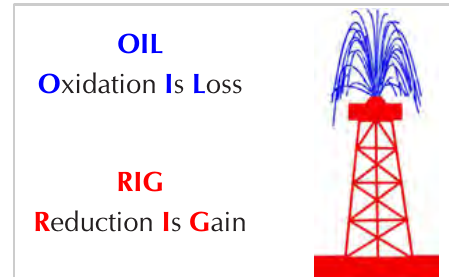
The OIL RIG mnemonic
Important
A simple way to remember oxidation and reduction is the OIL RIG mnemonic:
- OIL: Oxidation Is Loss (of electrons)
- RIG: Reduction Is Gain (of electrons)
This mnemonic is essential for understanding all redox chemistry and should be memorised as your first step in mastering this topic.
Key definitions
Oxidation occurs when an element or compound loses electrons. For example:
Reduction occurs when an element or compound gains electrons. For example:
Note
Important distinctions:
Oxidising agent is the substance that gains electrons and causes another substance to be oxidised. The oxidising agent itself is reduced in the process.
Reducing agent is the substance that loses electrons and causes another substance to be reduced. The reducing agent itself is oxidised in the process.
Identifying redox reactions
To determine if a reaction is a redox reaction, ask these two questions:
Note
Quick Check for Redox Reactions:
- Is there a compound or atom being oxidised?
- Is there a compound or atom being reduced?
If both answers are "yes", then the reaction is a redox reaction.
Writing half-reactions
A half-reaction shows either the oxidation process or the reduction process separately. Every redox reaction can be written as two half-reactions.
Example
Worked Example: Iron and tin reaction
Overall reaction:
This can be written as two half-reactions:
- Reduction half-reaction:
- Oxidation half-reaction:
Notice that in the overall reaction, the reduction half-reaction is multiplied by two so that the number of electrons gained equals the number of electrons lost.
Balancing redox reactions
Half-reactions can be used to balance complex redox reactions. The key principle is that electrons lost must equal electrons gained.
Important
Seven-Step Balancing Method:
Step 1: Write down the unbalanced oxidation half-reaction
Step 2: Balance the number of atoms on both sides of the equation
Step 3: Once the atoms are balanced, check that the charges balance by adding electrons
Step 4: Repeat steps 1-3 with the reduction half-reaction
Step 5: Compare the number of electrons in each equation and multiply each half-reaction by a suitable number so that electrons released equals electrons accepted
Step 6: Combine the two half-reactions to get the final equation for the overall reaction
Step 7: Do a final check to ensure the equation is balanced
Example
Worked Example 1: Basic redox balancing
Question: Chlorine gas oxidises ions to ions. In the process, chlorine is reduced to chloride ions. Write a balanced equation for this reaction.
Solution:
Step 1: Write the unbalanced oxidation half-reaction
Step 2: Balance atoms (already balanced)
Step 3: Balance charges by adding electrons
Step 4: Write the unbalanced reduction half-reaction
Balance atoms: Balance charges:
Step 5: Compare electrons
- Oxidation:
- Reduction:
Multiply oxidation by 2:
Step 6: Combine half-reactions
Step 7: Check balance (atoms and charges are balanced)
Balancing in acidic medium
When reactions occur in acidic medium, water molecules () and hydrogen ions () can be added to balance oxygen and hydrogen atoms.
Note
Key steps for acidic medium:
- Add molecules to balance oxygen atoms
- Add ions to balance hydrogen atoms
- Add electrons to balance charges
Example
Worked Example 2: Acidic medium
Question: Balance the reaction in acidic medium:
The balanced equation becomes:
Balancing in alkaline medium
When reactions occur in alkaline medium, hydroxide ions () are present instead of ions.
Note
Key steps for alkaline medium:
- Add ions to balance charges
- Use and to balance hydrogen and oxygen
- The final balanced equation includes spectator ions
Example
Worked Example 3: Alkaline medium
Question: Balance the oxidation of by in alkaline medium.
This requires careful consideration of the hydroxide ions present in the alkaline solution and their effect on the balancing process.
Exam tips
Note
Essential Exam Strategies:
- Always check that both atoms and charges are balanced in your final equation
- Remember that electrons lost in oxidation must equal electrons gained in reduction
- In acidic medium, use and for balancing
- In alkaline medium, use and for balancing
- Practice identifying which substance is oxidised and which is reduced
Summary
Key Points to Remember:
- OIL RIG: Oxidation Is Loss, Reduction Is Gain (of electrons)
- Oxidising agents gain electrons and cause other substances to lose electrons
- Reducing agents lose electrons and cause other substances to gain electrons
- Half-reactions show the oxidation and reduction processes separately
- Always balance both atoms and charges in redox equations
- The number of electrons lost must equal the number of electrons gained in any redox reaction