Organic Molecules (Grade 12 NSC Matric Physical Sciences): Revision Notes
📚Revision Notes
Plastics and Polymers
What is a polymer?
Polymers are large molecules that are made up of many repeating building blocks called monomers. Think of a polymer like a long chain where each link is identical - these links are the monomers.
Monomer: A small molecule that can combine with other identical molecules through chemical reactions to form a polymer. It acts as the basic repeating unit in the polymer structure.
Polymer: A large molecule consisting of many repeating structural units (monomers) that are connected together by covalent chemical bonds.
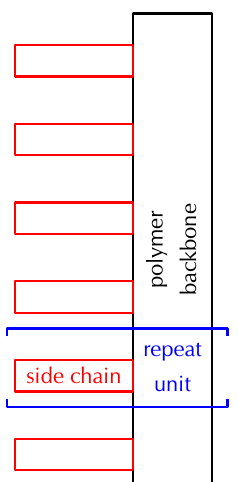
In organic polymers, the monomers are joined together through their carbon atoms, which form the main polymer backbone or chain. Additional groups called side chains can branch off from this main backbone, giving different polymers their unique properties.
Note
Macromolecule: Any molecule that contains a very large number of atoms. Polymers are a specific type of macromolecule because they contain chains of repeating identical units.
Plastic: A subgroup of organic polymers that can be moulded during manufacture. Plastics may contain one or more organic polymers along with other additives to improve their properties.
Important
The key feature that makes polymers different from other large molecules is the repetition of identical or very similar monomer units throughout the polymer chain. This repetitive structure gives polymers their unique mechanical and physical properties.
How do polymers form?
Polymers are created through a process called polymerisation, where individual monomer molecules react together to form long polymer chains. There are two main types of polymerisation reactions that you need to understand.
Polymerisation: The process of chemically bonding monomers (single units) together to form longer chains called polymers.
Addition polymerisation
In addition polymerisation, monomer molecules are added to a growing polymer chain one at a time. Importantly, no small molecules are eliminated during this process - all the atoms from the monomers end up in the final polymer.
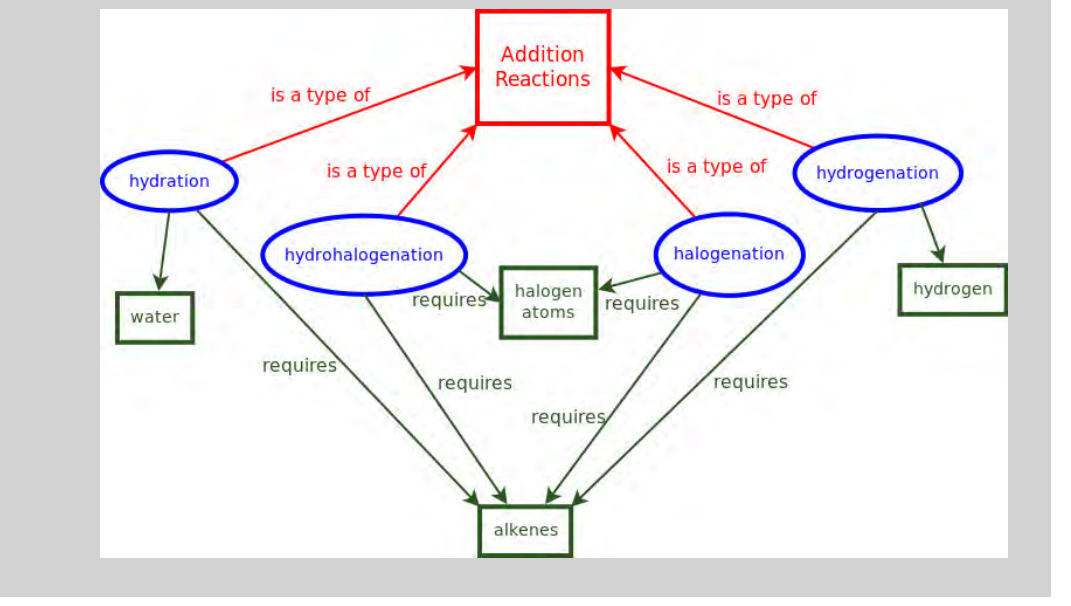
Addition polymerisation typically occurs with monomers that contain carbon-carbon double bonds (C=C). During the reaction, these double bonds break open, allowing the monomers to link together through new single bonds.
Note
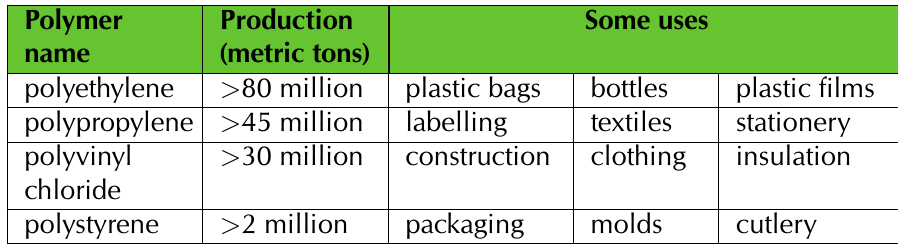
The four major addition polymers you should know are:
- Polyethylene (from ethene)
- Polypropylene (from propene)
- Polyvinyl chloride (PVC) (from vinyl chloride)
- Polystyrene (from styrene)
Polyethylene formation
Polyethylene is formed when many ethene monomers join together. Ethene is an unsaturated hydrocarbon with a double bond between its two carbon atoms.

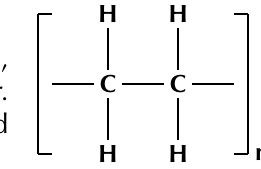
The polymerisation reaction can be written as:
Where represents the number of monomer units that join together (typically thousands).
Note
Polyethylene is the most commonly produced plastic worldwide, with over 80 million metric tonnes manufactured annually. It is used to make plastic bags, bottles, films, and many other everyday items.
Polypropylene formation
Polypropylene is stronger than polyethylene and is formed from propene monomers. Propene has a methyl group () attached to one of the carbon atoms in the double bond.
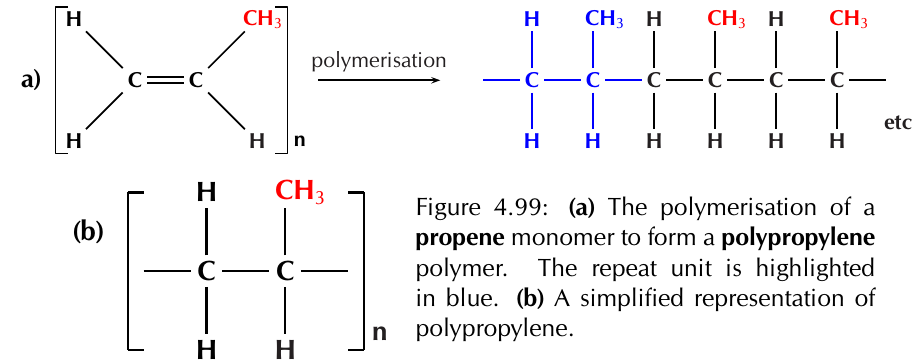
The reaction shows how the double bonds in propene molecules break and form single bonds to create the polymer chain, with methyl groups as side chains.
Polyvinyl chloride (PVC) formation
PVC is formed from vinyl chloride monomers, which contain a chlorine atom attached to the carbon-carbon double bond.

PVC is widely used in construction for plastic piping, and with the addition of plasticisers, it becomes flexible enough for clothing and upholstery applications.
Polystyrene formation
Polystyrene is formed from styrene monomers, which contain a benzene ring attached to the carbon-carbon double bond.
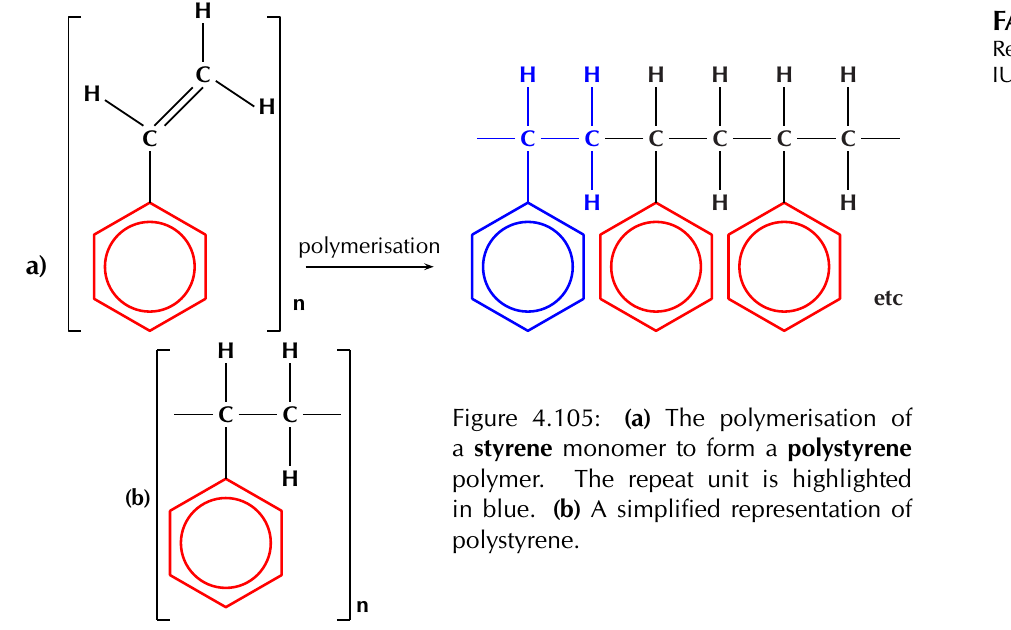
Polystyrene is used for protective packaging, disposable cutlery, and can be expanded to form polystyrene foam for insulation.
Properties of addition polymers
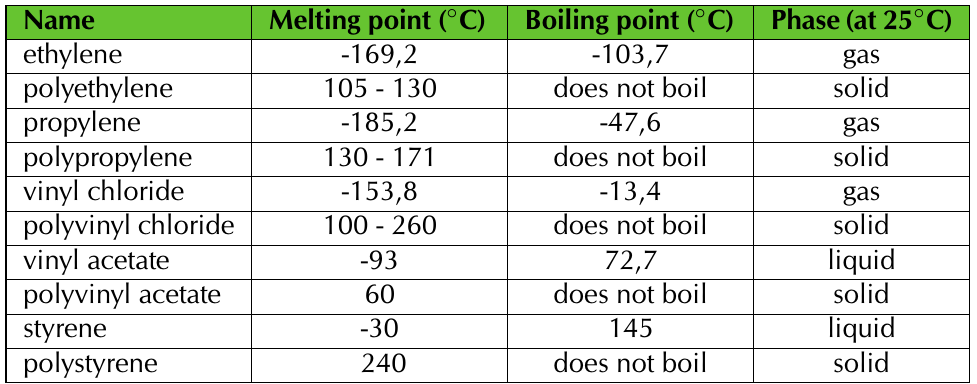
An important pattern emerges when comparing the physical properties of monomers and their corresponding polymers:
Important
Key observations:
- Monomers are typically gases or liquids at room temperature
- Polymers are typically solids at room temperature
- Polymers have much higher melting points than their monomers
- Many polymers do not boil - they decompose instead when heated
This occurs because polymer chains are much larger and have stronger intermolecular forces between them compared to small monomer molecules.
Condensation polymerisation
In condensation polymerisation, two different types of monomer molecules combine together, and a small molecule (usually water) is eliminated during the bonding process.
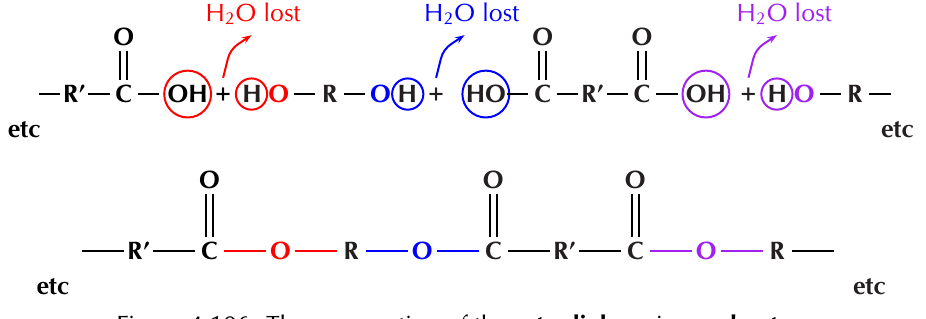
This type of polymerisation typically involves monomers with functional groups such as:
- Carboxylic acid groups (-COOH)
- Alcohol groups (-OH)
- Amine groups (-NH₂)
The most important condensation polymers are polyesters, which contain ester linkages in their main chain formed by the reaction between carboxylic acids and alcohols.
Polyethylene terephthalate (PET) formation
PET is formed when ethylene glycol (a diol with two -OH groups) reacts with terephthalic acid (a dicarboxylic acid with two -COOH groups).
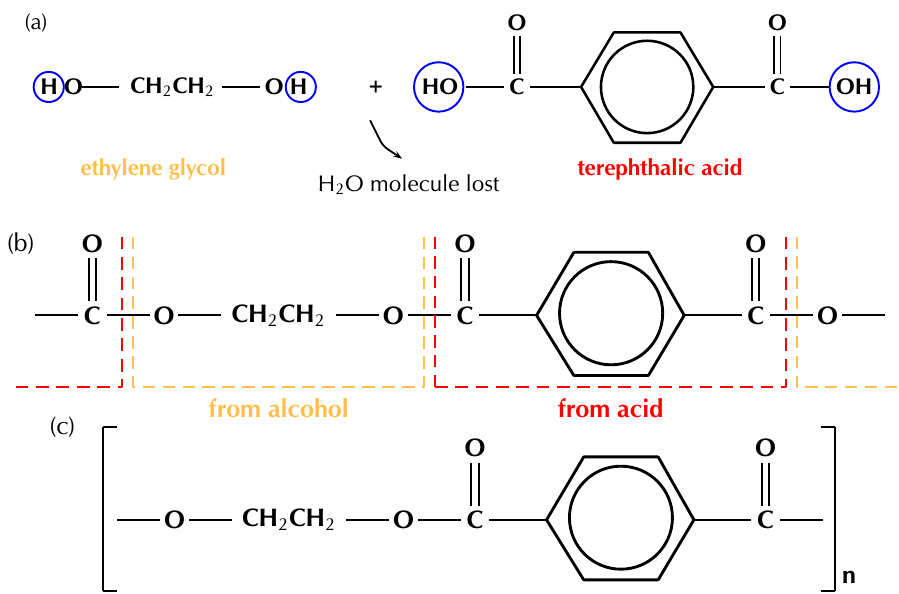
The reaction eliminates water molecules () as the ester bonds form between the alcohol and acid groups. PET is used to make synthetic fibres, plastic bottles, and food containers.
Polylactic acid (PLA) formation
PLA is an interesting polymer because it can be made from biological sources rather than petroleum. It is formed from lactic acid monomers, where each monomer contains both a carboxylic acid group and an alcohol group.
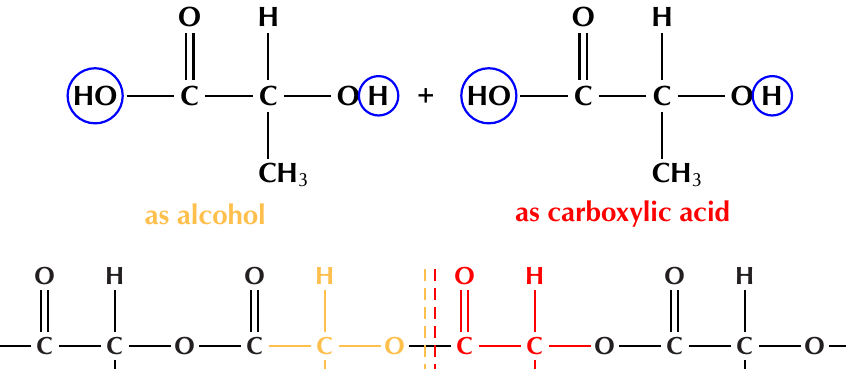
Note
PLA is biodegradable and is used for medical implants, packaging materials, and 3D printing filaments. It represents an environmentally friendlier alternative to traditional petroleum-based plastics.
Properties comparison between monomers and polymers
Understanding the dramatic differences in properties between monomers and their corresponding polymers helps explain why polymerisation is such a useful process:
Note
Physical state differences:
- Monomers like ethylene and propylene are gases at room temperature
- Their polymers (polyethylene and polypropylene) are solid plastics
Thermal properties:
- Monomers have low melting and boiling points
- Polymers have high melting points and often decompose rather than boil
Molecular size:
- Monomers contain just a few atoms
- Polymers can contain thousands or millions of atoms
These differences occur because long polymer chains become entangled with each other and have much stronger intermolecular forces than small monomer molecules.
Environmental impact and recycling
While plastics have revolutionised modern life, they also create significant environmental challenges:
Environmental problems
Important
Major Environmental Issues:
Waste disposal: Most plastics are not easily broken down by microorganisms, making them non-biodegradable. This leads to accumulation of plastic waste in landfills and the environment.
Air pollution: When plastics burn, they can release toxic gases including carbon monoxide, hydrogen cyanide, and hydrogen chloride, especially from PVC and other chlorine-containing plastics.
Recycling challenges: Different types of plastic have different properties and require different recycling processes. This makes it difficult to recycle mixed plastic waste efficiently.
Plastic identification and recycling
Plastics are marked with recycling codes to help with proper sorting and recycling:
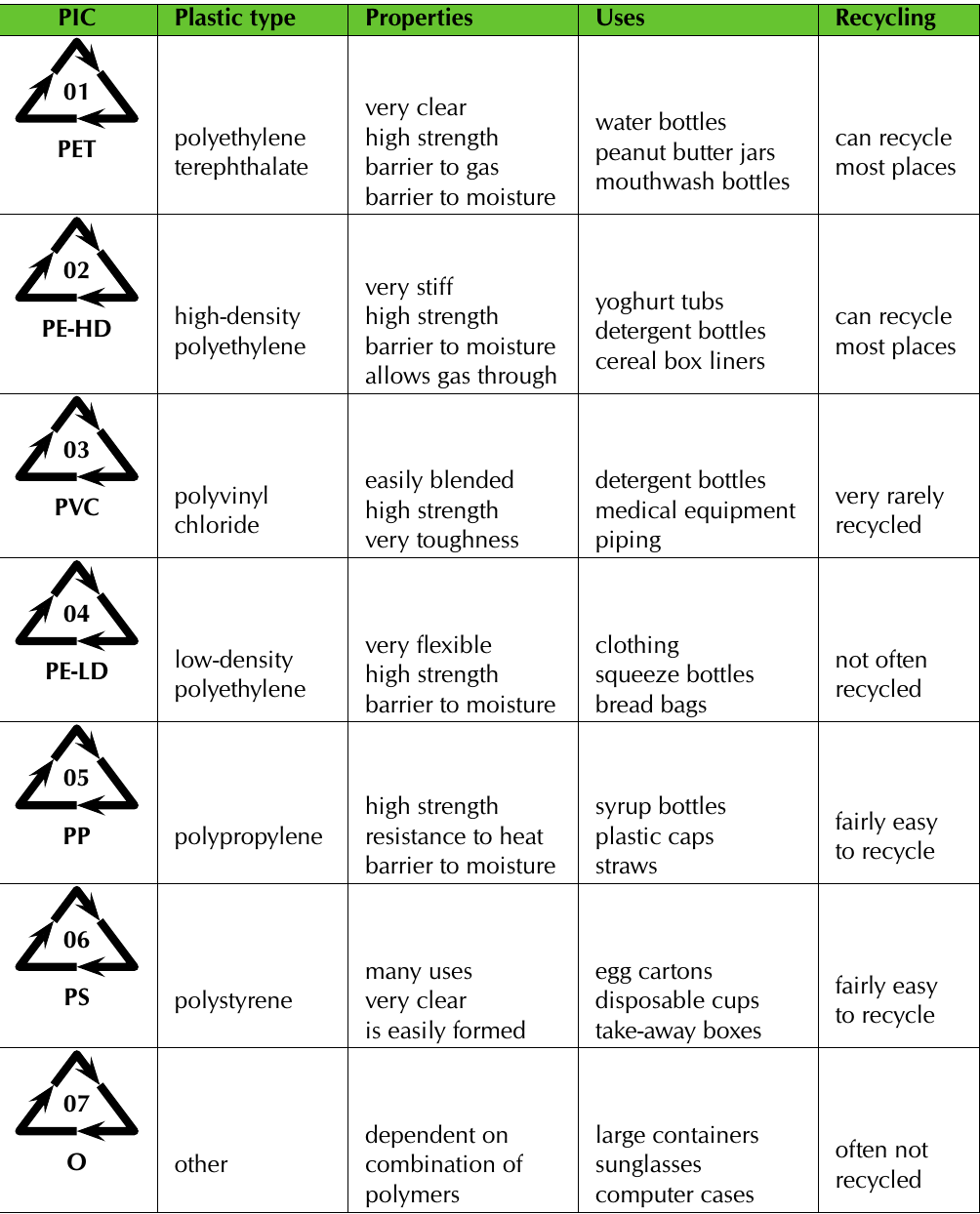
The recycling codes range from 01 to 07:
- 01 (PET): Water bottles, can be recycled in most places
- 02 (PE-HD): Detergent bottles, can be recycled in most places
- 03 (PVC): Piping and medical equipment, very rarely recycled
- 04 (PE-LD): Plastic bags, not often recycled
- 05 (PP): Bottle caps, fairly easy to recycle
- 06 (PS): Disposable cups, fairly easy to recycle
- 07 (Other): Mixed plastics, often not recycled
Biodegradable alternatives
Scientists are developing biodegradable plastics made from renewable resources like plant materials. These plastics can be broken down by microorganisms, reducing environmental impact. However, they are currently more expensive than traditional plastics.
Identifying monomers and polymers
Being able to work backwards from a polymer structure to identify its monomer is an important skill. Here's a systematic approach:
Example
Worked Example 1: Identifying the monomer for PVC
Question: What monomer was used to make this polymer? [H-Cl] [C-C] [H-H]ₙ
Solution:
- Identify the repeat unit: The polymer contains alternating hydrogen and chlorine atoms
- Determine the polymerisation type: Since there are no oxygen atoms, this must be addition polymerisation
- Apply knowledge: Addition polymerisation requires a monomer with a double bond
- Name the monomer: This must be vinyl chloride (chloroethene)
- Draw the monomer structure:
Example
Worked Example 2: Identifying polymerisation type
Question: Was addition or condensation polymerisation used to make this polymer? [O-H] [C-C-O] [CH₃]ₙ
Solution:
- Look for functional groups: The repeat unit contains ester linkages (C-O bonds with C=O)
- Apply knowledge: Ester linkages form when alcohols react with carboxylic acids, eliminating water
- Conclusion: This must be condensation polymerisation (this is polylactic acid)
Summary
Key Points to Remember:
-
Monomers are small molecules that join together to form polymers - large molecules made of repeating units
-
Addition polymerisation occurs when monomers with double bonds join together without eliminating any small molecules - all atoms end up in the polymer
-
Condensation polymerisation occurs when monomers react together and eliminate small molecules (usually water) to form ester or amide linkages
-
Polymers have dramatically different properties from their monomers - they are typically solids with high melting points, while monomers are often gases or liquids
-
Environmental impact is a major concern with plastics due to their non-biodegradable nature, but proper recycling and development of biodegradable alternatives can help address these issues