IUPAC Naming and Formulae (Grade 12 NSC Matric Physical Sciences): Revision Notes
📚Revision Notes
IUPAC Naming and Formulae
What is IUPAC naming?
IUPAC naming refers to the systematic method of naming organic compounds using rules established by the International Union of Pure and Applied Chemistry. This standardised system ensures that every organic compound has a unique, consistent name that can be understood by chemists worldwide.
The main purpose of IUPAC naming is to eliminate confusion that arises from using common names for compounds. By following specific rules, we can determine a compound's structure just from its name, making communication in chemistry much clearer and more precise.
Note
Think of IUPAC naming like a universal language for chemistry - just as scientists around the world use the same symbols for elements, they also use the same systematic rules for naming organic compounds. This prevents confusion when a single compound might have multiple common names in different regions.
Essential reference tables for IUPAC naming
Understanding IUPAC naming requires memorising several key reference tables that form the building blocks of systematic nomenclature. These tables are your foundation for successful organic compound naming.
Functional groups and their suffixes
The functional group in a molecule determines the suffix (ending) of the compound's name. This is the most important part of the naming process because it identifies the main chemical behaviour of the molecule.
Important
Functional groups always take priority in IUPAC naming!
The functional group determines:
- The suffix of the compound name
- The direction of carbon chain numbering
- Which carbon chain is considered the "main" chain
Here are the eight most common functional groups you'll encounter:
- Alkanes (single bonds only) use the suffix -ane
- Alkenes (double bonds) use the suffix -ene
- Alkynes (triple bonds) use the suffix -yne
- Alcohols (hydroxyl group) use the suffix -ol
- Aldehydes (carbonyl at end) use the suffix -al
- Ketones (carbonyl in middle) use the suffix -one
- Carboxylic acids (carboxyl group) use the suffix -oic acid
- Esters (ester linkage) use the suffix -oate
Carbon chain prefixes
The prefix of the compound's name indicates how many carbon atoms are in the longest continuous carbon chain containing the functional group.
These prefixes follow a logical pattern and are crucial for naming:
- Meth- for 1 carbon atom
- Eth- for 2 carbon atoms
- Prop- for 3 carbon atoms
- But- for 4 carbon atoms
- Pent- for 5 carbon atoms
- Hex- for 6 carbon atoms
- Hept- for 7 carbon atoms
- Oct- for 8 carbon atoms
- Non- for 9 carbon atoms
- Dec- for 10 carbon atoms
Note
Memory tip: The first four prefixes (meth-, eth-, prop-, but-) are unique, but from pent- onwards, they follow Greek number patterns that you might recognise from other areas of science and mathematics.
Numerical prefixes for multiple groups
When naming compounds with multiple identical substituents or functional groups, we use numerical prefixes to indicate how many are present.
- Di- indicates 2 identical groups
- Tri- indicates 3 identical groups
- Tetra- indicates 4 identical groups
Halogen naming prefixes
When halogen atoms are attached to carbon chains as substituents, they require specific naming prefixes.
- Fluorine becomes fluoro
- Chlorine becomes chloro
- Bromine becomes bromo
- Iodine becomes iodo
Step-by-step IUPAC naming rules
The key to successful IUPAC naming is following a systematic approach. Remember the important rule: "start at the end (the suffix) and work backwards" - this means identify the functional group first, then build the rest of the name.
Important
The Golden Rule of IUPAC Naming
Always start by identifying the functional group first! This determines:
- What suffix to use
- Which direction to number the carbon chain
- What counts as the "main" chain vs. branches
Everything else in the naming process follows from this first step.
Step 1: Identify the functional group
Look for the functional group in the molecule. This determines the suffix of the name and takes priority in naming decisions.
Step 2: Find the longest carbon chain
Locate the longest continuous carbon chain that contains the functional group. Count the carbon atoms in this chain - this number determines the prefix.
Step 3: Number the carbon atoms
Number the carbons in the longest chain, starting from the end closest to the functional group. If the molecule is an alkane (no functional group), start numbering to give branched groups the lowest possible numbers.
Step 4: Identify and name branched groups
Look for any carbon chains branching off the main chain. Count the carbons in each branch and name them using the appropriate prefix followed by -yl. Note their position on the main chain using the carbon number.
Step 5: Identify halogen atoms
Treat halogen atoms like branched groups. Use their specific prefixes (fluoro, chloro, bromo, iodo) and note their positions on the main chain.
Step 6: Combine all elements
Arrange the name components in this order:
- Branched groups and halogens in alphabetical order (with position numbers)
- Main chain prefix
- Functional group suffix
Example
Worked Example: Naming an Alkane
Let's work through a complete example to demonstrate the IUPAC naming process.
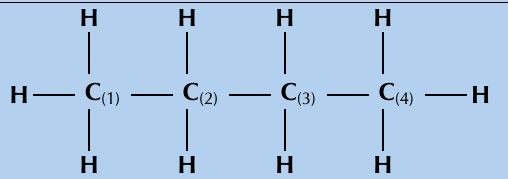
Question: Name the alkane compound shown above.
Solution:
Step 1: Identify the functional group This compound contains only carbon and hydrogen atoms with single bonds between carbons. It is an alkane, so the suffix will be -ane.
Step 2: Find the longest carbon chain Counting along the chain, we can identify 4 carbon atoms in a continuous line. The longest chain contains 4 carbons.
Step 3: Number the carbon atoms The carbons are numbered C(1), C(2), C(3), and C(4) as shown in the diagram. Since this is an alkane with no functional groups, we can start numbering from either end.
Step 4: Look for branched groups This compound has no branched groups - it is a straight chain alkane.
Step 5: Look for halogen atoms There are no halogen atoms present in this compound.
Step 6: Combine the elements
- Longest chain: 4 carbons = but-
- Functional group: alkane = -ane
- Final name: butane
Additional naming considerations
When naming more complex molecules, remember these important points that often catch students out:
Note
Advanced Naming Tips
- Multiple identical substituents use numerical prefixes (di-, tri-, tetra-)
- Alphabetical ordering applies to substituent names (ignoring numerical prefixes)
- Lowest possible numbers should always be used for substituent positions
- Functional groups take priority over other substituents for numbering direction
These rules become especially important when dealing with complex molecules that have multiple branches or functional groups.
Summary
Key Points to Remember:
- IUPAC naming provides a unique, systematic name for every organic compound
- Functional groups determine the suffix and take naming priority
- Carbon chain length determines the prefix (meth-, eth-, prop-, etc.)
- Always work backwards from the functional group when naming
- Use numerical prefixes (di-, tri-) for multiple identical substituents
- Start at the end and work backwards - identify the functional group first!