Organic Molecular Structures (Grade 12 NSC Matric Physical Sciences): Revision Notes
📚Revision Notes
Organic Molecular Structures
What are organic molecules?
Organic chemistry is the branch of chemistry that focuses on studying compounds containing carbon atoms. Understanding organic molecules is essential since they form the basis of all living things and many everyday materials.
Note
Definition: Organic molecule An organic molecule is a molecule that contains carbon atoms, typically bonded to other carbon atoms and hydrogen atoms.
Key characteristics of organic molecules
While carbon is present in all organic compounds, other elements commonly found include:
- Hydrogen (H) - most abundant after carbon
- Oxygen (O) - found in alcohols, acids, and many biological molecules
- Nitrogen (N) - present in proteins and nucleic acids
- Sulfur (S) - found in some amino acids
- Phosphorus (P) - important in DNA and energy molecules
Importance and examples
Organic molecules range from simple structures to incredibly complex compounds containing thousands of atoms. They are vital because they:
- Make up our bodies (proteins, DNA, fats)
- Provide energy (sugars, fats)
- Form everyday materials (plastics, medicines, dyes)
- Exist naturally in millions of different forms
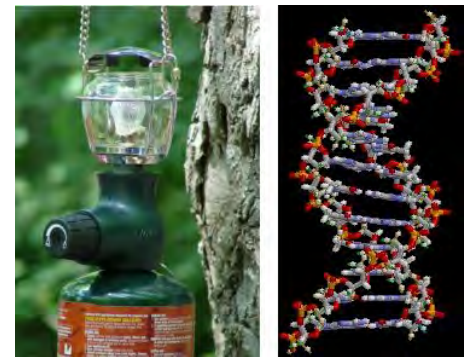
Examples include simple molecules like propane (used in gas lamps) and complex molecules like DNA that carries genetic information.
Special properties of carbon
Carbon has unique characteristics that make it the foundation of organic chemistry. Understanding these properties explains why carbon can form such diverse and complex molecules.

Four valence electrons
Important
Carbon has four valence electrons, which means each carbon atom can form a maximum of four bonds with other atoms.
This versatility allows carbon to:
- Form bonds with other carbon atoms (single, double, or triple bonds)
- Bond with different elements like hydrogen, oxygen, nitrogen, and halogens
- Create straight chains, branched structures, and cyclic molecules
Catenation - carbon's chain-forming ability
Note
Catenation is the ability of carbon atoms to bond together, forming long chains. This property is crucial because it allows the formation of both simple and highly complex molecular structures.
This unique property enables:
- Formation of unbranched (straight) chains where carbon atoms link in a single line
- Creation of branched chains where additional carbon groups attach to the main chain
- Development of both simple and highly complex molecular structures
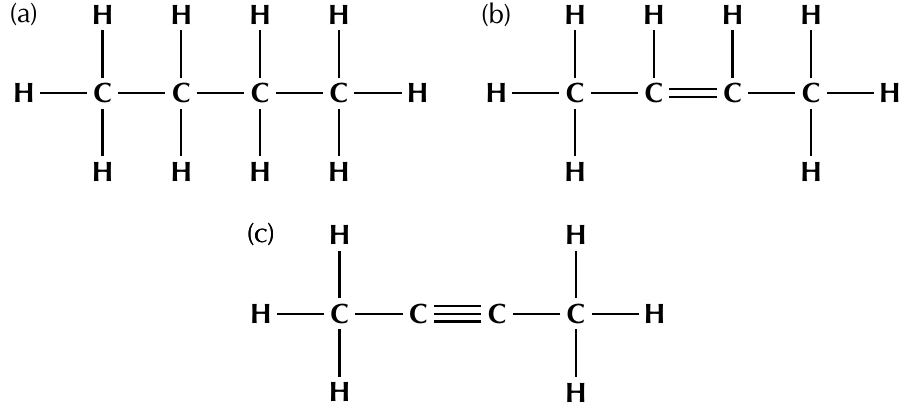
Example
Example: Four-Carbon Compounds with Different Bond Types
The diagram shows three four-carbon compounds demonstrating different bond types:
- Butane (C₄H₁₀): saturated alkane with only single bonds
- 2-butene (C₄H₈): unsaturated alkene with one double bond
- 2-butyne (C₄H₆): unsaturated alkyne with one triple bond
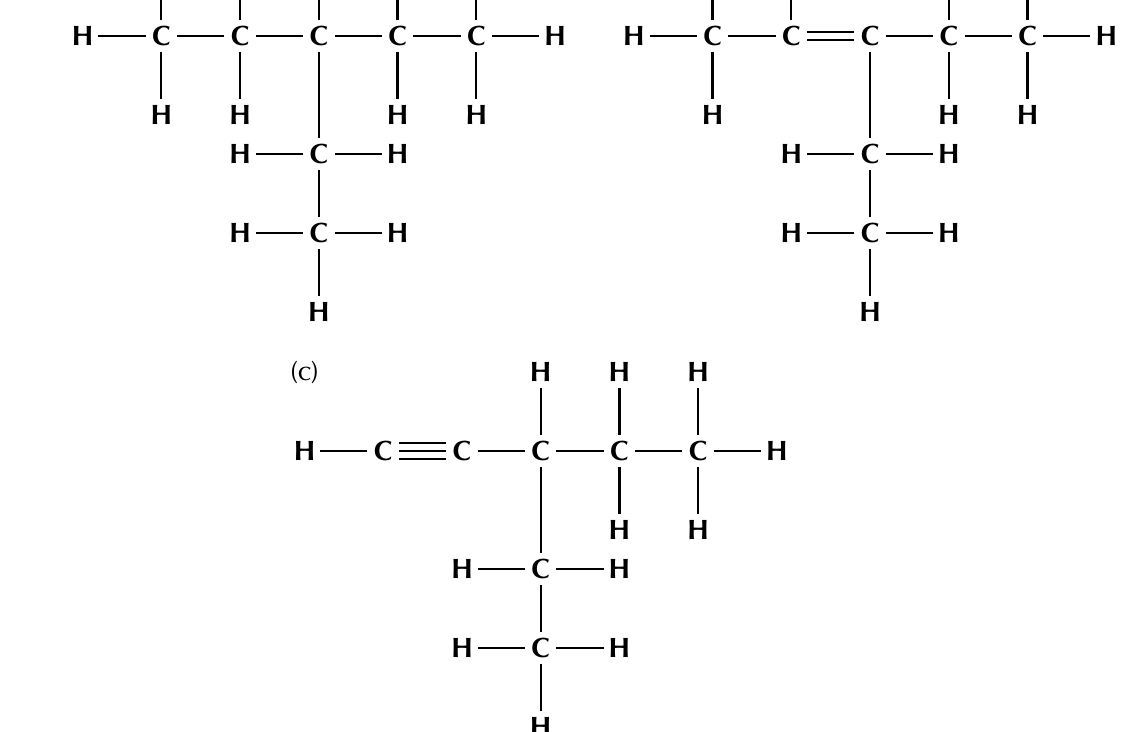
These structures show how the same number of carbon atoms can be arranged differently, creating branched isomers with different properties.
Types of carbon chains
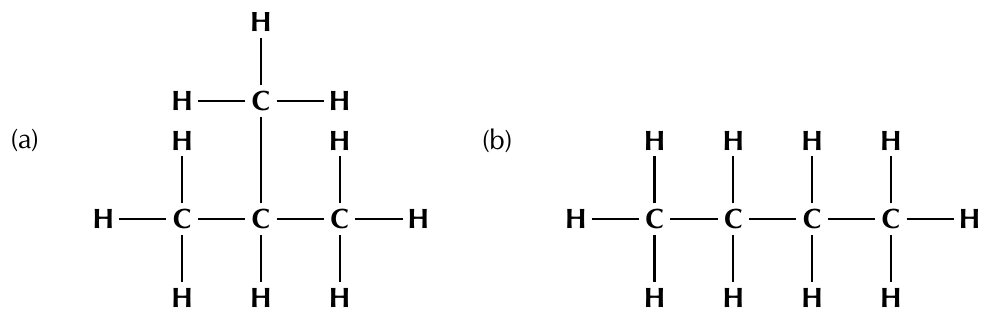
Carbon atoms can arrange in two main patterns:
- (a) Branched chains: Have side groups attached to the main carbon skeleton
- (b) Unbranched (straight) chains: Form a continuous line of carbon atoms
Covalent bonding in organic molecules
Due to carbon's position in the periodic table, most bonds formed with other atoms are covalent bonds. The small difference in electronegativity between carbon and hydrogen means that C-H bonds are almost purely covalent, making most organic compounds non-polar. This affects their solubility and other physical properties.
Sources of carbon
Photosynthesis - nature's carbon factory
The primary source of carbon in organic compounds is carbon dioxide from the atmosphere. Plants convert carbon dioxide and water into organic compounds through photosynthesis:
This process allows plants to create their own organic compounds, while animals obtain organic compounds by consuming plants or other animals.
Fossil fuels
Note
Other important carbon sources include fossil fuels which formed from the decaying remains of ancient organisms and represent stored organic compounds from millions of years ago.
These fuels include:
- Coal
- Petroleum
- Natural gas
Representing organic molecules
Understanding different ways to represent organic molecules is crucial for interpreting chemical information. There are several methods, each serving different purposes.
Important
Why Multiple Representations Matter
Different representation methods serve different purposes in chemistry. Learning to convert between them is essential for understanding molecular structure and properties.
Structural formula
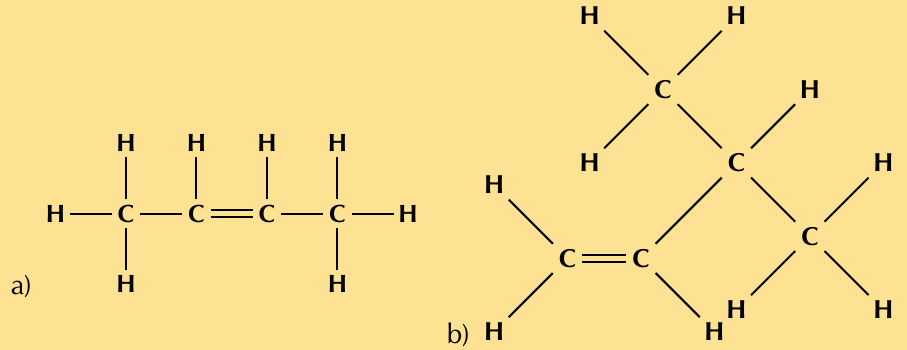
The structural formula shows every bond between atoms in the molecule. Each bond appears as a line connecting the atoms.
Example
Example: Structural Formula Benefits
Structural formulae clearly display:
- All carbon-carbon bonds
- All carbon-hydrogen bonds
- Double and triple bonds where present
- The complete molecular framework
Semi-structural formula
A semi-structural formula simplifies the representation by grouping atoms without showing every individual bond. This method:
- Groups hydrogen atoms with their attached carbon atoms
- Shows the carbon skeleton clearly
- Reduces visual complexity while maintaining structural information
Example
Example: Butane Semi-Structural Formula
- Semi-structural: CH₃—CH₂—CH₂—CH₃
- Shows carbon chain without drawing every C-H bond
Condensed structural formula
The condensed structural formula provides the most compact representation by:
- Grouping all atoms bonded to each carbon
- Not showing any bonds between atoms
- Using brackets for branched groups
Example
Example: Condensed Structural Formulas
- 2-methylpropane: CH₃CH(CH₃)CH₃
- Butane: CH₃CH₂CH₂CH₃
Note how the CH₂ groups in butane can be abbreviated as (CH₂)₂.
Molecular formula
The molecular formula shows only the number of each type of atom present:
- 2-methylpropane: C₄H₁₀
- Butane: C₄H₁₀
The molecular formula provides no structural information but gives the exact atomic composition.
2D vs 3D representations

Note
Understanding Dimensional Representations
Different representation methods for methane (CH₄) show:
- Structural formula: Shows bonds as lines
- Ball-and-stick model: Displays atoms as spheres with connecting bonds
- Space-filling model: Shows the actual molecular volume and shape
Example
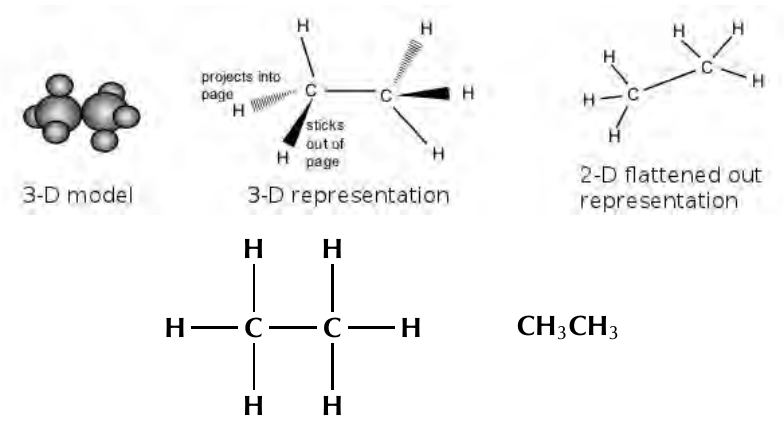
Example: Five Ways to Represent Ethane (C₂H₆)
- 3D ball-and-stick model: Shows actual molecular geometry
- 3D structural representation: Uses wedged and dashed bonds (wedges = coming forwards, dashes = going back)
- 2D flattened representation: Shows structure in a plane
- Complete structural formula: Displays all bonds as lines
- Condensed formula: CH₃CH₃
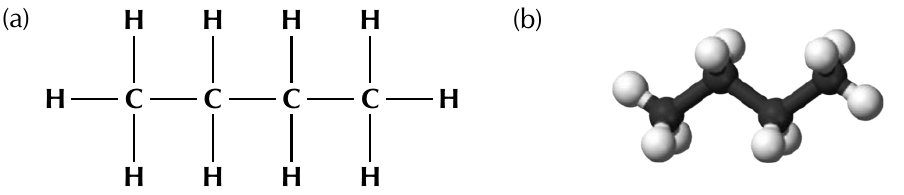
The comparison between 2D structural drawings and 3D ball-and-stick models shows how the same molecule can appear different depending on the representation method chosen.
Exam tips for molecular representations
Important
Essential Exam Tips
- Practice converting between different representation types
- Remember that different representations of the same molecule contain identical atomic compositions
- Use structural formulae when you need to show specific bonding patterns
- Use molecular formulae for calculations involving molar masses or stoicheiometry
- Pay attention to bond types - single, double, and triple bonds affect molecular properties
Remember!
Summary
Key Points to Remember:
-
Organic molecules contain carbon atoms bonded to other carbon atoms and hydrogen atoms, plus other elements like oxygen, nitrogen, and sulphur.
-
Carbon's four valence electrons allow it to form four bonds, creating diverse molecular structures through catenation (chain formation).
-
Carbon sources include atmospheric CO₂ (converted by photosynthesis) and fossil fuels formed from ancient organic matter.
-
Multiple representation methods exist: structural (shows all bonds), semi-structural (groups atoms), condensed (most compact), and molecular (atomic count only).
-
Practice converting between representations as this is a common exam requirement, and remember that the same molecule looks different depending on how it's drawn.