Physical Properties and Intermolecular Forces (Grade 12 NSC Matric Physical Sciences): Revision Notes
📚Revision Notes
Physical Properties and Intermolecular Forces
Introduction to intermolecular forces
Understanding how molecules interact with each other is crucial for predicting the physical properties of organic compounds. The phase of a substance (solid, liquid, or gas) depends on how strongly its particles are held together. When intermolecular forces are weak, particles can move far apart, existing as a gas. Strong intermolecular forces hold particles closely together in solid structures.
Temperature plays a vital role in determining phase. Higher temperatures give particles more energy to overcome the forces holding them together, potentially causing phase changes.
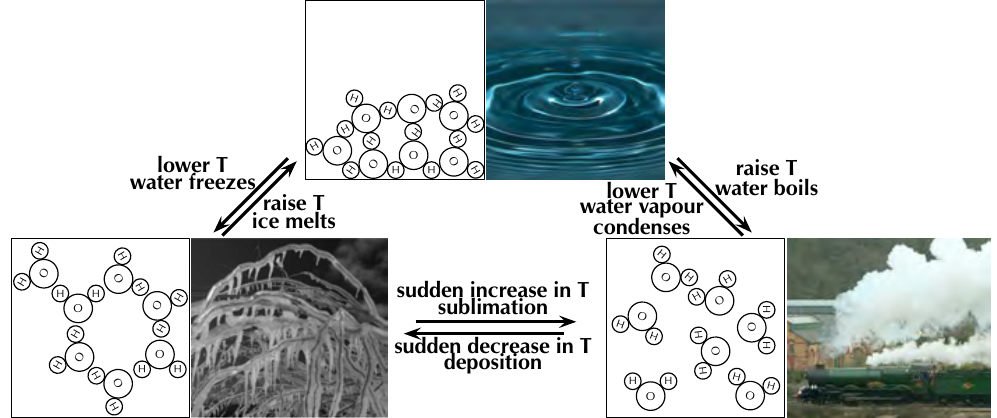
Note
Intermolecular forces are the attractive forces that exist between molecules. These forces determine many physical properties including melting points, boiling points, viscosity, and volatility. Without intermolecular forces, molecules would not stick together and liquids or solids could not exist.
Types of intermolecular forces
There are three main types of intermolecular forces, listed from strongest to weakest:
Hydrogen bonding
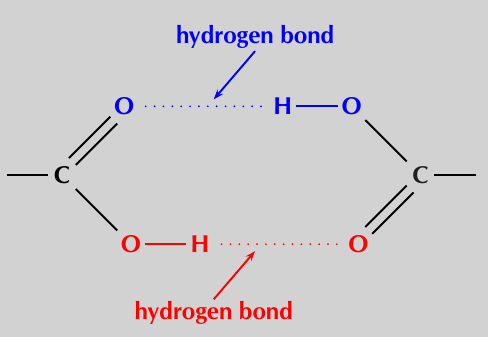
Hydrogen bonding occurs when a hydrogen atom is covalently bonded to a highly electronegative atom (such as oxygen, nitrogen, or fluorine). The hydrogen atom on one molecule is attracted to the electronegative atom on a nearby molecule, creating a strong intermolecular attraction.
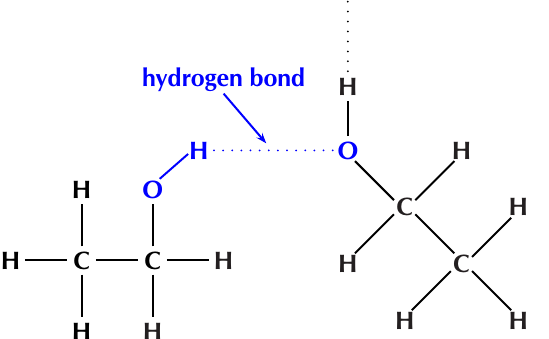
This is a special case of dipole-dipole forces and represents the strongest type of intermolecular force. Compounds that can form hydrogen bonds typically have much higher boiling points than similar compounds without hydrogen bonding capability.
Dipole-dipole forces
Dipole-dipole forces occur between polar molecules. These molecules have an uneven charge distribution, with one end slightly positive and the other slightly negative. The positive end of one molecule attracts the negative end of another molecule, holding them together.
van der Waals forces
van der Waals forces are the weakest intermolecular forces and include:
-
Induced-dipole forces: Even non-polar molecules can experience temporary attractions. Electrons are constantly moving, so at any moment the charge distribution might be uneven, creating a temporary dipole. This temporary dipole can induce dipoles in neighbouring molecules.
-
Dipole-induced-dipole forces: Polar molecules can induce dipoles in nearby non-polar molecules, creating weak attractions between them.
Important
Remember the strength order: van der Waals forces < dipole-dipole forces < hydrogen bonding
This order is crucial for predicting and comparing physical properties of different compounds.
Physical properties affected by intermolecular forces
Viscosity
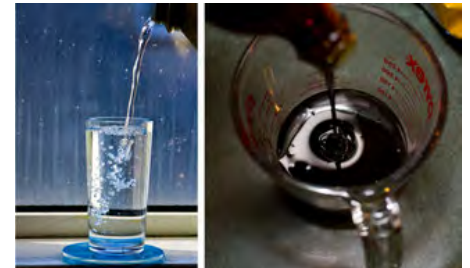
Viscosity measures how much a liquid resists flowing. Think of the difference between pouring water versus pouring syrup - water flows much more easily because it has lower viscosity.
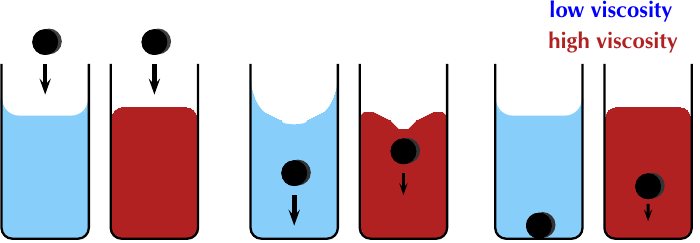
Substances with stronger intermolecular forces have higher viscosity because the forces create more internal friction, making it harder for molecules to move past each other. The stronger the intermolecular forces, the more resistance there is to flow.
Density
Density measures the mass per unit of volume. Solids are typically the most dense phase because strong intermolecular forces pull molecules together tightly, packing more molecules into a given space.
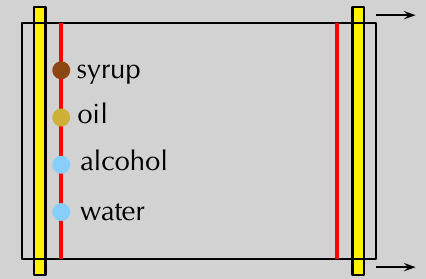
Different liquids can be separated based on their densities, with denser liquids settling at the bottom of containers.
Melting and boiling points
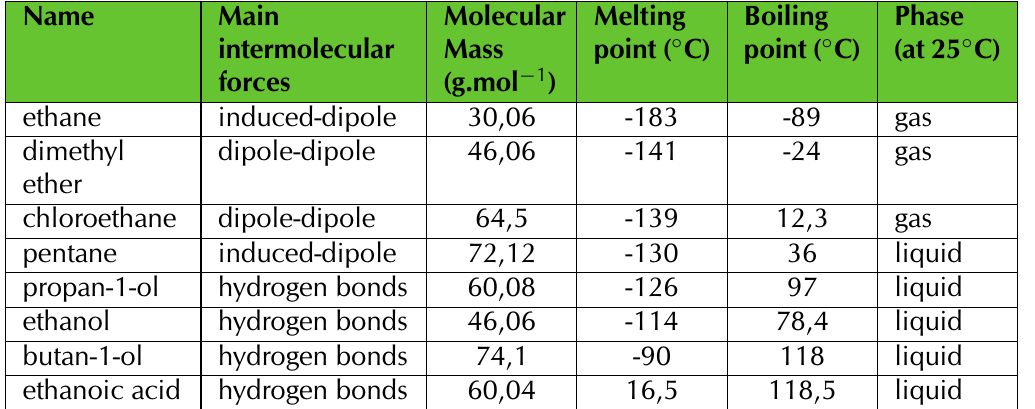
Intermolecular forces directly affect the temperatures at which substances change phase. Melting points and boiling points increase as intermolecular forces become stronger, because more energy (heat) is needed to overcome these forces.
Note
The table above shows clear trends: compounds with only induced-dipole forces (like ethane) have very low melting and boiling points, while compounds with hydrogen bonding (like alcohols and carboxylic acids) have much higher melting and boiling points.
Vapour pressure and flammability
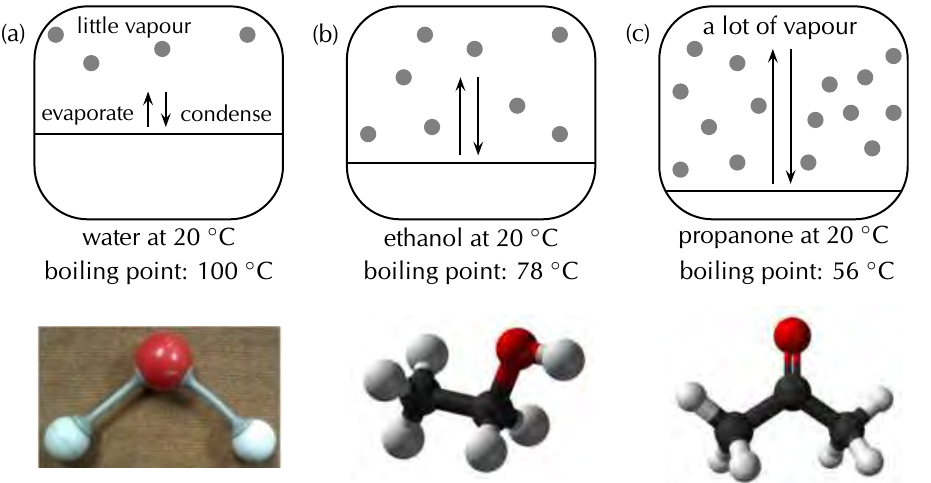
Vapour pressure is the pressure created by molecules that have enough energy to escape from the liquid phase into the gas phase. Substances with weaker intermolecular forces have higher vapour pressures because molecules can escape more easily.
Flash point is the lowest temperature at which a substance can form a flammable mixture with air. Substances with higher vapour pressures (weaker intermolecular forces) have lower flash points and are more flammable.
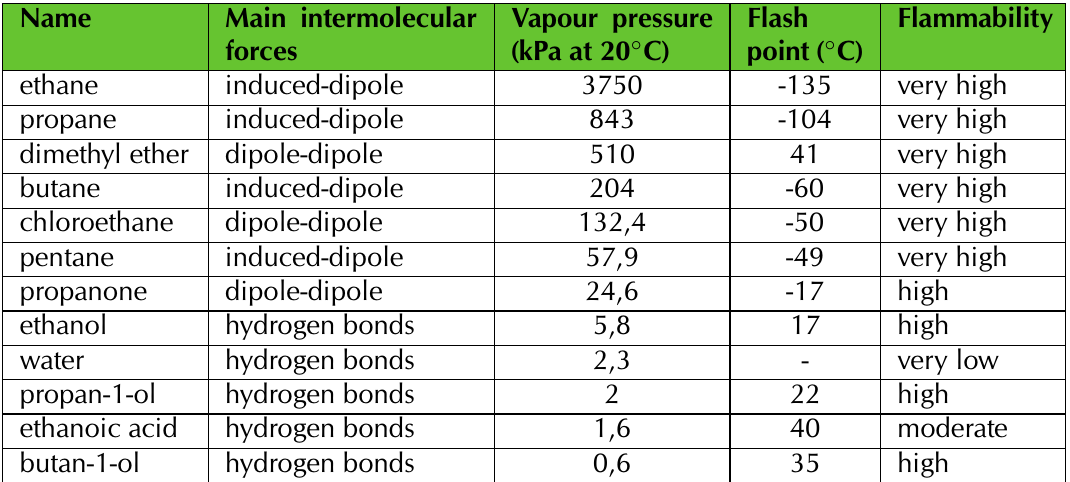
The relationship is clear: as intermolecular forces increase, vapour pressure decreases and flash point increases, making substances less flammable.
Worked example approach
When analysing organic compounds and their physical properties, follow this systematic approach:
Example
Worked Example: Analysing Physical Properties
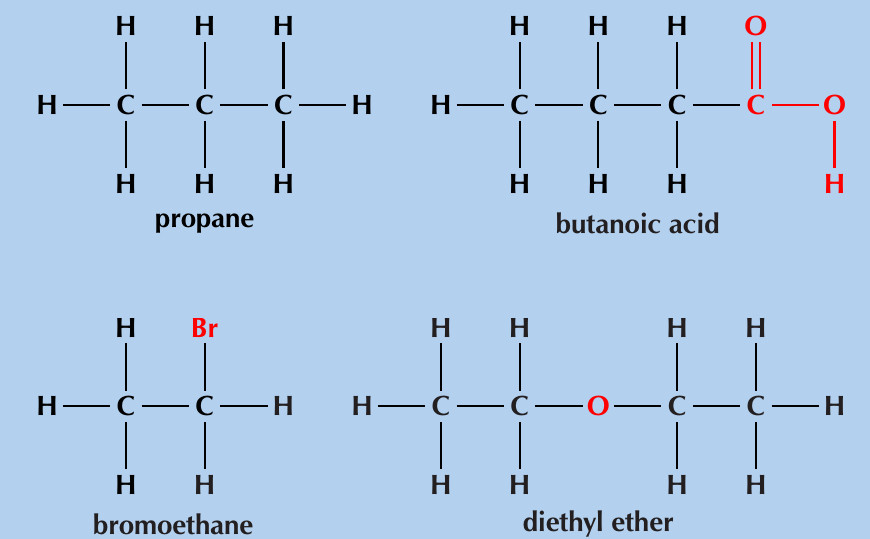
Step 1: Draw structural representations Identify the molecular structure and functional groups present.
Step 2: Identify intermolecular forces
- Alkanes (like propane): Only induced-dipole forces
- Carboxylic acids (like butanoic acid): Hydrogen bonding due to -COOH group
- Alkyl halides (like bromoethane): Dipole-dipole forces due to electronegative halogen
- Ethers (like diethyl ether): Mainly induced-dipole forces, some dipole-dipole
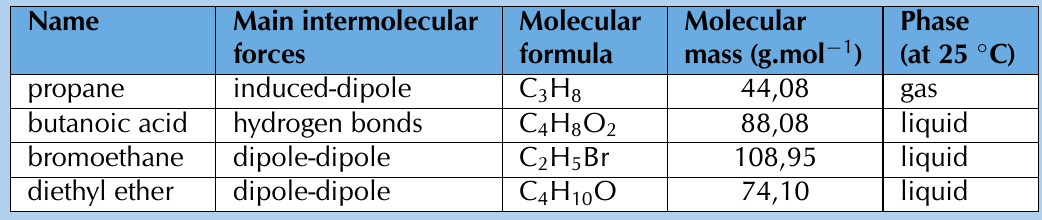
Step 3: Compare force strengths Rank the compounds by intermolecular force strength: Hydrogen bonding > Dipole-dipole > Induced-dipole
Step 4: Predict physical properties
- Stronger forces → Higher melting/boiling points
- Stronger forces → Lower vapour pressure
- Stronger forces → Higher viscosity
Step 5: Verify with data Check that your predictions match experimental values.
Exam tips and common mistakes
Understanding the key concepts helps avoid common pitfalls when studying intermolecular forces and physical properties.
Important
Common Mistakes to Avoid:
-
Don't confuse hydrogen bonding with intramolecular covalent bonds. Hydrogen bonding occurs between molecules, not within them.
-
Remember that molecular mass also affects physical properties, but intermolecular forces usually have a greater impact.
-
When comparing compounds, always consider both intermolecular forces and molecular size.
-
Practice identifying functional groups that can form hydrogen bonds: -OH (alcohols), -COOH (carboxylic acids), -NH (amines).
Summary
Key Points to Remember:
- Intermolecular forces determine physical properties by affecting how strongly molecules attract each other
- Strength order: van der Waals forces < dipole-dipole forces < hydrogen bonding
- Stronger intermolecular forces lead to higher melting/boiling points, higher viscosity, lower vapour pressure, and reduced flammability
- Hydrogen bonding occurs when H is bonded to N, O, or F and creates the strongest intermolecular attractions
- Problem-solving strategy: Draw structures → identify forces → compare strengths → predict properties → verify with data